

12
Electromagnetic Fields in Biological Systems
1.8 Propagation of Electromagnetic
Energy from Antennas
Electromagnetic energy at all frequencies can be radiated into space or a material
medium through the use of antennas. The spatial distribution of electromagnetic
energy from an antenna is directional and varies with distance from the antenna. The
short dipole antenna is used in this chapter as a model to examine the coupling and
distribution of electromagnetic energy in biological interactions. The dipole antenna is
important for both practical and conceptual reasons because any linear antenna may
be regarded as a series of dipoles and large antennas of other configurations may be
considered as assemblies of many dipoles. Thus, results and observations obtained from
a dipole antenna can provide insights into electromagnetic wave propagation associated
with antennas, in general.
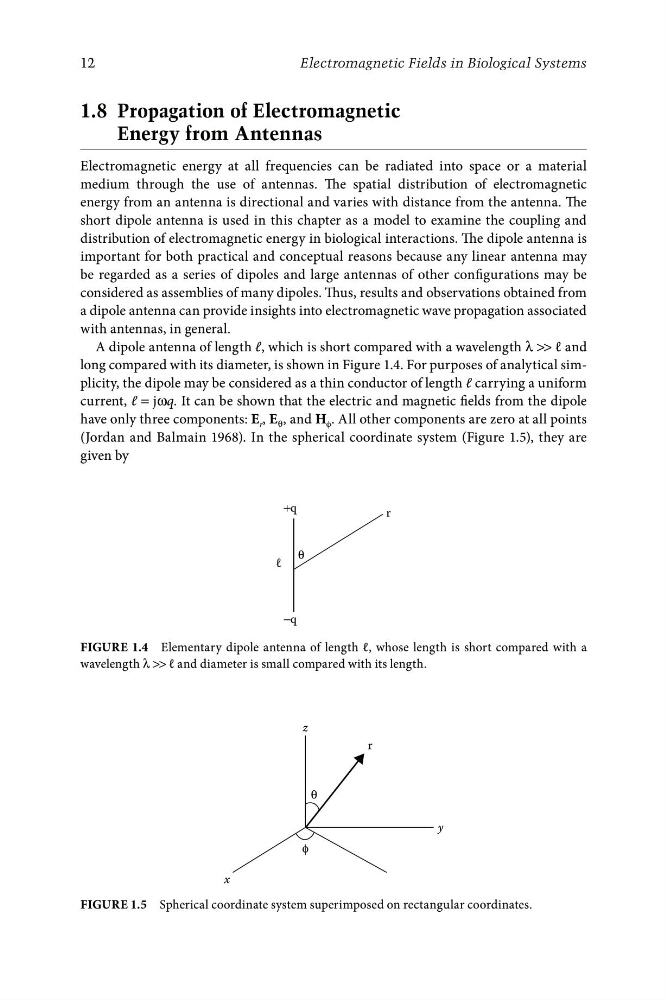
A dipole antenna of length ℓ, which is short compared with a wavelength λ >> ℓ and
long compared with its diameter, is shown in Figure 1.4. For purposes of analytical simplicity, the dipole may be considered as a thin conductor of length ℓ carrying a uniform
current, ℓ = jωq. It can be shown that the electric and magnetic fields from the dipole
have only three components: E r , E θ , and H ϕ . All other components are zero at all points
(Jordan and Balmain 1968). In the spherical coordinate system (Figure 1.5), they are
given by
r
+q
θ
ℓ
−q
FigurE 1.4 Elementary dipole antenna of length ℓ, whose length is short compared with a
wavelength λ >> ℓ and diameter is small compared with its length.
z
r
y
ϕ
θ
x
FigurE 1.5 Spherical coordinate system superimposed on rectangular coordinates.
Electromagnetic Fields in Biological Systems
1.8 Propagation of Electromagnetic
Energy from Antennas
Electromagnetic energy at all frequencies can be radiated into space or a material
medium through the use of antennas. The spatial distribution of electromagnetic
energy from an antenna is directional and varies with distance from the antenna. The
short dipole antenna is used in this chapter as a model to examine the coupling and
distribution of electromagnetic energy in biological interactions. The dipole antenna is
important for both practical and conceptual reasons because any linear antenna may
be regarded as a series of dipoles and large antennas of other configurations may be
considered as assemblies of many dipoles. Thus, results and observations obtained from
a dipole antenna can provide insights into electromagnetic wave propagation associated
with antennas, in general.
A dipole antenna of length ℓ, which is short compared with a wavelength λ >> ℓ and
long compared with its diameter, is shown in Figure 1.4. For purposes of analytical simplicity, the dipole may be considered as a thin conductor of length ℓ carrying a uniform
current, ℓ = jωq. It can be shown that the electric and magnetic fields from the dipole
have only three components: E r , E θ , and H ϕ . All other components are zero at all points
(Jordan and Balmain 1968). In the spherical coordinate system (Figure 1.5), they are
given by
r
+q
θ
ℓ
−q
FigurE 1.4 Elementary dipole antenna of length ℓ, whose length is short compared with a
wavelength λ >> ℓ and diameter is small compared with its length.
z
r
y
ϕ
θ
x
FigurE 1.5 Spherical coordinate system superimposed on rectangular coordinates.