

9
Coupling of Electromagnetic Fields into Biological Systems
The orientation of total electric fields in two media separated by a boundary can be
expressed as in Equation 1.12 for media 1 and 2, such that
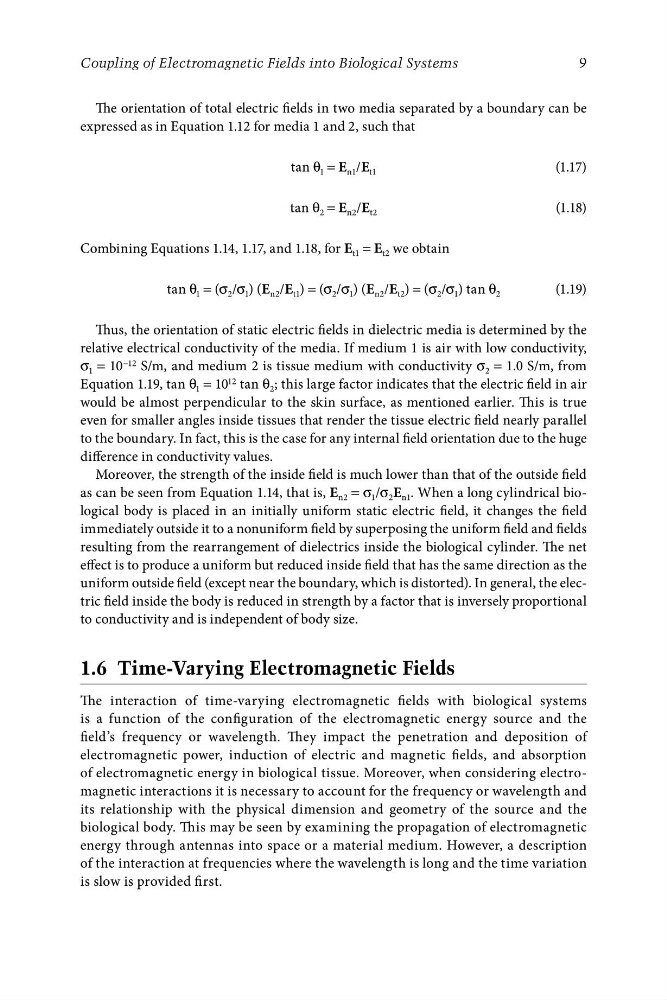
tan θ 1 = E n1 /E t1
(1.17)
tan θ 2 = E n2 /E t2
(1.18)
Combining Equations 1.14, 1.17, and 1.18, for E t1 = E t2 we obtain
tan θ 1 = (σ 2 /σ 1 ) (E n2 /E t1 ) = (σ 2 /σ 1 ) (E n2 /E t2 ) = (σ 2 /σ 1 ) tan θ 2
(1.19)
Thus, the orientation of static electric fields in dielectric media is determined by the
relative electrical conductivity of the media. If medium 1 is air with low conductivity,
σ 1 = 10 −12 S/m, and medium 2 is tissue medium with conductivity σ 2 = 1.0 S/m, from
Equation 1.19, tan θ 1 = 10 12 tan θ 2 ; this large factor indicates that the electric field in air
would be almost perpendicular to the skin surface, as mentioned earlier. This is true
even for smaller angles inside tissues that render the tissue electric field nearly parallel
to the boundary. In fact, this is the case for any internal field orientation due to the huge
difference in conductivity values.
Moreover, the strength of the inside field is much lower than that of the outside field
as can be seen from Equation 1.14, that is, E n2 = σ 1 /σ 2 E n1 . When a long cylindrical biological body is placed in an initially uniform static electric field, it changes the field
immediately outside it to a nonuniform field by superposing the uniform field and fields
resulting from the rearrangement of dielectrics inside the biological cylinder. The net
effect is to produce a uniform but reduced inside field that has the same direction as the
uniform outside field (except near the boundary, which is distorted). In general, the electric field inside the body is reduced in strength by a factor that is inversely proportional
to conductivity and is independent of body size.
1.6 Time-Varying Electromagnetic Fields
The interaction of time-varying electromagnetic fields with biological systems
is a function of the configuration of the electromagnetic energy source and the
field’s frequency or wavelength. They impact the penetration and deposition of
electromagnetic power, induction of electric and magnetic fields, and absorption
of electromagnetic energy in biological tissue. Moreover, when considering electromagnetic interactions it is necessary to account for the frequency or wavelength and
its relationship with the physical dimension and geometry of the source and the
biological body. This may be seen by examining the propagation of electromagnetic
energy through antennas into space or a material medium. However, a description
of the interaction at frequencies where the wavelength is long and the time variation
is slow is provided first.
Coupling of Electromagnetic Fields into Biological Systems
The orientation of total electric fields in two media separated by a boundary can be
expressed as in Equation 1.12 for media 1 and 2, such that
tan θ 1 = E n1 /E t1
(1.17)
tan θ 2 = E n2 /E t2
(1.18)
Combining Equations 1.14, 1.17, and 1.18, for E t1 = E t2 we obtain
tan θ 1 = (σ 2 /σ 1 ) (E n2 /E t1 ) = (σ 2 /σ 1 ) (E n2 /E t2 ) = (σ 2 /σ 1 ) tan θ 2
(1.19)
Thus, the orientation of static electric fields in dielectric media is determined by the
relative electrical conductivity of the media. If medium 1 is air with low conductivity,
σ 1 = 10 −12 S/m, and medium 2 is tissue medium with conductivity σ 2 = 1.0 S/m, from
Equation 1.19, tan θ 1 = 10 12 tan θ 2 ; this large factor indicates that the electric field in air
would be almost perpendicular to the skin surface, as mentioned earlier. This is true
even for smaller angles inside tissues that render the tissue electric field nearly parallel
to the boundary. In fact, this is the case for any internal field orientation due to the huge
difference in conductivity values.
Moreover, the strength of the inside field is much lower than that of the outside field
as can be seen from Equation 1.14, that is, E n2 = σ 1 /σ 2 E n1 . When a long cylindrical biological body is placed in an initially uniform static electric field, it changes the field
immediately outside it to a nonuniform field by superposing the uniform field and fields
resulting from the rearrangement of dielectrics inside the biological cylinder. The net
effect is to produce a uniform but reduced inside field that has the same direction as the
uniform outside field (except near the boundary, which is distorted). In general, the electric field inside the body is reduced in strength by a factor that is inversely proportional
to conductivity and is independent of body size.
1.6 Time-Varying Electromagnetic Fields
The interaction of time-varying electromagnetic fields with biological systems
is a function of the configuration of the electromagnetic energy source and the
field’s frequency or wavelength. They impact the penetration and deposition of
electromagnetic power, induction of electric and magnetic fields, and absorption
of electromagnetic energy in biological tissue. Moreover, when considering electromagnetic interactions it is necessary to account for the frequency or wavelength and
its relationship with the physical dimension and geometry of the source and the
biological body. This may be seen by examining the propagation of electromagnetic
energy through antennas into space or a material medium. However, a description
of the interaction at frequencies where the wavelength is long and the time variation
is slow is provided first.