

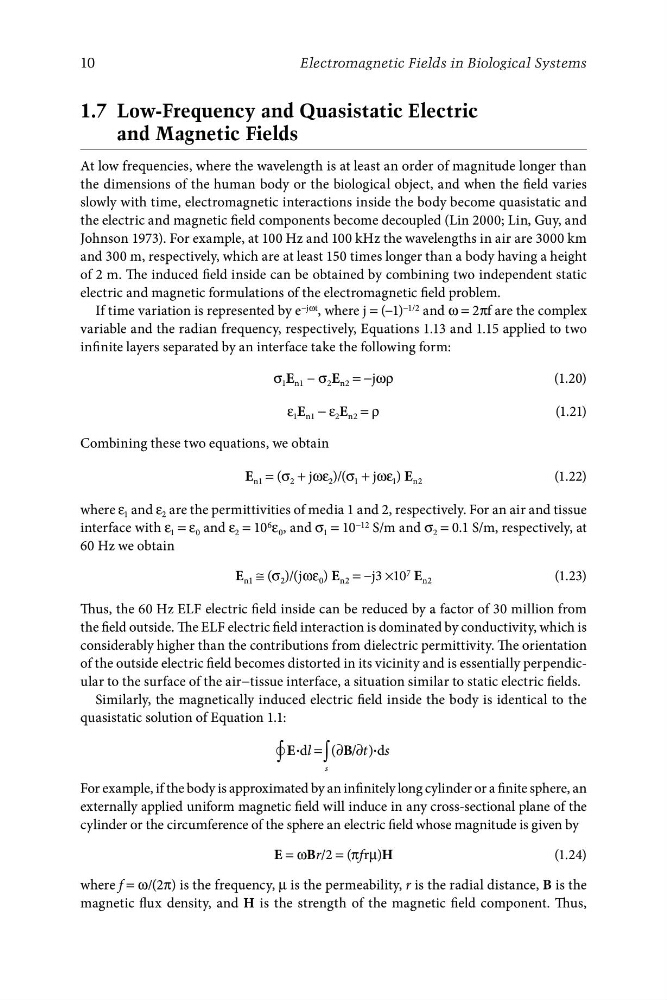
10
Electromagnetic Fields in Biological Systems
1.7 Low-Frequency and Quasistatic Electric
and Magnetic Fields
At low frequencies, where the wavelength is at least an order of magnitude longer than
the dimensions of the human body or the biological object, and when the field varies
slowly with time, electromagnetic interactions inside the body become quasistatic and
the electric and magnetic field components become decoupled (Lin 2000; Lin, Guy, and
Johnson 1973). For example, at 100 Hz and 100 kHz the wavelengths in air are 3000 km
and 300 m, respectively, which are at least 150 times longer than a body having a height
of 2 m. The induced field inside can be obtained by combining two independent static
electric and magnetic formulations of the electromagnetic field problem.
If time variation is represented by e −jωt , where j = (−1) −1/2 and ω = 2πf are the complex
variable and the radian frequency, respectively, Equations 1.13 and 1.15 applied to two
infinite layers separated by an interface take the following form:
σ 1 E n1 − σ 2 E n2 = −jωρ
(1.20)
ε 1 E n1 − ε 2 E n2 = ρ
(1.21)
Combining these two equations, we obtain
E n1 = (σ 2 + jωε 2 )/(σ 1 + jωε 1 ) E n2
(1.22)
where ε 1 and ε 2 are the permittivities of media 1 and 2, respectively. For an air and tissue
interface with ε
6
−12
1 = ε 0 and ε 2 = 10 ε 0 , and σ 1 = 10 S/m and σ 2 = 0.1 S/m, respectively, at
60 Hz we obtain
E n1 ≅ (σ 2 )/(jωε 0 ) E n2 = −j3 ×10 7 E n2
(1.23)
Thus, the 60 Hz ELF electric field inside can be reduced by a factor of 30 million from
the field outside. The ELF electric field interaction is dominated by conductivity, which is
considerably higher than the contributions from dielectric permittivity. The orientation
of the outside electric field becomes distorted in its vicinity and is essentially perpendicular to the surface of the air−tissue interface, a situation similar to static electric fields.
Similarly, the magnetically induced electric field inside the body is identical to the
quasistatic solution of Equation 1.1:
E·dl = (∂ ∂
B/ t)·ds
� ∫
∫
s
For example, if the body is approximated by an infinitely long cylinder or a finite sphere, an
externally applied uniform magnetic field will induce in any cross-sectional plane of the
cylinder or the circumference of the sphere an electric field whose magnitude is given by
E = ωBr/2 = (πfrμ)H
(1.24)
where f = ω/(2π) is the frequency, μ is the permeability, r is the radial distance, B is the
magnetic flux density, and H is the strength of the magnetic field component. Thus,
Electromagnetic Fields in Biological Systems
1.7 Low-Frequency and Quasistatic Electric
and Magnetic Fields
At low frequencies, where the wavelength is at least an order of magnitude longer than
the dimensions of the human body or the biological object, and when the field varies
slowly with time, electromagnetic interactions inside the body become quasistatic and
the electric and magnetic field components become decoupled (Lin 2000; Lin, Guy, and
Johnson 1973). For example, at 100 Hz and 100 kHz the wavelengths in air are 3000 km
and 300 m, respectively, which are at least 150 times longer than a body having a height
of 2 m. The induced field inside can be obtained by combining two independent static
electric and magnetic formulations of the electromagnetic field problem.
If time variation is represented by e −jωt , where j = (−1) −1/2 and ω = 2πf are the complex
variable and the radian frequency, respectively, Equations 1.13 and 1.15 applied to two
infinite layers separated by an interface take the following form:
σ 1 E n1 − σ 2 E n2 = −jωρ
(1.20)
ε 1 E n1 − ε 2 E n2 = ρ
(1.21)
Combining these two equations, we obtain
E n1 = (σ 2 + jωε 2 )/(σ 1 + jωε 1 ) E n2
(1.22)
where ε 1 and ε 2 are the permittivities of media 1 and 2, respectively. For an air and tissue
interface with ε
6
−12
1 = ε 0 and ε 2 = 10 ε 0 , and σ 1 = 10 S/m and σ 2 = 0.1 S/m, respectively, at
60 Hz we obtain
E n1 ≅ (σ 2 )/(jωε 0 ) E n2 = −j3 ×10 7 E n2
(1.23)
Thus, the 60 Hz ELF electric field inside can be reduced by a factor of 30 million from
the field outside. The ELF electric field interaction is dominated by conductivity, which is
considerably higher than the contributions from dielectric permittivity. The orientation
of the outside electric field becomes distorted in its vicinity and is essentially perpendicular to the surface of the air−tissue interface, a situation similar to static electric fields.
Similarly, the magnetically induced electric field inside the body is identical to the
quasistatic solution of Equation 1.1:
E·dl = (∂ ∂
B/ t)·ds
� ∫
∫
s
For example, if the body is approximated by an infinitely long cylinder or a finite sphere, an
externally applied uniform magnetic field will induce in any cross-sectional plane of the
cylinder or the circumference of the sphere an electric field whose magnitude is given by
E = ωBr/2 = (πfrμ)H
(1.24)
where f = ω/(2π) is the frequency, μ is the permeability, r is the radial distance, B is the
magnetic flux density, and H is the strength of the magnetic field component. Thus,