

8
Electromagnetic Fields in Biological Systems
∇ · B = 0
(1.16)
Since magnetic permeability is the same as that of free space for most biological materials (μ r = 1), the magnetic fields (B and H) inside are the same as those outside, in total
or by component. For example, Equation 1.16 for an infinite layer of biological material
becomes B n1 − B n2 = 0. Thus, the normal components of magnetic flux density B inside
and outside are equal to each other. Likewise, H n1 − H n2 = 0 since B = μH and μ is the
same for most biological materials.
As mentioned earlier, the tangential components of electric fields inside are the
same as those outside (E t1 = E t2 ). However, the normal components of electric flux densities inside and outside differ by an amount equal to surface charge density, that is,
D n1 − D n2 = ρ. For a highly conducting medium, the electric field inside is essentially
zero: D n2 = ε 2 E n2 = 0 and E t1 = E t2 = 0. Note that if σ 2 in Equation 1.14 approaches infinity as in a perfectly conducting medium, then E n2 = 0. Thus, static electric fields at the
surface of a good conductor must be perpendicular to the boundary since D n1 = ρ is the
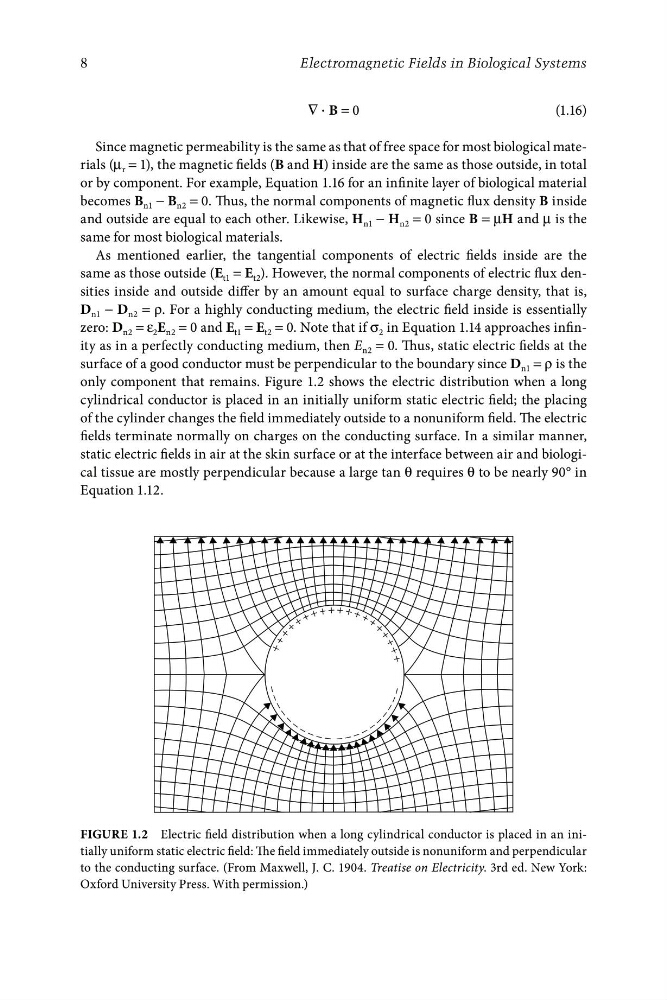
only component that remains. Figure 1.2 shows the electric distribution when a long
cylindrical conductor is placed in an initially uniform static electric field; the placing
of the cylinder changes the field immediately outside to a nonuniform field. The electric
fields terminate normally on charges on the conducting surface. In a similar manner,
static electric fields in air at the skin surface or at the interface between air and biological tissue are mostly perpendicular because a large tan θ requires θ to be nearly 90° in
Equation 1.12.
−
−
−
−
−
−
−
−
−
−
−
−
−
−
−
−
−
−
−
− + + +
+
+ + + + + + + + + + +
+
+
+
+
FigurE 1.2 Electric field distribution when a long cylindrical conductor is placed in an initially uniform static electric field: The field immediately outside is nonuniform and perpendicular
to the conducting surface. (From Maxwell, J. C. 1904. Treatise on Electricity. 3rd ed. New York:
Oxford University Press. With permission.)