

−∇ i ( ∇ σϕ ) = ∇ i( jωσa 0 )
(4.6)
The boundary condition is shown in Equation 4.7, considering that the normal component
of induced current on the boundary surface between human and air is zero (J ° n = 0).
−ni ∇ ϕ = jωσ A 0 in
(4.7)
The electric scalar potential in Equation 4.6 is to be solved using the boundary condition
specified in Equation 4.7. Equation 4.7 is to be discretized at a point that eight voxels
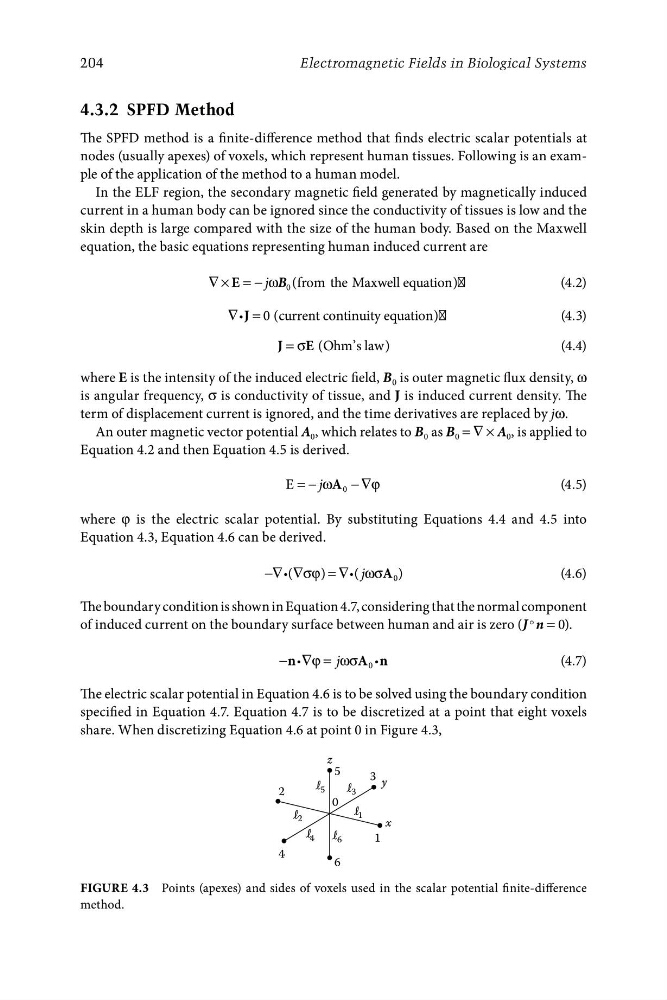
share. When discretizing Equation 4.6 at point 0 in Figure 4.3,
z
5
3
2
5
y
3
0
2
1
x
4
6
1
4
6
Figure 4.3 Points (apexes) and sides of voxels used in the scalar potential finite-difference
method.
204
Electromagnetic Fields in Biological Systems
4.3.2 SPFD Method
The SPFD method is a finite-difference method that finds electric scalar potentials at
nodes (usually apexes) of voxels, which represent human tissues. Following is an example of the application of the method to a human model.
In the ELF region, the secondary magnetic field generated by magnetically induced
current in a human body can be ignored since the conductivity of tissues is low and the
skin depth is large compared with the size of the human body. Based on the Maxwell
equation, the basic equations representing human induced current are
∇ × e = − jωB 0 (from the Maxwell equation)
(4.2)
∇iJ = 0 (current continuity equation)
(4.3)
J = σE (
’
(4.4)
Ohm s law)
where e is the intensity of the induced electric field, B 0 is outer magnetic flux density, ω
is angular frequency, σ is conductivity of tissue, and J is induced current density. The
term of displacement current is ignored, and the time derivatives are replaced by jω.
An outer magnetic vector potential A 0 , which relates to B 0 as B 0 = ∇ × A 0 , is applied to
Equation 4.2 and then Equation 4.5 is derived.
E = − jωa 0 − ∇ ϕ
(4.5)
where φ is the electric scalar potential. By substituting Equations 4.4 and 4.5 into
Equation 4.3, Equation 4.6 can be derived.