

Liu et al. produced oleaginous microbial biomass by consuming two yeast strains,
i.e., Lipomyces starkeyi and Rhodosporidium toruloides, and Mortierella isabellina
as one fungal strain.
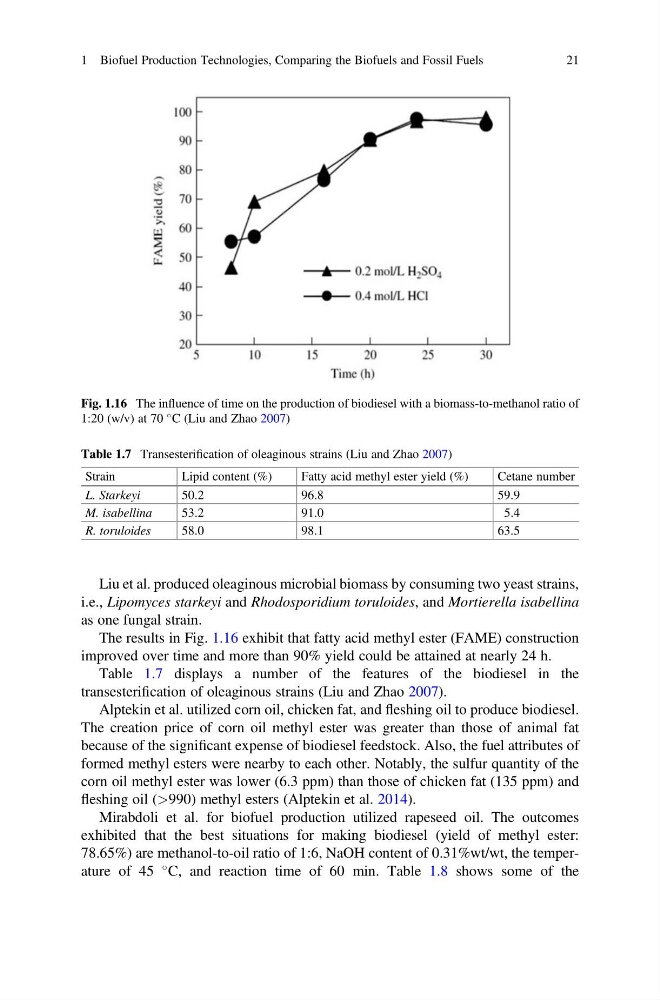
The results in Fig. 1.16 exhibit that fatty acid methyl ester (FAME) construction
improved over time and more than 90% yield could be attained at nearly 24 h.
Table 1.7 displays a number of the features of the biodiesel in the
transesterification of oleaginous strains (Liu and Zhao 2007).
Alptekin et al. utilized corn oil, chicken fat, and fleshing oil to produce biodiesel.
The creation price of corn oil methyl ester was greater than those of animal fat
because of the significant expense of biodiesel feedstock. Also, the fuel attributes of
formed methyl esters were nearby to each other. Notably, the sulfur quantity of the
corn oil methyl ester was lower (6.3 ppm) than those of chicken fat (135 ppm) and
fleshing oil (>990) methyl esters (Alptekin et al. 2014).
Mirabdoli et al. for biofuel production utilized rapeseed oil. The outcomes
exhibited that the best situations for making biodiesel (yield of methyl ester:
78.65%) are methanol-to-oil ratio of 1:6, NaOH content of 0.31%wt/wt, the temperature of 45
C, and reaction time of 60 min. Table 1.8 shows some of the
Fig. 1.16 The influence of time on the production of biodiesel with a biomass-to-methanol ratio of
1:20 (w/v) at 70
C (Liu and Zhao 2007)
Table 1.7 Transesterification of oleaginous strains (Liu and Zhao 2007)
Strain
Lipid content (%)
Fatty acid methyl ester yield (%)
Cetane number
L. Starkeyi
50.2
96.8
59.9
M. isabellina
53.2
91.0
5.4
R. toruloides
58.0
98.1
63.5
1 Biofuel Production Technologies, Comparing the Biofuels and Fossil Fuels
21
i.e., Lipomyces starkeyi and Rhodosporidium toruloides, and Mortierella isabellina
as one fungal strain.
The results in Fig. 1.16 exhibit that fatty acid methyl ester (FAME) construction
improved over time and more than 90% yield could be attained at nearly 24 h.
Table 1.7 displays a number of the features of the biodiesel in the
transesterification of oleaginous strains (Liu and Zhao 2007).
Alptekin et al. utilized corn oil, chicken fat, and fleshing oil to produce biodiesel.
The creation price of corn oil methyl ester was greater than those of animal fat
because of the significant expense of biodiesel feedstock. Also, the fuel attributes of
formed methyl esters were nearby to each other. Notably, the sulfur quantity of the
corn oil methyl ester was lower (6.3 ppm) than those of chicken fat (135 ppm) and
fleshing oil (>990) methyl esters (Alptekin et al. 2014).
Mirabdoli et al. for biofuel production utilized rapeseed oil. The outcomes
exhibited that the best situations for making biodiesel (yield of methyl ester:
78.65%) are methanol-to-oil ratio of 1:6, NaOH content of 0.31%wt/wt, the temperature of 45
C, and reaction time of 60 min. Table 1.8 shows some of the
Fig. 1.16 The influence of time on the production of biodiesel with a biomass-to-methanol ratio of
1:20 (w/v) at 70
C (Liu and Zhao 2007)
Table 1.7 Transesterification of oleaginous strains (Liu and Zhao 2007)
Strain
Lipid content (%)
Fatty acid methyl ester yield (%)
Cetane number
L. Starkeyi
50.2
96.8
59.9
M. isabellina
53.2
91.0
5.4
R. toruloides
58.0
98.1
63.5
1 Biofuel Production Technologies, Comparing the Biofuels and Fossil Fuels
21