

due to their nanoscale size and high surface area (Kalpana and Rajeswari 2018).
Their optical properties are known to be dependent on the particle’s size, exhibiting
varying colors owing to absorption within the visible range. Their toughness,
reactivity, as well as other properties also depend on their unique structure, size,
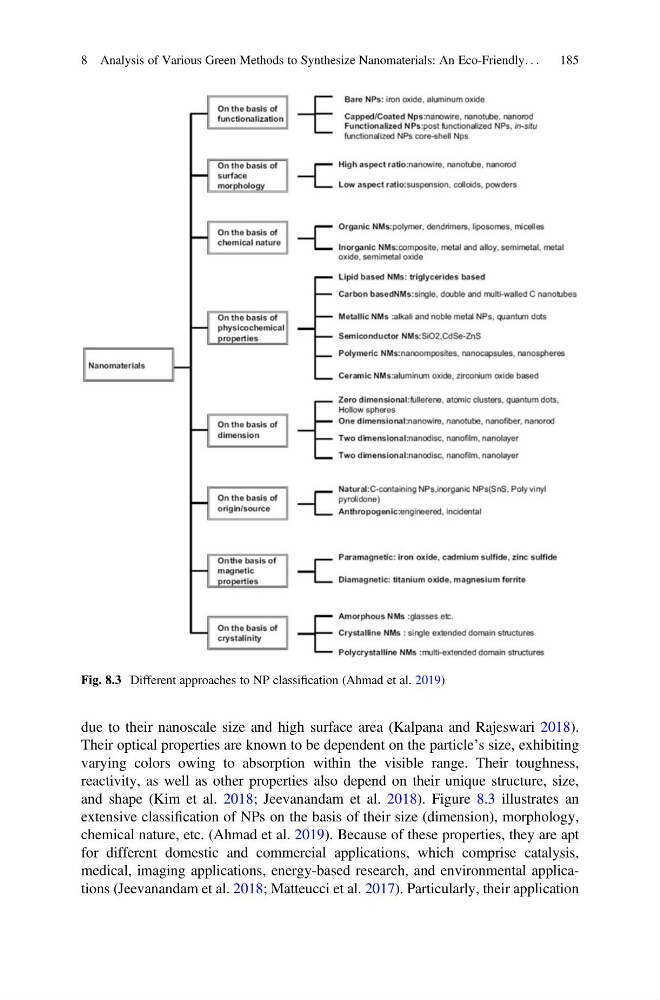
and shape (Kim et al. 2018; Jeevanandam et al. 2018). Figure 8.3 illustrates an
extensive classification of NPs on the basis of their size (dimension), morphology,
chemical nature, etc. (Ahmad et al. 2019). Because of these properties, they are apt
for different domestic and commercial applications, which comprise catalysis,
medical, imaging applications, energy-based research, and environmental applications (Jeevanandam et al. 2018; Matteucci et al. 2017). Particularly, their application
Fig. 8.3 Different approaches to NP classification (Ahmad et al. 2019)
8 Analysis of Various Green Methods to Synthesize Nanomaterials: An Eco-Friendly. . .
185
Their optical properties are known to be dependent on the particle’s size, exhibiting
varying colors owing to absorption within the visible range. Their toughness,
reactivity, as well as other properties also depend on their unique structure, size,
and shape (Kim et al. 2018; Jeevanandam et al. 2018). Figure 8.3 illustrates an
extensive classification of NPs on the basis of their size (dimension), morphology,
chemical nature, etc. (Ahmad et al. 2019). Because of these properties, they are apt
for different domestic and commercial applications, which comprise catalysis,
medical, imaging applications, energy-based research, and environmental applications (Jeevanandam et al. 2018; Matteucci et al. 2017). Particularly, their application
Fig. 8.3 Different approaches to NP classification (Ahmad et al. 2019)
8 Analysis of Various Green Methods to Synthesize Nanomaterials: An Eco-Friendly. . .
185