

in biology, medicine, food packaging, and environmental remediation is a very
active area of research at present. In addition, some articles have laid emphasis on
industrial applications of nanoparticles as well as their emergence in applications
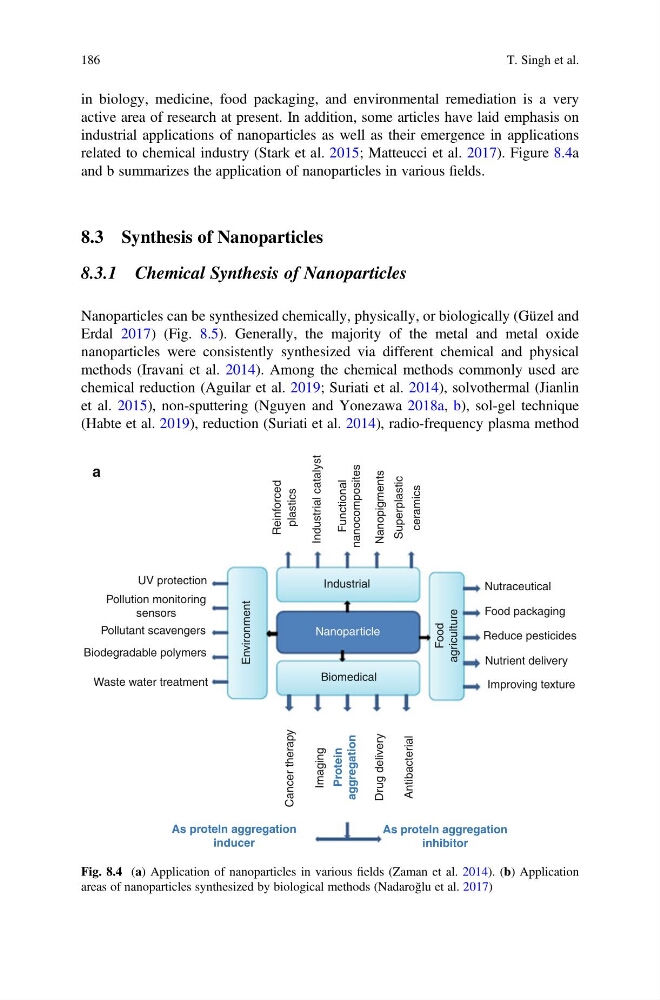
related to chemical industry (Stark et al. 2015; Matteucci et al. 2017). Figure 8.4a
and b summarizes the application of nanoparticles in various fields.
8.3 Synthesis of Nanoparticles
8.3.1 Chemical Synthesis of Nanoparticles
Nanoparticles can be synthesized chemically, physically, or biologically (Güzel and
Erdal 2017) (Fig. 8.5). Generally, the majority of the metal and metal oxide
nanoparticles were consistently synthesized via different chemical and physical
methods (Iravani et al. 2014). Among the chemical methods commonly used are
chemical reduction (Aguilar et al. 2019; Suriati et al. 2014), solvothermal (Jianlin
et al. 2015), non-sputtering (Nguyen and Yonezawa 2018a, b), sol-gel technique
(Habte et al. 2019), reduction (Suriati et al. 2014), radio-frequency plasma method
UV protection
Nutraceutical
Food packaging
Reduce pesticides
Nutrient delivery
Improving texture
Biomedical
Nanoparticle
Industrial
Reinforced
plastics
Industrial catalyst
Functional
nanocomposites
Nanopigments
Superplastic
ceramics
Pollution monitoring
sensors
Pollutant scavengers
Biodegradable polymers
Waste water treatment
As proteln aggregation
inducer
As proteln aggregation
inhibitor
Cancer therapy
Imaging
Protein
aggregation
Drug delivery
Antibacterial
Environment
Food
agriculture
a
Fig. 8.4 (a) Application of nanoparticles in various fields (Zaman et al. 2014). (b) Application
areas of nanoparticles synthesized by biological methods (Nadaroğlu et al. 2017)
186
T. Singh et al.
active area of research at present. In addition, some articles have laid emphasis on
industrial applications of nanoparticles as well as their emergence in applications
related to chemical industry (Stark et al. 2015; Matteucci et al. 2017). Figure 8.4a
and b summarizes the application of nanoparticles in various fields.
8.3 Synthesis of Nanoparticles
8.3.1 Chemical Synthesis of Nanoparticles
Nanoparticles can be synthesized chemically, physically, or biologically (Güzel and
Erdal 2017) (Fig. 8.5). Generally, the majority of the metal and metal oxide
nanoparticles were consistently synthesized via different chemical and physical
methods (Iravani et al. 2014). Among the chemical methods commonly used are
chemical reduction (Aguilar et al. 2019; Suriati et al. 2014), solvothermal (Jianlin
et al. 2015), non-sputtering (Nguyen and Yonezawa 2018a, b), sol-gel technique
(Habte et al. 2019), reduction (Suriati et al. 2014), radio-frequency plasma method
UV protection
Nutraceutical
Food packaging
Reduce pesticides
Nutrient delivery
Improving texture
Biomedical
Nanoparticle
Industrial
Reinforced
plastics
Industrial catalyst
Functional
nanocomposites
Nanopigments
Superplastic
ceramics
Pollution monitoring
sensors
Pollutant scavengers
Biodegradable polymers
Waste water treatment
As proteln aggregation
inducer
As proteln aggregation
inhibitor
Cancer therapy
Imaging
Protein
aggregation
Drug delivery
Antibacterial
Environment
Food
agriculture
a
Fig. 8.4 (a) Application of nanoparticles in various fields (Zaman et al. 2014). (b) Application
areas of nanoparticles synthesized by biological methods (Nadaroğlu et al. 2017)
186
T. Singh et al.