

agricultural wastes (Zamani et al. 2019), for the production of nanomaterials using a
variety of biotechnological techniques. Among the abovementioned biological entities, plants appeared as the leading candidate since it does not require any unique,
multi-step, and complex practice, namely, culture preparation, isolation, and culture
maintenance, in contrast with microorganisms (Santhoshkumar et al. 2017).
Furthermore, nanoparticles formed by the use of plants are considered more
stable, and the synthesis rate is more rapid; also it is cheaper and is comparatively
simple to use for the synthesis of a larger amount of nanoparticles (Altikatoglu et al.
2017; Jafarizad et al. 2015a, b; Das et al. 2017). In addition, the nanoparticles are
more diverse in size and shape in contrast to those formed by other organisms
(Khandel et al. 2018). Therefore, the aim of this chapter is to emphasize on the
different biological entities that are used to make greener, safer, and also environmentally sustainable nano-synthesis routes.
8.2 Properties and Application of Nanoparticles
Nanomaterials are at the forefront of the fast-evolving area of nanotechnology. Their
exclusive size-dependent characteristics build these materials advanced plus key in
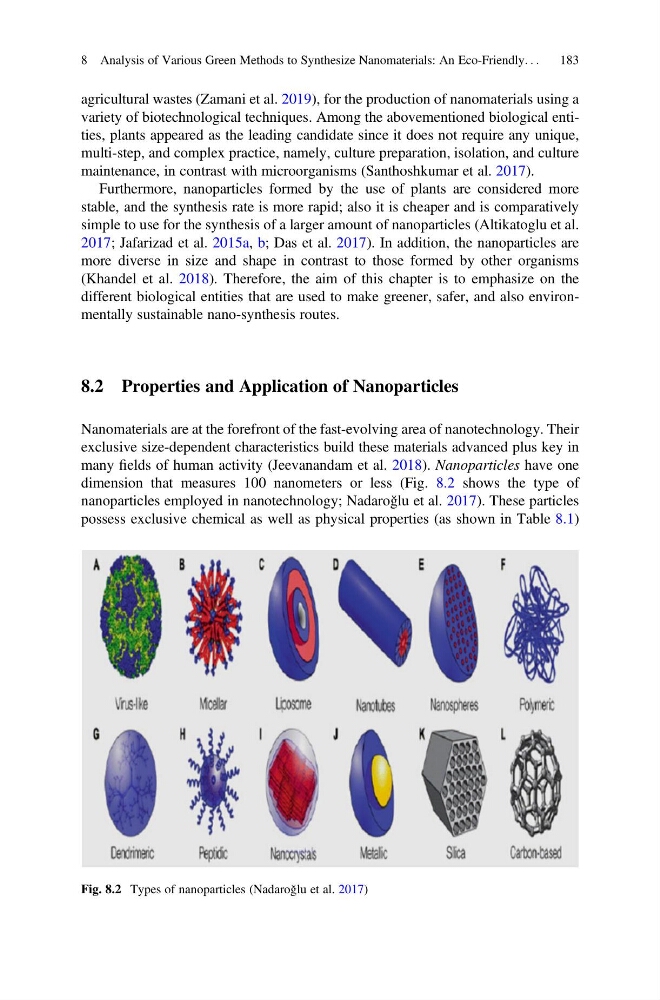
many fields of human activity (Jeevanandam et al. 2018). Nanoparticles have one
dimension that measures 100 nanometers or less (Fig. 8.2 shows the type of
nanoparticles employed in nanotechnology; Nadaroğlu et al. 2017). These particles
possess exclusive chemical as well as physical properties (as shown in Table 8.1)
Fig. 8.2 Types of nanoparticles (Nadaroğlu et al. 2017)
8 Analysis of Various Green Methods to Synthesize Nanomaterials: An Eco-Friendly. . .
183
variety of biotechnological techniques. Among the abovementioned biological entities, plants appeared as the leading candidate since it does not require any unique,
multi-step, and complex practice, namely, culture preparation, isolation, and culture
maintenance, in contrast with microorganisms (Santhoshkumar et al. 2017).
Furthermore, nanoparticles formed by the use of plants are considered more
stable, and the synthesis rate is more rapid; also it is cheaper and is comparatively
simple to use for the synthesis of a larger amount of nanoparticles (Altikatoglu et al.
2017; Jafarizad et al. 2015a, b; Das et al. 2017). In addition, the nanoparticles are
more diverse in size and shape in contrast to those formed by other organisms
(Khandel et al. 2018). Therefore, the aim of this chapter is to emphasize on the
different biological entities that are used to make greener, safer, and also environmentally sustainable nano-synthesis routes.
8.2 Properties and Application of Nanoparticles
Nanomaterials are at the forefront of the fast-evolving area of nanotechnology. Their
exclusive size-dependent characteristics build these materials advanced plus key in
many fields of human activity (Jeevanandam et al. 2018). Nanoparticles have one
dimension that measures 100 nanometers or less (Fig. 8.2 shows the type of
nanoparticles employed in nanotechnology; Nadaroğlu et al. 2017). These particles
possess exclusive chemical as well as physical properties (as shown in Table 8.1)
Fig. 8.2 Types of nanoparticles (Nadaroğlu et al. 2017)
8 Analysis of Various Green Methods to Synthesize Nanomaterials: An Eco-Friendly. . .
183