

8.1 Introduction
Nanotechnology has been defined as the manipulation of matter via specific chemical or physical processes to form materials with definite properties. This can then be
employed in diverse applications (Jeevanandam et al. 2018; Khandel et al. 2018).
Nanoscale-level particles obtained have diverse unique electrical, magnetic, and
optical characteristics owing to their relatively large precise surface area, high
surface energy, and quantum confinement (Wang and Wang 2015; Jeevanandam
et al. 2018). In recent studies, the attention in synthesizing nanoparticles through a
simple as well as an environment-friendly mode has been growing and has become a
major center of researchers (Nayantara and Kaur 2018; Singh et al. 2018a, b).
Chemical methods along with physical means are usually in use for the production
of nanoparticles, though due to restrictions of these methods, the center of research
has been headed for the augmentation of clean and eco-friendly way (Iravani et al.
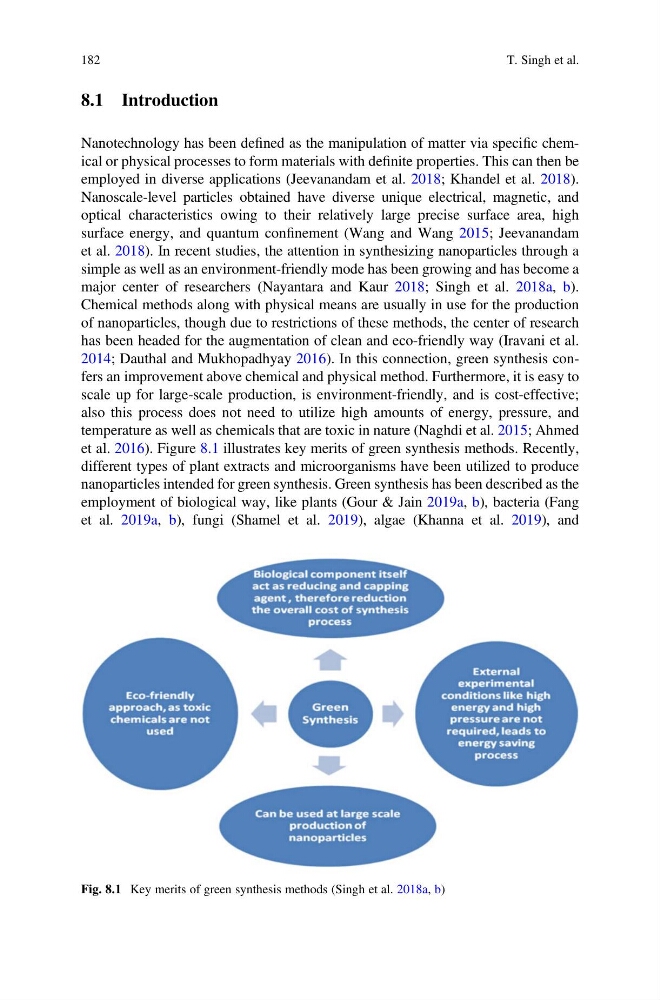
2014; Dauthal and Mukhopadhyay 2016). In this connection, green synthesis confers an improvement above chemical and physical method. Furthermore, it is easy to
scale up for large-scale production, is environment-friendly, and is cost-effective;
also this process does not need to utilize high amounts of energy, pressure, and
temperature as well as chemicals that are toxic in nature (Naghdi et al. 2015; Ahmed
et al. 2016). Figure 8.1 illustrates key merits of green synthesis methods. Recently,
different types of plant extracts and microorganisms have been utilized to produce
nanoparticles intended for green synthesis. Green synthesis has been described as the
employment of biological way, like plants (Gour & Jain 2019a, b), bacteria (Fang
et al. 2019a, b), fungi (Shamel et al. 2019), algae (Khanna et al. 2019), and
Fig. 8.1 Key merits of green synthesis methods (Singh et al. 2018a, b)
182
T. Singh et al.
Nanotechnology has been defined as the manipulation of matter via specific chemical or physical processes to form materials with definite properties. This can then be
employed in diverse applications (Jeevanandam et al. 2018; Khandel et al. 2018).
Nanoscale-level particles obtained have diverse unique electrical, magnetic, and
optical characteristics owing to their relatively large precise surface area, high
surface energy, and quantum confinement (Wang and Wang 2015; Jeevanandam
et al. 2018). In recent studies, the attention in synthesizing nanoparticles through a
simple as well as an environment-friendly mode has been growing and has become a
major center of researchers (Nayantara and Kaur 2018; Singh et al. 2018a, b).
Chemical methods along with physical means are usually in use for the production
of nanoparticles, though due to restrictions of these methods, the center of research
has been headed for the augmentation of clean and eco-friendly way (Iravani et al.
2014; Dauthal and Mukhopadhyay 2016). In this connection, green synthesis confers an improvement above chemical and physical method. Furthermore, it is easy to
scale up for large-scale production, is environment-friendly, and is cost-effective;
also this process does not need to utilize high amounts of energy, pressure, and
temperature as well as chemicals that are toxic in nature (Naghdi et al. 2015; Ahmed
et al. 2016). Figure 8.1 illustrates key merits of green synthesis methods. Recently,
different types of plant extracts and microorganisms have been utilized to produce
nanoparticles intended for green synthesis. Green synthesis has been described as the
employment of biological way, like plants (Gour & Jain 2019a, b), bacteria (Fang
et al. 2019a, b), fungi (Shamel et al. 2019), algae (Khanna et al. 2019), and
Fig. 8.1 Key merits of green synthesis methods (Singh et al. 2018a, b)
182
T. Singh et al.