

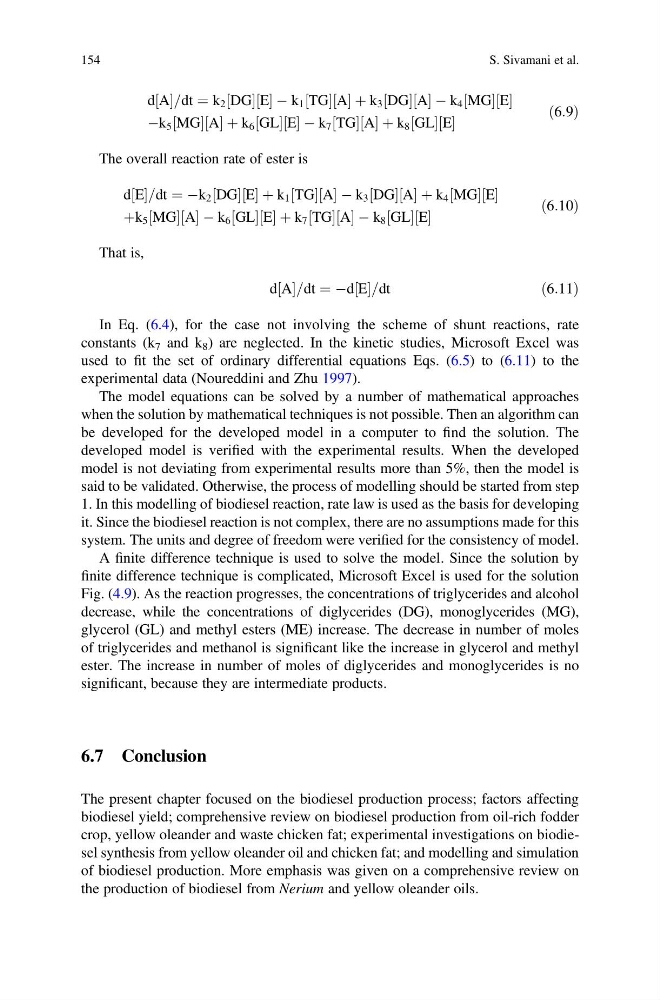
d A
½ =dt ¼ k 2 DG
½ E
½ À k 1 TG
½ A
½ þ k 3 DG
½ A
½ À k 4 MG
½
E
½
Àk 5 MG
½
A
½ þ k 6 GL
½ E
½ À k 7 TG
½ A
½ þ k 8 GL
½ E
½
ð6:9Þ
The overall reaction rate of ester is
d E
½ =dt ¼ Àk 2 DG
½ E
½ þ k 1 TG
½ A
½ À k 3 DG
½ A
½ þ k 4 MG
½
E
½
þk 5 MG
½
A
½ À k 6 GL
½ E
½ þ k 7 TG
½ A
½ À k 8 GL
½ E
½
ð6:10Þ
That is,
d A
½ =dt ¼ Àd E
½ =dt
ð6:11Þ
In Eq. (6.4), for the case not involving the scheme of shunt reactions, rate
constants (k 7 and k 8 ) are neglected. In the kinetic studies, Microsoft Excel was
used to fit the set of ordinary differential equations Eqs. (6.5) to (6.11) to the
experimental data (Noureddini and Zhu 1997).
The model equations can be solved by a number of mathematical approaches
when the solution by mathematical techniques is not possible. Then an algorithm can
be developed for the developed model in a computer to find the solution. The
developed model is verified with the experimental results. When the developed
model is not deviating from experimental results more than 5%, then the model is
said to be validated. Otherwise, the process of modelling should be started from step
1. In this modelling of biodiesel reaction, rate law is used as the basis for developing
it. Since the biodiesel reaction is not complex, there are no assumptions made for this
system. The units and degree of freedom were verified for the consistency of model.
A finite difference technique is used to solve the model. Since the solution by
finite difference technique is complicated, Microsoft Excel is used for the solution
Fig. (4.9). As the reaction progresses, the concentrations of triglycerides and alcohol
decrease, while the concentrations of diglycerides (DG), monoglycerides (MG),
glycerol (GL) and methyl esters (ME) increase. The decrease in number of moles
of triglycerides and methanol is significant like the increase in glycerol and methyl
ester. The increase in number of moles of diglycerides and monoglycerides is no
significant, because they are intermediate products.
6.7 Conclusion
The present chapter focused on the biodiesel production process; factors affecting
biodiesel yield; comprehensive review on biodiesel production from oil-rich fodder
crop, yellow oleander and waste chicken fat; experimental investigations on biodiesel synthesis from yellow oleander oil and chicken fat; and modelling and simulation
of biodiesel production. More emphasis was given on a comprehensive review on
the production of biodiesel from Nerium and yellow oleander oils.
154
S. Sivamani et al.
½ =dt ¼ k 2 DG
½ E
½ À k 1 TG
½ A
½ þ k 3 DG
½ A
½ À k 4 MG
½
E
½
Àk 5 MG
½
A
½ þ k 6 GL
½ E
½ À k 7 TG
½ A
½ þ k 8 GL
½ E
½
ð6:9Þ
The overall reaction rate of ester is
d E
½ =dt ¼ Àk 2 DG
½ E
½ þ k 1 TG
½ A
½ À k 3 DG
½ A
½ þ k 4 MG
½
E
½
þk 5 MG
½
A
½ À k 6 GL
½ E
½ þ k 7 TG
½ A
½ À k 8 GL
½ E
½
ð6:10Þ
That is,
d A
½ =dt ¼ Àd E
½ =dt
ð6:11Þ
In Eq. (6.4), for the case not involving the scheme of shunt reactions, rate
constants (k 7 and k 8 ) are neglected. In the kinetic studies, Microsoft Excel was
used to fit the set of ordinary differential equations Eqs. (6.5) to (6.11) to the
experimental data (Noureddini and Zhu 1997).
The model equations can be solved by a number of mathematical approaches
when the solution by mathematical techniques is not possible. Then an algorithm can
be developed for the developed model in a computer to find the solution. The
developed model is verified with the experimental results. When the developed
model is not deviating from experimental results more than 5%, then the model is
said to be validated. Otherwise, the process of modelling should be started from step
1. In this modelling of biodiesel reaction, rate law is used as the basis for developing
it. Since the biodiesel reaction is not complex, there are no assumptions made for this
system. The units and degree of freedom were verified for the consistency of model.
A finite difference technique is used to solve the model. Since the solution by
finite difference technique is complicated, Microsoft Excel is used for the solution
Fig. (4.9). As the reaction progresses, the concentrations of triglycerides and alcohol
decrease, while the concentrations of diglycerides (DG), monoglycerides (MG),
glycerol (GL) and methyl esters (ME) increase. The decrease in number of moles
of triglycerides and methanol is significant like the increase in glycerol and methyl
ester. The increase in number of moles of diglycerides and monoglycerides is no
significant, because they are intermediate products.
6.7 Conclusion
The present chapter focused on the biodiesel production process; factors affecting
biodiesel yield; comprehensive review on biodiesel production from oil-rich fodder
crop, yellow oleander and waste chicken fat; experimental investigations on biodiesel synthesis from yellow oleander oil and chicken fat; and modelling and simulation
of biodiesel production. More emphasis was given on a comprehensive review on
the production of biodiesel from Nerium and yellow oleander oils.
154
S. Sivamani et al.