

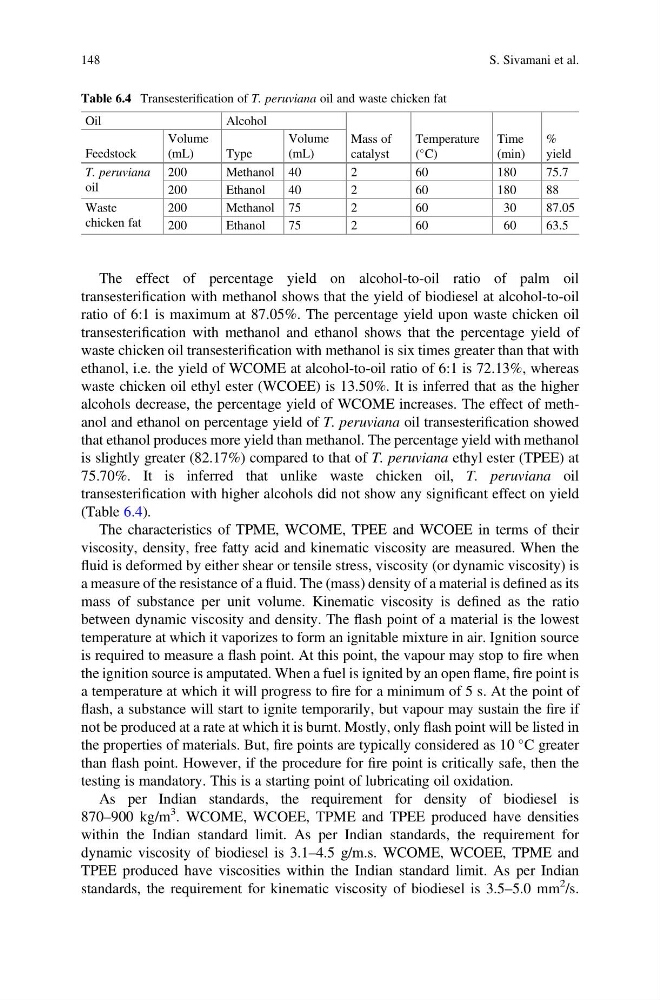
The effect of percentage yield on alcohol-to-oil ratio of palm oil
transesterification with methanol shows that the yield of biodiesel at alcohol-to-oil
ratio of 6:1 is maximum at 87.05%. The percentage yield upon waste chicken oil
transesterification with methanol and ethanol shows that the percentage yield of
waste chicken oil transesterification with methanol is six times greater than that with
ethanol, i.e. the yield of WCOME at alcohol-to-oil ratio of 6:1 is 72.13%, whereas
waste chicken oil ethyl ester (WCOEE) is 13.50%. It is inferred that as the higher
alcohols decrease, the percentage yield of WCOME increases. The effect of methanol and ethanol on percentage yield of T. peruviana oil transesterification showed
that ethanol produces more yield than methanol. The percentage yield with methanol
is slightly greater (82.17%) compared to that of T. peruviana ethyl ester (TPEE) at
75.70%. It is inferred that unlike waste chicken oil, T. peruviana oil
transesterification with higher alcohols did not show any significant effect on yield
(Table 6.4).
The characteristics of TPME, WCOME, TPEE and WCOEE in terms of their
viscosity, density, free fatty acid and kinematic viscosity are measured. When the
fluid is deformed by either shear or tensile stress, viscosity (or dynamic viscosity) is
a measure of the resistance of a fluid. The (mass) density of a material is defined as its
mass of substance per unit volume. Kinematic viscosity is defined as the ratio
between dynamic viscosity and density. The flash point of a material is the lowest
temperature at which it vaporizes to form an ignitable mixture in air. Ignition source
is required to measure a flash point. At this point, the vapour may stop to fire when
the ignition source is amputated. When a fuel is ignited by an open flame, fire point is
a temperature at which it will progress to fire for a minimum of 5 s. At the point of
flash, a substance will start to ignite temporarily, but vapour may sustain the fire if
not be produced at a rate at which it is burnt. Mostly, only flash point will be listed in
the properties of materials. But, fire points are typically considered as 10
C greater
than flash point. However, if the procedure for fire point is critically safe, then the
testing is mandatory. This is a starting point of lubricating oil oxidation.
As per Indian standards, the requirement for density of biodiesel is
870–900 kg/m
3 . WCOME, WCOEE, TPME and TPEE produced have densities
within the Indian standard limit. As per Indian standards, the requirement for
dynamic viscosity of biodiesel is 3.1–4.5 g/m.s. WCOME, WCOEE, TPME and
TPEE produced have viscosities within the Indian standard limit. As per Indian
standards, the requirement for kinematic viscosity of biodiesel is 3.5–5.0 mm
2 /s.
Table 6.4 Transesterification of T. peruviana oil and waste chicken fat
Oil
Alcohol
Mass of
catalyst
Temperature
(
C)
Time
(min)
%
yield
Feedstock
Volume
(mL)
Type
Volume
(mL)
T. peruviana
oil
200
Methanol 40
2
60
180
75.7
200
Ethanol
40
2
60
180
88
Waste
chicken fat
200
Methanol 75
2
60
30
87.05
200
Ethanol
75
2
60
60
63.5
148
S. Sivamani et al.
transesterification with methanol shows that the yield of biodiesel at alcohol-to-oil
ratio of 6:1 is maximum at 87.05%. The percentage yield upon waste chicken oil
transesterification with methanol and ethanol shows that the percentage yield of
waste chicken oil transesterification with methanol is six times greater than that with
ethanol, i.e. the yield of WCOME at alcohol-to-oil ratio of 6:1 is 72.13%, whereas
waste chicken oil ethyl ester (WCOEE) is 13.50%. It is inferred that as the higher
alcohols decrease, the percentage yield of WCOME increases. The effect of methanol and ethanol on percentage yield of T. peruviana oil transesterification showed
that ethanol produces more yield than methanol. The percentage yield with methanol
is slightly greater (82.17%) compared to that of T. peruviana ethyl ester (TPEE) at
75.70%. It is inferred that unlike waste chicken oil, T. peruviana oil
transesterification with higher alcohols did not show any significant effect on yield
(Table 6.4).
The characteristics of TPME, WCOME, TPEE and WCOEE in terms of their
viscosity, density, free fatty acid and kinematic viscosity are measured. When the
fluid is deformed by either shear or tensile stress, viscosity (or dynamic viscosity) is
a measure of the resistance of a fluid. The (mass) density of a material is defined as its
mass of substance per unit volume. Kinematic viscosity is defined as the ratio
between dynamic viscosity and density. The flash point of a material is the lowest
temperature at which it vaporizes to form an ignitable mixture in air. Ignition source
is required to measure a flash point. At this point, the vapour may stop to fire when
the ignition source is amputated. When a fuel is ignited by an open flame, fire point is
a temperature at which it will progress to fire for a minimum of 5 s. At the point of
flash, a substance will start to ignite temporarily, but vapour may sustain the fire if
not be produced at a rate at which it is burnt. Mostly, only flash point will be listed in
the properties of materials. But, fire points are typically considered as 10
C greater
than flash point. However, if the procedure for fire point is critically safe, then the
testing is mandatory. This is a starting point of lubricating oil oxidation.
As per Indian standards, the requirement for density of biodiesel is
870–900 kg/m
3 . WCOME, WCOEE, TPME and TPEE produced have densities
within the Indian standard limit. As per Indian standards, the requirement for
dynamic viscosity of biodiesel is 3.1–4.5 g/m.s. WCOME, WCOEE, TPME and
TPEE produced have viscosities within the Indian standard limit. As per Indian
standards, the requirement for kinematic viscosity of biodiesel is 3.5–5.0 mm
2 /s.
Table 6.4 Transesterification of T. peruviana oil and waste chicken fat
Oil
Alcohol
Mass of
catalyst
Temperature
(
C)
Time
(min)
%
yield
Feedstock
Volume
(mL)
Type
Volume
(mL)
T. peruviana
oil
200
Methanol 40
2
60
180
75.7
200
Ethanol
40
2
60
180
88
Waste
chicken fat
200
Methanol 75
2
60
30
87.05
200
Ethanol
75
2
60
60
63.5
148
S. Sivamani et al.