

WCOME, WCOEE, TPME and TPEE produced have kinematic viscosities within
the Indian standard limit. As per Indian standards, the requirement for flash point of
biodiesel is !100
C. WCOME, WCOEE, TPME and TPEE produced have flash
points within the Indian standard limit. As per Indian standards, the requirement for
fire point of biodiesel is !100
C. WCOME, WCOEE, TPME and TPEE produced
have fire points within the Indian standard limit.
6.6 Modelling and Simulation of Biodiesel Production
The process of framing a set of equations that describe the dynamic behaviour of a
system is called modelling, and the set of equations is called model. The process of
solving a set of equations is called simulation (Luyben 2001). The process of
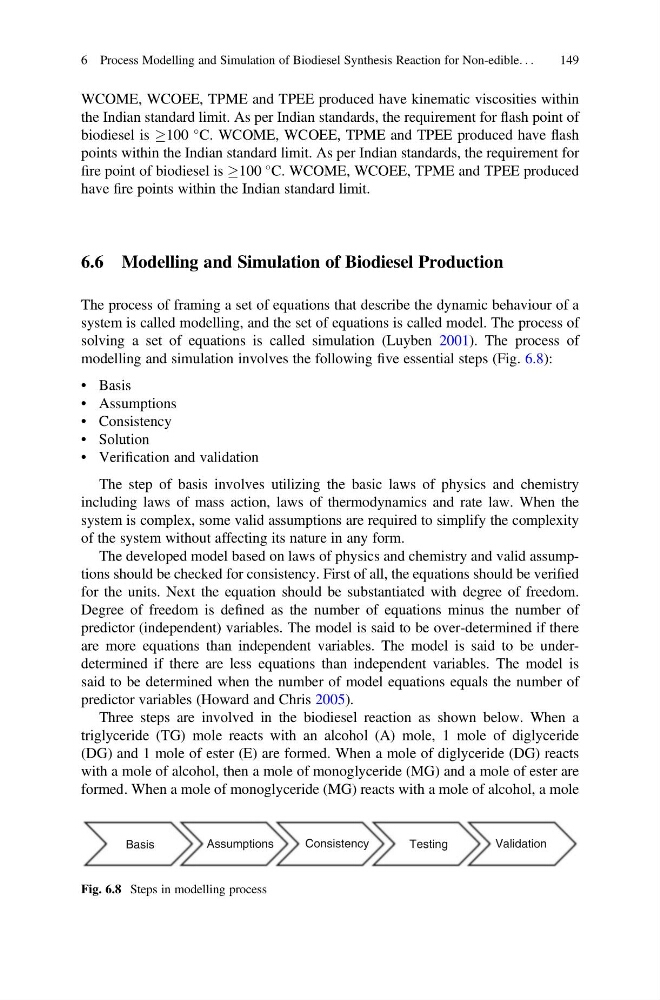
modelling and simulation involves the following five essential steps (Fig. 6.8):
• Basis
• Assumptions
• Consistency
• Solution
• Verification and validation
The step of basis involves utilizing the basic laws of physics and chemistry
including laws of mass action, laws of thermodynamics and rate law. When the
system is complex, some valid assumptions are required to simplify the complexity
of the system without affecting its nature in any form.
The developed model based on laws of physics and chemistry and valid assumptions should be checked for consistency. First of all, the equations should be verified
for the units. Next the equation should be substantiated with degree of freedom.
Degree of freedom is defined as the number of equations minus the number of
predictor (independent) variables. The model is said to be over-determined if there
are more equations than independent variables. The model is said to be underdetermined if there are less equations than independent variables. The model is
said to be determined when the number of model equations equals the number of
predictor variables (Howard and Chris 2005).
Three steps are involved in the biodiesel reaction as shown below. When a
triglyceride (TG) mole reacts with an alcohol (A) mole, 1 mole of diglyceride
(DG) and 1 mole of ester (E) are formed. When a mole of diglyceride (DG) reacts
with a mole of alcohol, then a mole of monoglyceride (MG) and a mole of ester are
formed. When a mole of monoglyceride (MG) reacts with a mole of alcohol, a mole
Basis
Assumptions
Consistency
Testing
Validation
Fig. 6.8 Steps in modelling process
6 Process Modelling and Simulation of Biodiesel Synthesis Reaction for Non-edible. . .
149
the Indian standard limit. As per Indian standards, the requirement for flash point of
biodiesel is !100
C. WCOME, WCOEE, TPME and TPEE produced have flash
points within the Indian standard limit. As per Indian standards, the requirement for
fire point of biodiesel is !100
C. WCOME, WCOEE, TPME and TPEE produced
have fire points within the Indian standard limit.
6.6 Modelling and Simulation of Biodiesel Production
The process of framing a set of equations that describe the dynamic behaviour of a
system is called modelling, and the set of equations is called model. The process of
solving a set of equations is called simulation (Luyben 2001). The process of
modelling and simulation involves the following five essential steps (Fig. 6.8):
• Basis
• Assumptions
• Consistency
• Solution
• Verification and validation
The step of basis involves utilizing the basic laws of physics and chemistry
including laws of mass action, laws of thermodynamics and rate law. When the
system is complex, some valid assumptions are required to simplify the complexity
of the system without affecting its nature in any form.
The developed model based on laws of physics and chemistry and valid assumptions should be checked for consistency. First of all, the equations should be verified
for the units. Next the equation should be substantiated with degree of freedom.
Degree of freedom is defined as the number of equations minus the number of
predictor (independent) variables. The model is said to be over-determined if there
are more equations than independent variables. The model is said to be underdetermined if there are less equations than independent variables. The model is
said to be determined when the number of model equations equals the number of
predictor variables (Howard and Chris 2005).
Three steps are involved in the biodiesel reaction as shown below. When a
triglyceride (TG) mole reacts with an alcohol (A) mole, 1 mole of diglyceride
(DG) and 1 mole of ester (E) are formed. When a mole of diglyceride (DG) reacts
with a mole of alcohol, then a mole of monoglyceride (MG) and a mole of ester are
formed. When a mole of monoglyceride (MG) reacts with a mole of alcohol, a mole
Basis
Assumptions
Consistency
Testing
Validation
Fig. 6.8 Steps in modelling process
6 Process Modelling and Simulation of Biodiesel Synthesis Reaction for Non-edible. . .
149