

curcas (ratanjyote), Calophyllum inophyllum (nagchampa), Azadirachta indica
(neem), Hevea brasiliensis (rubber), etc. (Niju et al. 2020a). The industrial sources
for oil-rich fodder crops include rich fodder crude and used vegetable oils. The
sources of non-edible fats are processing industries for meat, fish, leather, etc.
(Agarwal 2007; Sandhya et al. 2016).
Biodiesel is used for transportation and power generation applications. When it is
used for transportation as an alternative liquid biofuel in diesel engines, it can be
mixed with petrodiesel at any level or used in its pure form, without or little engine
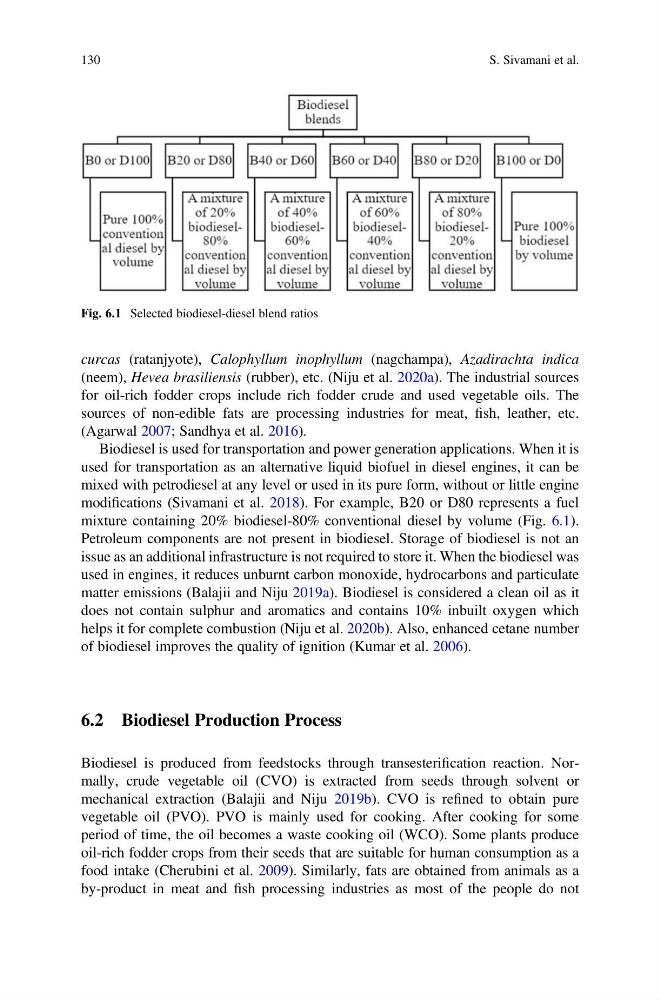
modifications (Sivamani et al. 2018). For example, B20 or D80 represents a fuel
mixture containing 20% biodiesel-80% conventional diesel by volume (Fig. 6.1).
Petroleum components are not present in biodiesel. Storage of biodiesel is not an
issue as an additional infrastructure is not required to store it. When the biodiesel was
used in engines, it reduces unburnt carbon monoxide, hydrocarbons and particulate
matter emissions (Balajii and Niju 2019a). Biodiesel is considered a clean oil as it
does not contain sulphur and aromatics and contains 10% inbuilt oxygen which
helps it for complete combustion (Niju et al. 2020b). Also, enhanced cetane number
of biodiesel improves the quality of ignition (Kumar et al. 2006).
6.2 Biodiesel Production Process
Biodiesel is produced from feedstocks through transesterification reaction. Normally, crude vegetable oil (CVO) is extracted from seeds through solvent or
mechanical extraction (Balajii and Niju 2019b). CVO is refined to obtain pure
vegetable oil (PVO). PVO is mainly used for cooking. After cooking for some
period of time, the oil becomes a waste cooking oil (WCO). Some plants produce
oil-rich fodder crops from their seeds that are suitable for human consumption as a
food intake (Cherubini et al. 2009). Similarly, fats are obtained from animals as a
by-product in meat and fish processing industries as most of the people do not
Fig. 6.1 Selected biodiesel-diesel blend ratios
130
S. Sivamani et al.
(neem), Hevea brasiliensis (rubber), etc. (Niju et al. 2020a). The industrial sources
for oil-rich fodder crops include rich fodder crude and used vegetable oils. The
sources of non-edible fats are processing industries for meat, fish, leather, etc.
(Agarwal 2007; Sandhya et al. 2016).
Biodiesel is used for transportation and power generation applications. When it is
used for transportation as an alternative liquid biofuel in diesel engines, it can be
mixed with petrodiesel at any level or used in its pure form, without or little engine
modifications (Sivamani et al. 2018). For example, B20 or D80 represents a fuel
mixture containing 20% biodiesel-80% conventional diesel by volume (Fig. 6.1).
Petroleum components are not present in biodiesel. Storage of biodiesel is not an
issue as an additional infrastructure is not required to store it. When the biodiesel was
used in engines, it reduces unburnt carbon monoxide, hydrocarbons and particulate
matter emissions (Balajii and Niju 2019a). Biodiesel is considered a clean oil as it
does not contain sulphur and aromatics and contains 10% inbuilt oxygen which
helps it for complete combustion (Niju et al. 2020b). Also, enhanced cetane number
of biodiesel improves the quality of ignition (Kumar et al. 2006).
6.2 Biodiesel Production Process
Biodiesel is produced from feedstocks through transesterification reaction. Normally, crude vegetable oil (CVO) is extracted from seeds through solvent or
mechanical extraction (Balajii and Niju 2019b). CVO is refined to obtain pure
vegetable oil (PVO). PVO is mainly used for cooking. After cooking for some
period of time, the oil becomes a waste cooking oil (WCO). Some plants produce
oil-rich fodder crops from their seeds that are suitable for human consumption as a
food intake (Cherubini et al. 2009). Similarly, fats are obtained from animals as a
by-product in meat and fish processing industries as most of the people do not
Fig. 6.1 Selected biodiesel-diesel blend ratios
130
S. Sivamani et al.