

consume fat due to its cholesterol content (Niju et al. 2019a). Also, fats are generated
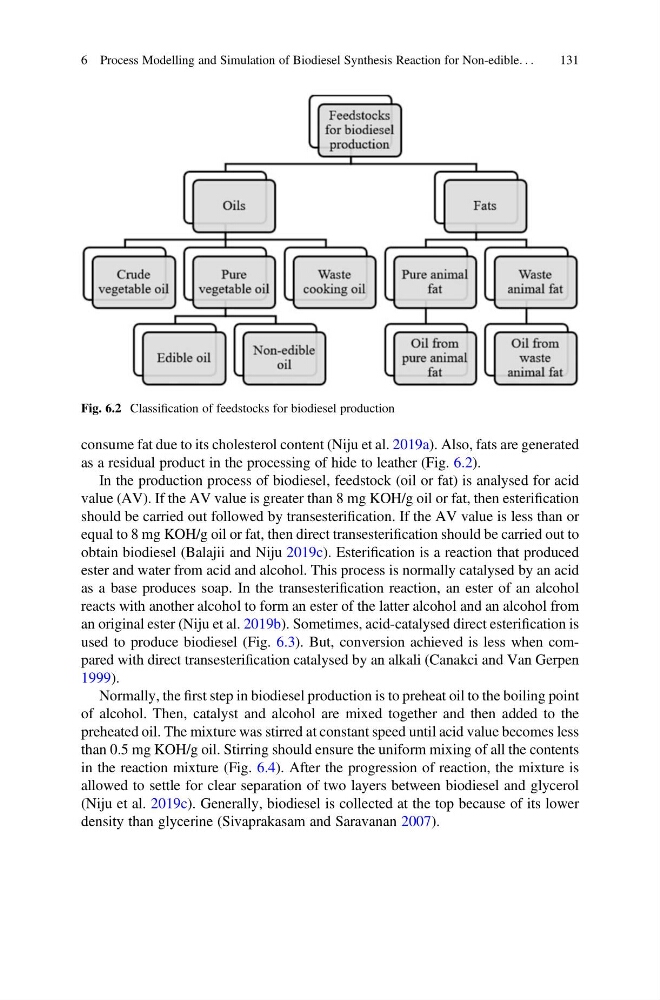
as a residual product in the processing of hide to leather (Fig. 6.2).
In the production process of biodiesel, feedstock (oil or fat) is analysed for acid
value (AV). If the AV value is greater than 8 mg KOH/g oil or fat, then esterification
should be carried out followed by transesterification. If the AV value is less than or
equal to 8 mg KOH/g oil or fat, then direct transesterification should be carried out to
obtain biodiesel (Balajii and Niju 2019c). Esterification is a reaction that produced
ester and water from acid and alcohol. This process is normally catalysed by an acid
as a base produces soap. In the transesterification reaction, an ester of an alcohol
reacts with another alcohol to form an ester of the latter alcohol and an alcohol from
an original ester (Niju et al. 2019b). Sometimes, acid-catalysed direct esterification is
used to produce biodiesel (Fig. 6.3). But, conversion achieved is less when compared with direct transesterification catalysed by an alkali (Canakci and Van Gerpen
1999).
Normally, the first step in biodiesel production is to preheat oil to the boiling point
of alcohol. Then, catalyst and alcohol are mixed together and then added to the
preheated oil. The mixture was stirred at constant speed until acid value becomes less
than 0.5 mg KOH/g oil. Stirring should ensure the uniform mixing of all the contents
in the reaction mixture (Fig. 6.4). After the progression of reaction, the mixture is
allowed to settle for clear separation of two layers between biodiesel and glycerol
(Niju et al. 2019c). Generally, biodiesel is collected at the top because of its lower
density than glycerine (Sivaprakasam and Saravanan 2007).
Fig. 6.2 Classification of feedstocks for biodiesel production
6 Process Modelling and Simulation of Biodiesel Synthesis Reaction for Non-edible. . .
131
as a residual product in the processing of hide to leather (Fig. 6.2).
In the production process of biodiesel, feedstock (oil or fat) is analysed for acid
value (AV). If the AV value is greater than 8 mg KOH/g oil or fat, then esterification
should be carried out followed by transesterification. If the AV value is less than or
equal to 8 mg KOH/g oil or fat, then direct transesterification should be carried out to
obtain biodiesel (Balajii and Niju 2019c). Esterification is a reaction that produced
ester and water from acid and alcohol. This process is normally catalysed by an acid
as a base produces soap. In the transesterification reaction, an ester of an alcohol
reacts with another alcohol to form an ester of the latter alcohol and an alcohol from
an original ester (Niju et al. 2019b). Sometimes, acid-catalysed direct esterification is
used to produce biodiesel (Fig. 6.3). But, conversion achieved is less when compared with direct transesterification catalysed by an alkali (Canakci and Van Gerpen
1999).
Normally, the first step in biodiesel production is to preheat oil to the boiling point
of alcohol. Then, catalyst and alcohol are mixed together and then added to the
preheated oil. The mixture was stirred at constant speed until acid value becomes less
than 0.5 mg KOH/g oil. Stirring should ensure the uniform mixing of all the contents
in the reaction mixture (Fig. 6.4). After the progression of reaction, the mixture is
allowed to settle for clear separation of two layers between biodiesel and glycerol
(Niju et al. 2019c). Generally, biodiesel is collected at the top because of its lower
density than glycerine (Sivaprakasam and Saravanan 2007).
Fig. 6.2 Classification of feedstocks for biodiesel production
6 Process Modelling and Simulation of Biodiesel Synthesis Reaction for Non-edible. . .
131