

5.4.1.3 Metagenomic Library Screening
The construction of a metagenomic library includes sequence-based screening,
configuration screening of compounds, function-based screening, as well as
substrate-induced gene expression (SIGEX) screening (Singh et al. 2016; Wei
et al. 2020).
5.4.1.4 Next-Generation Sequencing
High-throughput sequencing methods produce a higher amount of output than that
of Sanger sequencing. Using next-generation sequencing method, metagenomics
characterizes the microbial communities of environmental samples. Next-generation
sequencing methods are useful because of high gene diversity. Second-generation
sequencing include 454 Genome Sequencer, SOLiD platform, and Illumina Genome
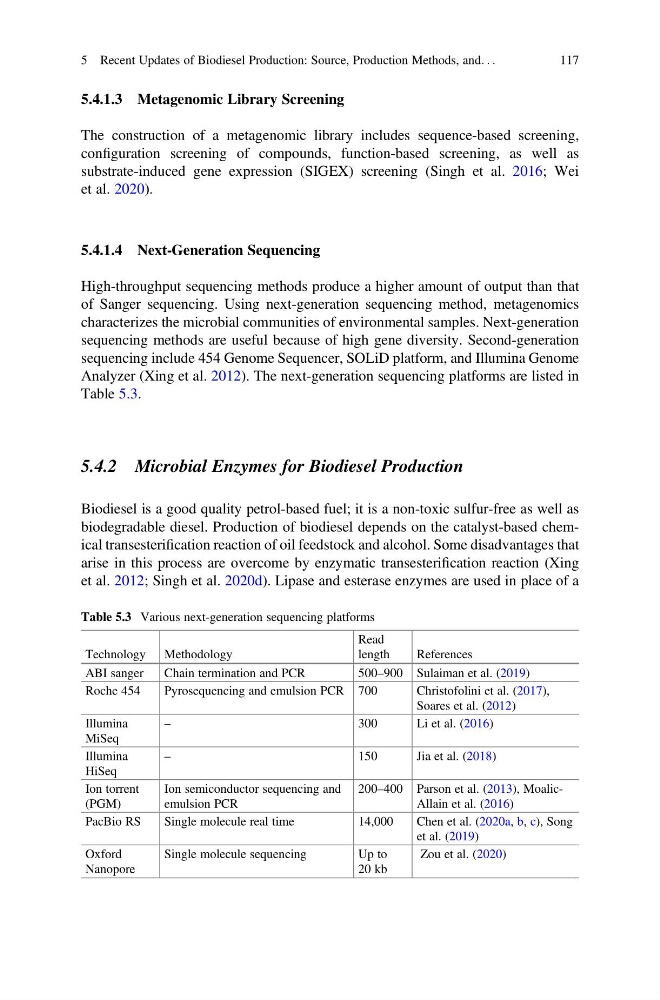
Analyzer (Xing et al. 2012). The next-generation sequencing platforms are listed in
Table 5.3.
5.4.2 Microbial Enzymes for Biodiesel Production
Biodiesel is a good quality petrol-based fuel; it is a non-toxic sulfur-free as well as
biodegradable diesel. Production of biodiesel depends on the catalyst-based chemical transesterification reaction of oil feedstock and alcohol. Some disadvantages that
arise in this process are overcome by enzymatic transesterification reaction (Xing
et al. 2012; Singh et al. 2020d). Lipase and esterase enzymes are used in place of a
Table 5.3 Various next-generation sequencing platforms
Technology Methodology
Read
length
References
ABI sanger
Chain termination and PCR
500–900 Sulaiman et al. (2019)
Roche 454
Pyrosequencing and emulsion PCR 700
Christofolini et al. (2017),
Soares et al. (2012)
Illumina
MiSeq
–
300
Li et al. (2016)
Illumina
HiSeq
–
150
Jia et al. (2018)
Ion torrent
(PGM)
Ion semiconductor sequencing and
emulsion PCR
200–400 Parson et al. (2013), MoalicAllain et al. (2016)
PacBio RS
Single molecule real time
14,000
Chen et al. (2020a, b, c), Song
et al. (2019)
Oxford
Nanopore
Single molecule sequencing
Up to
20 kb
Zou et al. (2020)
5 Recent Updates of Biodiesel Production: Source, Production Methods, and. . .
117
The construction of a metagenomic library includes sequence-based screening,
configuration screening of compounds, function-based screening, as well as
substrate-induced gene expression (SIGEX) screening (Singh et al. 2016; Wei
et al. 2020).
5.4.1.4 Next-Generation Sequencing
High-throughput sequencing methods produce a higher amount of output than that
of Sanger sequencing. Using next-generation sequencing method, metagenomics
characterizes the microbial communities of environmental samples. Next-generation
sequencing methods are useful because of high gene diversity. Second-generation
sequencing include 454 Genome Sequencer, SOLiD platform, and Illumina Genome
Analyzer (Xing et al. 2012). The next-generation sequencing platforms are listed in
Table 5.3.
5.4.2 Microbial Enzymes for Biodiesel Production
Biodiesel is a good quality petrol-based fuel; it is a non-toxic sulfur-free as well as
biodegradable diesel. Production of biodiesel depends on the catalyst-based chemical transesterification reaction of oil feedstock and alcohol. Some disadvantages that
arise in this process are overcome by enzymatic transesterification reaction (Xing
et al. 2012; Singh et al. 2020d). Lipase and esterase enzymes are used in place of a
Table 5.3 Various next-generation sequencing platforms
Technology Methodology
Read
length
References
ABI sanger
Chain termination and PCR
500–900 Sulaiman et al. (2019)
Roche 454
Pyrosequencing and emulsion PCR 700
Christofolini et al. (2017),
Soares et al. (2012)
Illumina
MiSeq
–
300
Li et al. (2016)
Illumina
HiSeq
–
150
Jia et al. (2018)
Ion torrent
(PGM)
Ion semiconductor sequencing and
emulsion PCR
200–400 Parson et al. (2013), MoalicAllain et al. (2016)
PacBio RS
Single molecule real time
14,000
Chen et al. (2020a, b, c), Song
et al. (2019)
Oxford
Nanopore
Single molecule sequencing
Up to
20 kb
Zou et al. (2020)
5 Recent Updates of Biodiesel Production: Source, Production Methods, and. . .
117