

sodium or potassium hydroxide (Demirbas et al. 2016). The biodiesel production
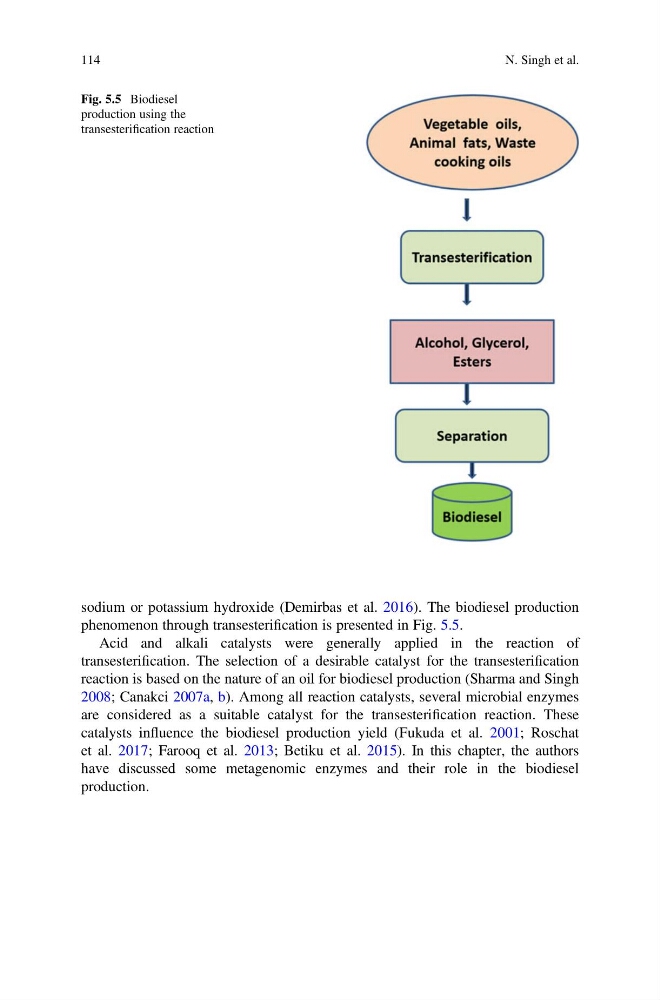
phenomenon through transesterification is presented in Fig. 5.5.
Acid and alkali catalysts were generally applied in the reaction of
transesterification. The selection of a desirable catalyst for the transesterification
reaction is based on the nature of an oil for biodiesel production (Sharma and Singh
2008; Canakci 2007a, b). Among all reaction catalysts, several microbial enzymes
are considered as a suitable catalyst for the transesterification reaction. These
catalysts influence the biodiesel production yield (Fukuda et al. 2001; Roschat
et al. 2017; Farooq et al. 2013; Betiku et al. 2015). In this chapter, the authors
have discussed some metagenomic enzymes and their role in the biodiesel
production.
Fig. 5.5 Biodiesel
production using the
transesterification reaction
114
N. Singh et al.
phenomenon through transesterification is presented in Fig. 5.5.
Acid and alkali catalysts were generally applied in the reaction of
transesterification. The selection of a desirable catalyst for the transesterification
reaction is based on the nature of an oil for biodiesel production (Sharma and Singh
2008; Canakci 2007a, b). Among all reaction catalysts, several microbial enzymes
are considered as a suitable catalyst for the transesterification reaction. These
catalysts influence the biodiesel production yield (Fukuda et al. 2001; Roschat
et al. 2017; Farooq et al. 2013; Betiku et al. 2015). In this chapter, the authors
have discussed some metagenomic enzymes and their role in the biodiesel
production.
Fig. 5.5 Biodiesel
production using the
transesterification reaction
114
N. Singh et al.