

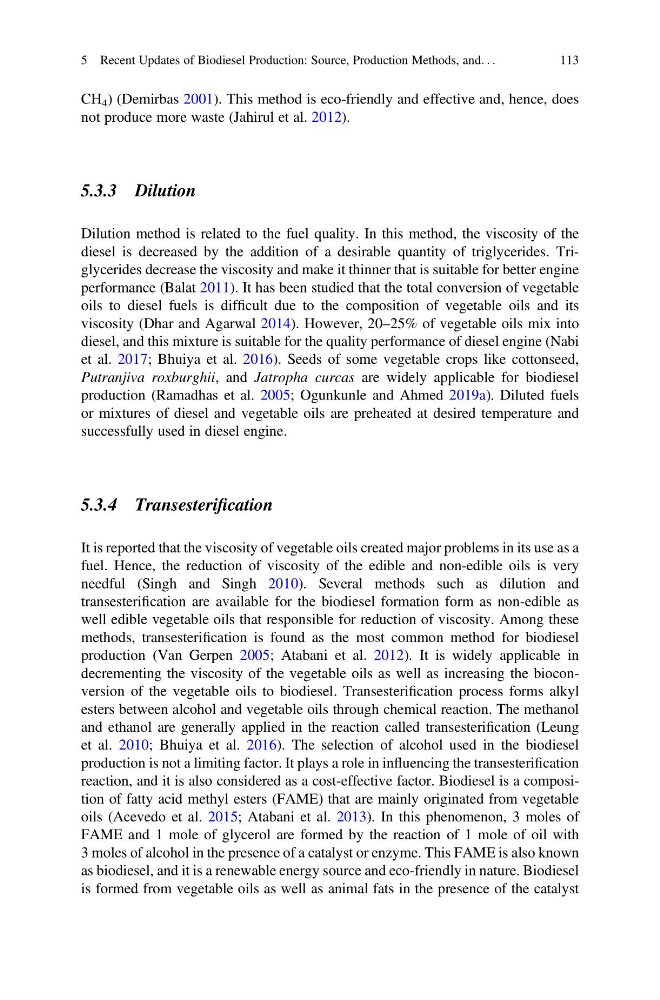
CH 4 ) (Demirbas 2001). This method is eco-friendly and effective and, hence, does
not produce more waste (Jahirul et al. 2012).
5.3.3 Dilution
Dilution method is related to the fuel quality. In this method, the viscosity of the
diesel is decreased by the addition of a desirable quantity of triglycerides. Triglycerides decrease the viscosity and make it thinner that is suitable for better engine
performance (Balat 2011). It has been studied that the total conversion of vegetable
oils to diesel fuels is difficult due to the composition of vegetable oils and its
viscosity (Dhar and Agarwal 2014). However, 20–25% of vegetable oils mix into
diesel, and this mixture is suitable for the quality performance of diesel engine (Nabi
et al. 2017; Bhuiya et al. 2016). Seeds of some vegetable crops like cottonseed,
Putranjiva roxburghii, and Jatropha curcas are widely applicable for biodiesel
production (Ramadhas et al. 2005; Ogunkunle and Ahmed 2019a). Diluted fuels
or mixtures of diesel and vegetable oils are preheated at desired temperature and
successfully used in diesel engine.
5.3.4 Transesterification
It is reported that the viscosity of vegetable oils created major problems in its use as a
fuel. Hence, the reduction of viscosity of the edible and non-edible oils is very
needful (Singh and Singh 2010). Several methods such as dilution and
transesterification are available for the biodiesel formation form as non-edible as
well edible vegetable oils that responsible for reduction of viscosity. Among these
methods, transesterification is found as the most common method for biodiesel
production (Van Gerpen 2005; Atabani et al. 2012). It is widely applicable in
decrementing the viscosity of the vegetable oils as well as increasing the bioconversion of the vegetable oils to biodiesel. Transesterification process forms alkyl
esters between alcohol and vegetable oils through chemical reaction. The methanol
and ethanol are generally applied in the reaction called transesterification (Leung
et al. 2010; Bhuiya et al. 2016). The selection of alcohol used in the biodiesel
production is not a limiting factor. It plays a role in influencing the transesterification
reaction, and it is also considered as a cost-effective factor. Biodiesel is a composition of fatty acid methyl esters (FAME) that are mainly originated from vegetable
oils (Acevedo et al. 2015; Atabani et al. 2013). In this phenomenon, 3 moles of
FAME and 1 mole of glycerol are formed by the reaction of 1 mole of oil with
3 moles of alcohol in the presence of a catalyst or enzyme. This FAME is also known
as biodiesel, and it is a renewable energy source and eco-friendly in nature. Biodiesel
is formed from vegetable oils as well as animal fats in the presence of the catalyst
5 Recent Updates of Biodiesel Production: Source, Production Methods, and. . .
113
not produce more waste (Jahirul et al. 2012).
5.3.3 Dilution
Dilution method is related to the fuel quality. In this method, the viscosity of the
diesel is decreased by the addition of a desirable quantity of triglycerides. Triglycerides decrease the viscosity and make it thinner that is suitable for better engine
performance (Balat 2011). It has been studied that the total conversion of vegetable
oils to diesel fuels is difficult due to the composition of vegetable oils and its
viscosity (Dhar and Agarwal 2014). However, 20–25% of vegetable oils mix into
diesel, and this mixture is suitable for the quality performance of diesel engine (Nabi
et al. 2017; Bhuiya et al. 2016). Seeds of some vegetable crops like cottonseed,
Putranjiva roxburghii, and Jatropha curcas are widely applicable for biodiesel
production (Ramadhas et al. 2005; Ogunkunle and Ahmed 2019a). Diluted fuels
or mixtures of diesel and vegetable oils are preheated at desired temperature and
successfully used in diesel engine.
5.3.4 Transesterification
It is reported that the viscosity of vegetable oils created major problems in its use as a
fuel. Hence, the reduction of viscosity of the edible and non-edible oils is very
needful (Singh and Singh 2010). Several methods such as dilution and
transesterification are available for the biodiesel formation form as non-edible as
well edible vegetable oils that responsible for reduction of viscosity. Among these
methods, transesterification is found as the most common method for biodiesel
production (Van Gerpen 2005; Atabani et al. 2012). It is widely applicable in
decrementing the viscosity of the vegetable oils as well as increasing the bioconversion of the vegetable oils to biodiesel. Transesterification process forms alkyl
esters between alcohol and vegetable oils through chemical reaction. The methanol
and ethanol are generally applied in the reaction called transesterification (Leung
et al. 2010; Bhuiya et al. 2016). The selection of alcohol used in the biodiesel
production is not a limiting factor. It plays a role in influencing the transesterification
reaction, and it is also considered as a cost-effective factor. Biodiesel is a composition of fatty acid methyl esters (FAME) that are mainly originated from vegetable
oils (Acevedo et al. 2015; Atabani et al. 2013). In this phenomenon, 3 moles of
FAME and 1 mole of glycerol are formed by the reaction of 1 mole of oil with
3 moles of alcohol in the presence of a catalyst or enzyme. This FAME is also known
as biodiesel, and it is a renewable energy source and eco-friendly in nature. Biodiesel
is formed from vegetable oils as well as animal fats in the presence of the catalyst
5 Recent Updates of Biodiesel Production: Source, Production Methods, and. . .
113