

fatty acids or oils are extracted from the biodiesel crop seeds. These extracted oils are
further converted into biodiesel through several methods such as pyrolysis, dilution,
as well as transesterification (Song et al. 2011). The biodiesel production methods
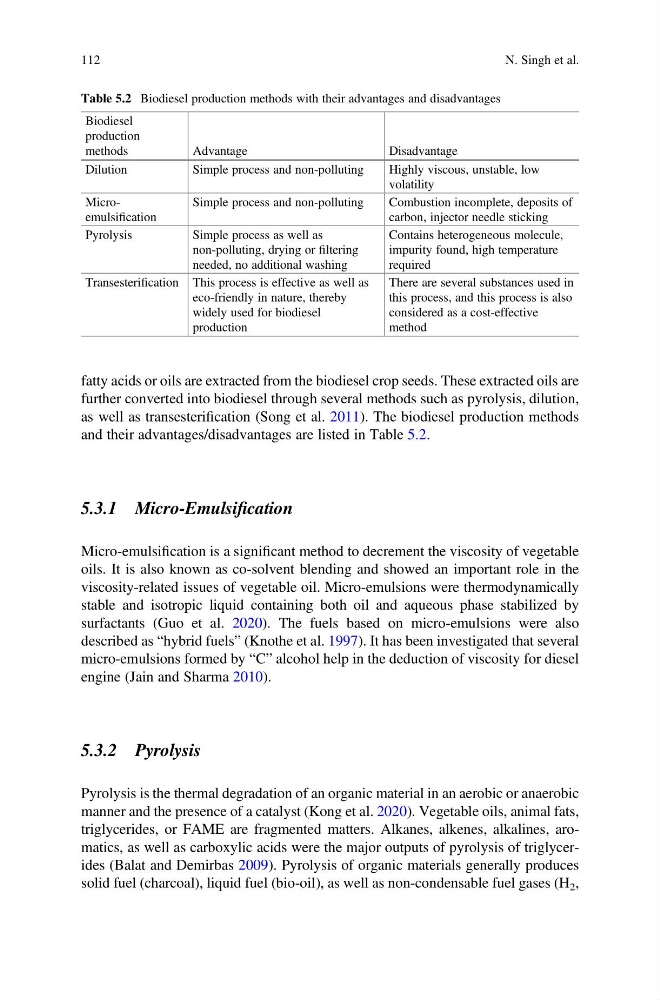
and their advantages/disadvantages are listed in Table 5.2.
5.3.1 Micro-Emulsification
Micro-emulsification is a significant method to decrement the viscosity of vegetable
oils. It is also known as co-solvent blending and showed an important role in the
viscosity-related issues of vegetable oil. Micro-emulsions were thermodynamically
stable and isotropic liquid containing both oil and aqueous phase stabilized by
surfactants (Guo et al. 2020). The fuels based on micro-emulsions were also
described as “hybrid fuels” (Knothe et al. 1997). It has been investigated that several
micro-emulsions formed by “C” alcohol help in the deduction of viscosity for diesel
engine (Jain and Sharma 2010).
5.3.2 Pyrolysis
Pyrolysis is the thermal degradation of an organic material in an aerobic or anaerobic
manner and the presence of a catalyst (Kong et al. 2020). Vegetable oils, animal fats,
triglycerides, or FAME are fragmented matters. Alkanes, alkenes, alkalines, aromatics, as well as carboxylic acids were the major outputs of pyrolysis of triglycerides (Balat and Demirbas 2009). Pyrolysis of organic materials generally produces
solid fuel (charcoal), liquid fuel (bio-oil), as well as non-condensable fuel gases (H 2 ,
Table 5.2 Biodiesel production methods with their advantages and disadvantages
Biodiesel
production
methods
Advantage
Disadvantage
Dilution
Simple process and non-polluting
Highly viscous, unstable, low
volatility
Microemulsification
Simple process and non-polluting
Combustion incomplete, deposits of
carbon, injector needle sticking
Pyrolysis
Simple process as well as
non-polluting, drying or filtering
needed, no additional washing
Contains heterogeneous molecule,
impurity found, high temperature
required
Transesterification This process is effective as well as
eco-friendly in nature, thereby
widely used for biodiesel
production
There are several substances used in
this process, and this process is also
considered as a cost-effective
method
112
N. Singh et al.
further converted into biodiesel through several methods such as pyrolysis, dilution,
as well as transesterification (Song et al. 2011). The biodiesel production methods
and their advantages/disadvantages are listed in Table 5.2.
5.3.1 Micro-Emulsification
Micro-emulsification is a significant method to decrement the viscosity of vegetable
oils. It is also known as co-solvent blending and showed an important role in the
viscosity-related issues of vegetable oil. Micro-emulsions were thermodynamically
stable and isotropic liquid containing both oil and aqueous phase stabilized by
surfactants (Guo et al. 2020). The fuels based on micro-emulsions were also
described as “hybrid fuels” (Knothe et al. 1997). It has been investigated that several
micro-emulsions formed by “C” alcohol help in the deduction of viscosity for diesel
engine (Jain and Sharma 2010).
5.3.2 Pyrolysis
Pyrolysis is the thermal degradation of an organic material in an aerobic or anaerobic
manner and the presence of a catalyst (Kong et al. 2020). Vegetable oils, animal fats,
triglycerides, or FAME are fragmented matters. Alkanes, alkenes, alkalines, aromatics, as well as carboxylic acids were the major outputs of pyrolysis of triglycerides (Balat and Demirbas 2009). Pyrolysis of organic materials generally produces
solid fuel (charcoal), liquid fuel (bio-oil), as well as non-condensable fuel gases (H 2 ,
Table 5.2 Biodiesel production methods with their advantages and disadvantages
Biodiesel
production
methods
Advantage
Disadvantage
Dilution
Simple process and non-polluting
Highly viscous, unstable, low
volatility
Microemulsification
Simple process and non-polluting
Combustion incomplete, deposits of
carbon, injector needle sticking
Pyrolysis
Simple process as well as
non-polluting, drying or filtering
needed, no additional washing
Contains heterogeneous molecule,
impurity found, high temperature
required
Transesterification This process is effective as well as
eco-friendly in nature, thereby
widely used for biodiesel
production
There are several substances used in
this process, and this process is also
considered as a cost-effective
method
112
N. Singh et al.