

112 ◾ Distillation Control, Optimization, and Tuning
− 9.1) = 21.9 min, and the calculated apparent dead time is
ADT= 23.7 − 21.9 = 1.8 min.
For the case with T 1 = 20 and T 2 = 2 the calculated TFO =
1.5(23.6 − 10.3) = 20.0 min, and the calculated ADT = 23.6 –
20.0 = 3.6 min.
Many different tuning rules have been published for estimating the controller tuning parameters to use for a first-order
plus dead time (FOPDT) process response, and they are too
numerous for a complete review in this book. Only a few will
be presented.
10.4 Quarter Decay Ratio
(QDR) Tuning Rules
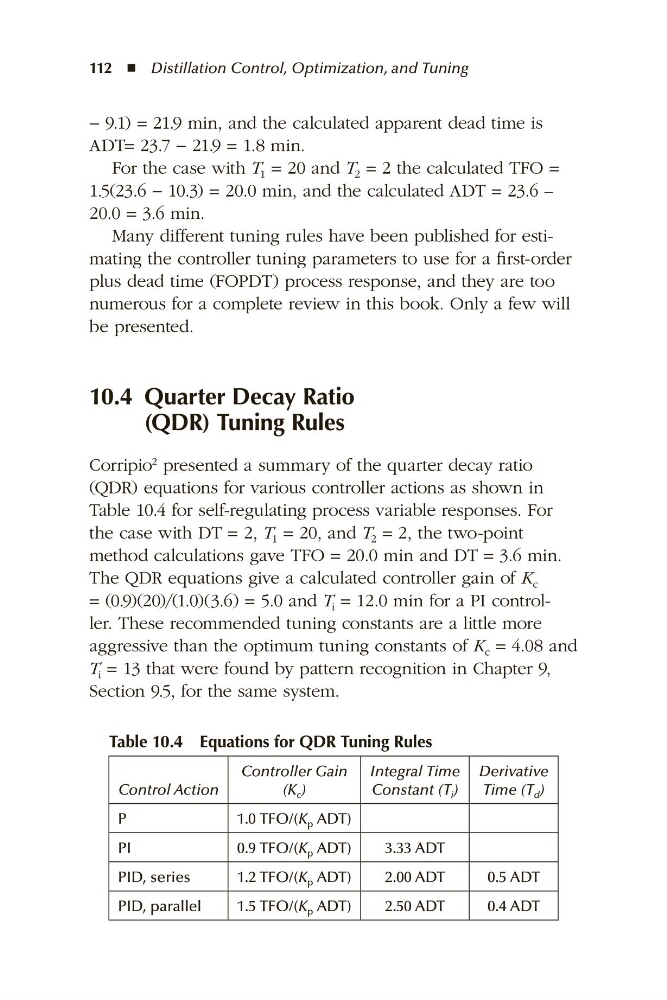
Corripio 2 presented a summary of the quarter decay ratio
(QDR) equations for various controller actions as shown in
Table 10.4 for self-regulating process variable responses. For
the case with DT = 2, T 1 = 20, and T 2 = 2, the two-point
method calculations gave TFO = 20.0 min and DT = 3.6 min.
The QDR equations give a calculated controller gain of K c
= (0.9)(20)/(1.0)(3.6) = 5.0 and T i = 12.0 min for a PI controller. These recommended tuning constants are a little more
aggressive than the optimum tuning constants of K c = 4.08 and
T i = 13 that were found by pattern recognition in Chapter 9,
Section 9.5, for the same system.
Table 10.4 Equations for QDR Tuning Rules
Control Action
Controller Gain
(K c )
Integral Time
Constant (T i )
Derivative
Time (T d )
P
1.0 TFO/(K p ADT)
PI
0.9 TFO/(K p ADT)
3.33 ADT
PID, series
1.2 TFO/(K p ADT)
2.00 ADT
0.5 ADT
PID, parallel
1.5 TFO/(K p ADT)
2.50 ADT
0.4 ADT