

46
Phase transitions in the early universe
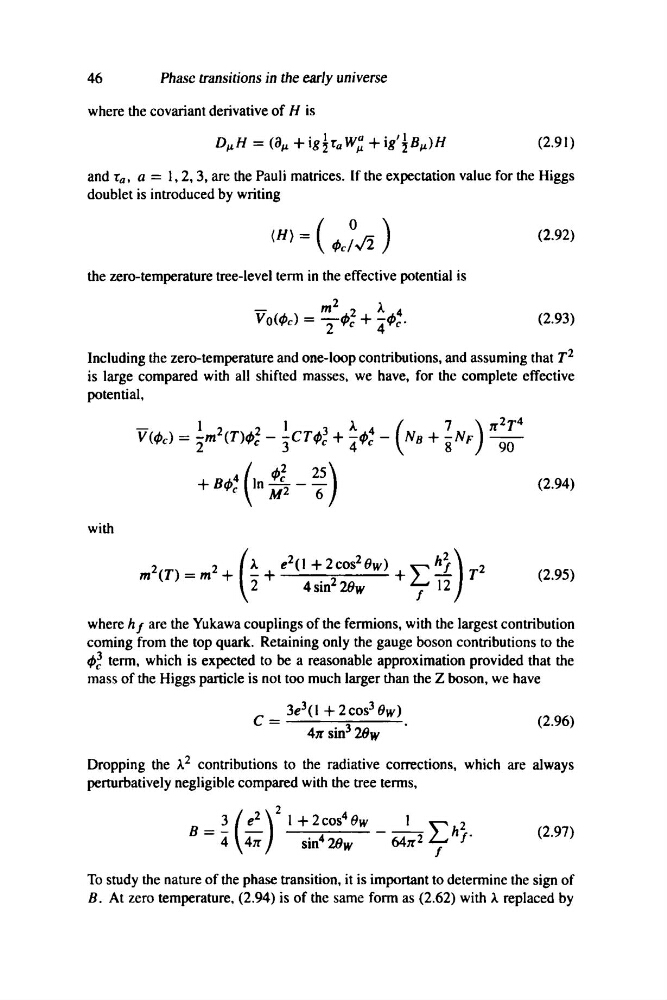
where the covariant derivative of H is
Djl.H = (a" +ig~'l'aW: +ig'~Bjl.)H
(2.91)
and 'l'a, a = 1,2,3, are the Pauli matrices. If the expectation value for the Higgs
doublet is introduced by writing
(H) = ( rfJ)../2 )
(2.92)
the zero-temperature tree-level term in the effective potential is
m 2
-
2
A. 4
Vo(rfJc) = TrfJc + "4rfJc'
(2.93)
Including the zero-temperature and one-loop contributions, and assuming that T2
is large compared with all shifted masses, we have, for the complete effective
potential,
-
I 2 2 I 3 A. 4 ( 7) 1r2T4
V(rfJd = 2m (T)rfJc - "jCTrfJc + "4rfJc - NB + gNF 9()
4 (
rfJ~ 25)
+BA. I n - - -
(2.94)
Y"c
M2
6
with
2
_
2
(~ e 2 (1 + 2cos 29 w) "h}) T2 (2.95)
m (T) - m + 2 +
. 2
+ L... 12
4sm 29w
I
where hI are the Yukawa couplings of the fermions, with the largest contribution
coming from the top quark. Retaining only the gauge boson contributions to the
rfJ~ term, which is expected to be a reasonable approximation provided that the
mass of the Higgs particle is not too much larger than the Z boson, we have
3e 3 (1 + 2 cos 3 9w)
(2.96)
C =
41r sin3 2 9 w .
Dropping the A. 2 contributions to the radiative corrections, which are always
perturbatively negligible compared with the tree terms,
B = ~ (~)2 I +2cos 4 9w _ _ 1_"h2. (2.97)
4 41r
sin4 29w
641r 2 L... I
I
To study the nature of the phase transition, it is important to determine the sign of
B. At zero temperature. (2.94) is of the same form as (2.62) with A. replaced by
Phase transitions in the early universe
where the covariant derivative of H is
Djl.H = (a" +ig~'l'aW: +ig'~Bjl.)H
(2.91)
and 'l'a, a = 1,2,3, are the Pauli matrices. If the expectation value for the Higgs
doublet is introduced by writing
(H) = ( rfJ)../2 )
(2.92)
the zero-temperature tree-level term in the effective potential is
m 2
-
2
A. 4
Vo(rfJc) = TrfJc + "4rfJc'
(2.93)
Including the zero-temperature and one-loop contributions, and assuming that T2
is large compared with all shifted masses, we have, for the complete effective
potential,
-
I 2 2 I 3 A. 4 ( 7) 1r2T4
V(rfJd = 2m (T)rfJc - "jCTrfJc + "4rfJc - NB + gNF 9()
4 (
rfJ~ 25)
+BA. I n - - -
(2.94)
Y"c
M2
6
with
2
_
2
(~ e 2 (1 + 2cos 29 w) "h}) T2 (2.95)
m (T) - m + 2 +
. 2
+ L... 12
4sm 29w
I
where hI are the Yukawa couplings of the fermions, with the largest contribution
coming from the top quark. Retaining only the gauge boson contributions to the
rfJ~ term, which is expected to be a reasonable approximation provided that the
mass of the Higgs particle is not too much larger than the Z boson, we have
3e 3 (1 + 2 cos 3 9w)
(2.96)
C =
41r sin3 2 9 w .
Dropping the A. 2 contributions to the radiative corrections, which are always
perturbatively negligible compared with the tree terms,
B = ~ (~)2 I +2cos 4 9w _ _ 1_"h2. (2.97)
4 41r
sin4 29w
641r 2 L... I
I
To study the nature of the phase transition, it is important to determine the sign of
B. At zero temperature. (2.94) is of the same form as (2.62) with A. replaced by