

Phase transitions in e/ectroweak theory
47
4'). and can be cast in the form (2.77) with the same replacement in (2.78). A little
calculation (exercise 2) shows that, when B > 0 and a > 0, the zero-temperature
effective potential always has a minimum at f/>c = 0, in contrast to the situation
when radiative corrections are neglected where there is a maximum at tPc = 0 and
a minimum at f/>; = _m 2 lA.
However, when B < 0, there can only be a minimum at tPc = 0 if a < O.
However, a < 0 is ruled out by the requirement that the mass-squared m~
of the physical neutral Higgs scalar particle given in (2.79) should be positive.
Thus, there is never a minimum at f/>c = 0 when B < 0 and the situation is
then qualitatively the same as in the absence of the zero-temperature radiative
corrections: the phase transition is first order.
The sign of B may be determined as follows. We shall retain only the largest
Yukawa coupling which is the top quark coupling h,. (Retaining more Yukawas
only strengthens the conclusion.) The corresponding Lagrangian is
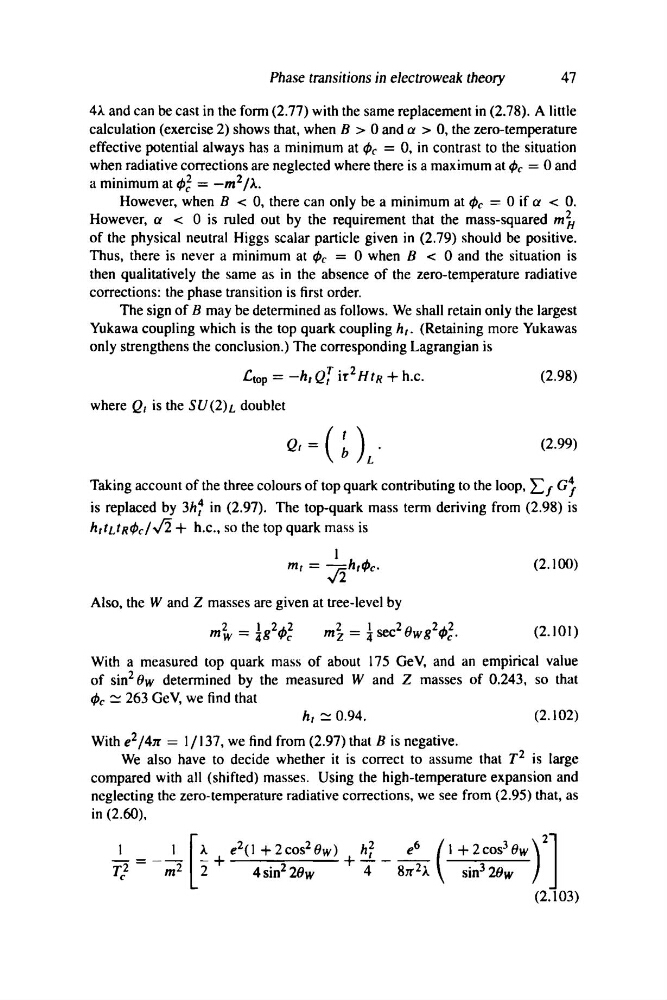
Ltop = -h, Q; i1'2 HtR + h.c.
(2.98)
where Q, is the SU(2)L doublet
(2.99)
Q, = ( ~ ) L·
Taking account of the three colours of top quark contributing to the loop, L / G}
is replaced by 3h: in (2.97). The top-quark mass term deriving from (2.98) is
hrtLtRtPcI..fi + h.c., so the top quark mass is
I
m, = ..fihrtPc.
(2.100)
Also, the Wand Z masses are given at tree-level by
2
1 2A.2
2
1
2 II
2A.2
mw = 4g 'l"c mz = ;{ sec t1wg 'l"c·
(2.101)
With a measured top quark mass of about 175 GeV, and an empirical value
of sin 2 0w determined by the measured Wand Z masses of 0.243, so that
f/>c ~ 263 GeV, we find that
hr ~ 0.94.
(2.102)
With e 2 /47r = 1 I 137, we find from (2.97) that B is negative.
We also have to decide whether it is correct to assume that T2 is large
compared with all (shifted) masses. Using the high-temperature expansion and
neglecting the zero-temperature radiative corrections, we see from (2.95) that, as
in (2.60),
_I = __ I [~+
2 Ow) + h~ _ ~ (I +2cos 3 0w)2]
e 2 (1 + 2 cos
Tc 2
m 2 2
4 sin 2 20w
4
87r 2 ').
sin 3 20w
(2.103)
47
4'). and can be cast in the form (2.77) with the same replacement in (2.78). A little
calculation (exercise 2) shows that, when B > 0 and a > 0, the zero-temperature
effective potential always has a minimum at f/>c = 0, in contrast to the situation
when radiative corrections are neglected where there is a maximum at tPc = 0 and
a minimum at f/>; = _m 2 lA.
However, when B < 0, there can only be a minimum at tPc = 0 if a < O.
However, a < 0 is ruled out by the requirement that the mass-squared m~
of the physical neutral Higgs scalar particle given in (2.79) should be positive.
Thus, there is never a minimum at f/>c = 0 when B < 0 and the situation is
then qualitatively the same as in the absence of the zero-temperature radiative
corrections: the phase transition is first order.
The sign of B may be determined as follows. We shall retain only the largest
Yukawa coupling which is the top quark coupling h,. (Retaining more Yukawas
only strengthens the conclusion.) The corresponding Lagrangian is
Ltop = -h, Q; i1'2 HtR + h.c.
(2.98)
where Q, is the SU(2)L doublet
(2.99)
Q, = ( ~ ) L·
Taking account of the three colours of top quark contributing to the loop, L / G}
is replaced by 3h: in (2.97). The top-quark mass term deriving from (2.98) is
hrtLtRtPcI..fi + h.c., so the top quark mass is
I
m, = ..fihrtPc.
(2.100)
Also, the Wand Z masses are given at tree-level by
2
1 2A.2
2
1
2 II
2A.2
mw = 4g 'l"c mz = ;{ sec t1wg 'l"c·
(2.101)
With a measured top quark mass of about 175 GeV, and an empirical value
of sin 2 0w determined by the measured Wand Z masses of 0.243, so that
f/>c ~ 263 GeV, we find that
hr ~ 0.94.
(2.102)
With e 2 /47r = 1 I 137, we find from (2.97) that B is negative.
We also have to decide whether it is correct to assume that T2 is large
compared with all (shifted) masses. Using the high-temperature expansion and
neglecting the zero-temperature radiative corrections, we see from (2.95) that, as
in (2.60),
_I = __ I [~+
2 Ow) + h~ _ ~ (I +2cos 3 0w)2]
e 2 (1 + 2 cos
Tc 2
m 2 2
4 sin 2 20w
4
87r 2 ').
sin 3 20w
(2.103)