

Phase transitions in electroweak theory
45
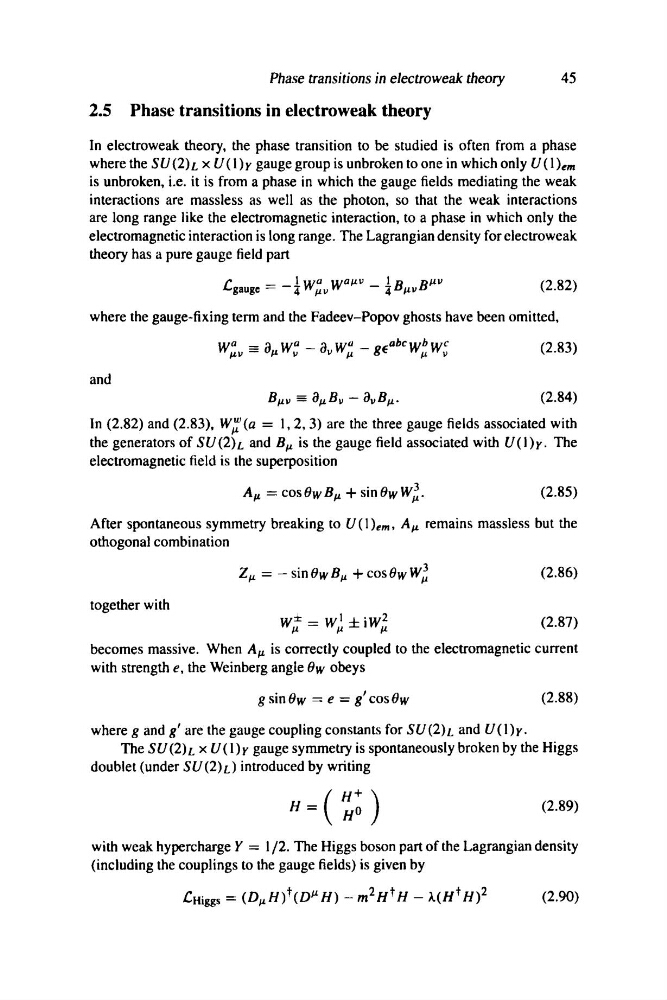
2.5 Phase transitions in electroweak theory
In electroweak theory, the phase transition to be studied is often from a phase
where the S U (2) L x U (I) y gauge group is unbroken to one in which only U (I )em
is unbroken. i.e. it is from a phase in which the gauge fields mediating the weak
interactions are massless as well as the photon, so that the weak interactions
are long range like the electromagnetic interaction. to a phase in which only the
electromagnetic interaction is long range. The Lagrangian density for electroweak
theory has a pure gauge field part
;0
I W a Wait"
I B Bit"
(2.82)
l..gaugc = -4" It"
- 4" It"
where the gauge-fixing term and the Fadeev-Popov ghosts have been omitted,
w a = a w a - a w a _ g..,abcwbwc
(2.83)
"''' - It"
"It
'"
It"
and
Bit" = altB" - a"BIt .
(2.84)
In (2.82) and (2.83). W; (a = I. 2. 3) are the three gauge fields associated with
the generators of SU(2)L and Bit is the gauge field associated with U(I)y. The
electromagnetic field is the superposition
A", = cosOwB", + sinOwW~.
(2.85)
After spontaneous symmetry breaking to U(I)t'm. AIt remains massless but the
othogonal combination
ZIt = -sinOwBIt +cosOwW~
(2.86)
together with
w± = W l ±iW 2
(2.87)
It
It
It
becomes massive. When AIt is correctly coupled to the electromagnetic current
with strength e. the Weinberg angle Ow obeys
g sin8w = e = g' cos8w
(2.88)
where g and g' are the gauge coupling constants for SU(2)L and U(I)y.
The SU(2)L x U(I)y gauge symmetry is spontaneously broken by the Higgs
doublet (under SU(2)Ll introduced by writing
H = ( ~: )
(2.89)
with weak hypercharge Y = 1/2. The Higgs boson part of the Lagrangian density
(including the couplings to the gauge fields) is given by
CHiggs = (DItH)t(DIt H) - m 2 Ht H - 'A(H t H)2
(2.90)
45
2.5 Phase transitions in electroweak theory
In electroweak theory, the phase transition to be studied is often from a phase
where the S U (2) L x U (I) y gauge group is unbroken to one in which only U (I )em
is unbroken. i.e. it is from a phase in which the gauge fields mediating the weak
interactions are massless as well as the photon, so that the weak interactions
are long range like the electromagnetic interaction. to a phase in which only the
electromagnetic interaction is long range. The Lagrangian density for electroweak
theory has a pure gauge field part
;0
I W a Wait"
I B Bit"
(2.82)
l..gaugc = -4" It"
- 4" It"
where the gauge-fixing term and the Fadeev-Popov ghosts have been omitted,
w a = a w a - a w a _ g..,abcwbwc
(2.83)
"''' - It"
"It
'"
It"
and
Bit" = altB" - a"BIt .
(2.84)
In (2.82) and (2.83). W; (a = I. 2. 3) are the three gauge fields associated with
the generators of SU(2)L and Bit is the gauge field associated with U(I)y. The
electromagnetic field is the superposition
A", = cosOwB", + sinOwW~.
(2.85)
After spontaneous symmetry breaking to U(I)t'm. AIt remains massless but the
othogonal combination
ZIt = -sinOwBIt +cosOwW~
(2.86)
together with
w± = W l ±iW 2
(2.87)
It
It
It
becomes massive. When AIt is correctly coupled to the electromagnetic current
with strength e. the Weinberg angle Ow obeys
g sin8w = e = g' cos8w
(2.88)
where g and g' are the gauge coupling constants for SU(2)L and U(I)y.
The SU(2)L x U(I)y gauge symmetry is spontaneously broken by the Higgs
doublet (under SU(2)Ll introduced by writing
H = ( ~: )
(2.89)
with weak hypercharge Y = 1/2. The Higgs boson part of the Lagrangian density
(including the couplings to the gauge fields) is given by
CHiggs = (DItH)t(DIt H) - m 2 Ht H - 'A(H t H)2
(2.90)