

44
Phase transitions in the early universe
V(cIb)
D
B
A
C\)c
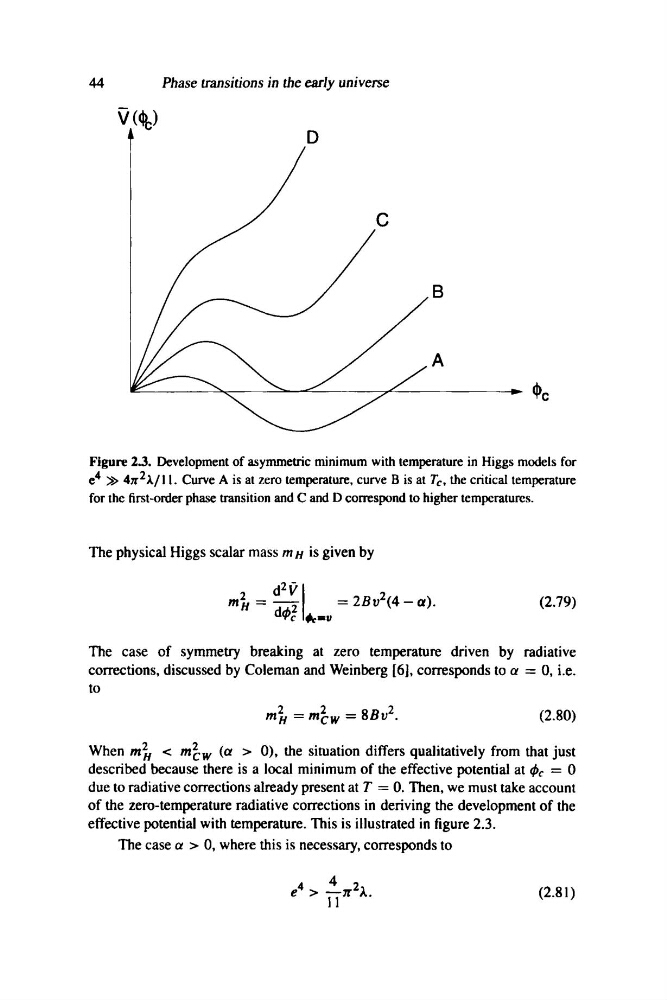
Figure 2.3. Development of asymmetric minimum with temperature in Higgs models for
e 4 » 47r 2 4/11. Curve A is at zero temperature. curve B is at Tc. the critical temperature
for the first-order phase transition and C and D correspond to higher temperatures.
The physical Higgs scalar mass m H is given by
2 _ d
2
V I = 2Bv2(4 - a).
(2.79)
mH - dq,l ~=II
The case of symmetry breaking at zero temperature driven by radiative
corrections, discussed by Coleman and Weinberg [6], corresponds to a = 0, i.e.
to
m~ = m~w = SBv 2 •
(2.80)
When m~ < m~w (a > 0), the situation differs qualitatively from that just
described because there is a local minimum of the effective potential at q,c = 0
due to radiative corrections already present at T = O. Then, we must take account
of the zero-temperature radiative corrections in deriving the development of the
effective potential with temperature. This is illustrated in figure 2.3.
The case a > 0, where this is necessary. corresponds to
4
e 4 > -1r 2 A.
(2.81)
11
Phase transitions in the early universe
V(cIb)
D
B
A
C\)c
Figure 2.3. Development of asymmetric minimum with temperature in Higgs models for
e 4 » 47r 2 4/11. Curve A is at zero temperature. curve B is at Tc. the critical temperature
for the first-order phase transition and C and D correspond to higher temperatures.
The physical Higgs scalar mass m H is given by
2 _ d
2
V I = 2Bv2(4 - a).
(2.79)
mH - dq,l ~=II
The case of symmetry breaking at zero temperature driven by radiative
corrections, discussed by Coleman and Weinberg [6], corresponds to a = 0, i.e.
to
m~ = m~w = SBv 2 •
(2.80)
When m~ < m~w (a > 0), the situation differs qualitatively from that just
described because there is a local minimum of the effective potential at q,c = 0
due to radiative corrections already present at T = O. Then, we must take account
of the zero-temperature radiative corrections in deriving the development of the
effective potential with temperature. This is illustrated in figure 2.3.
The case a > 0, where this is necessary. corresponds to
4
e 4 > -1r 2 A.
(2.81)
11