

Phase transitions in the Higgs model
43
V(~)
D
c
B
A
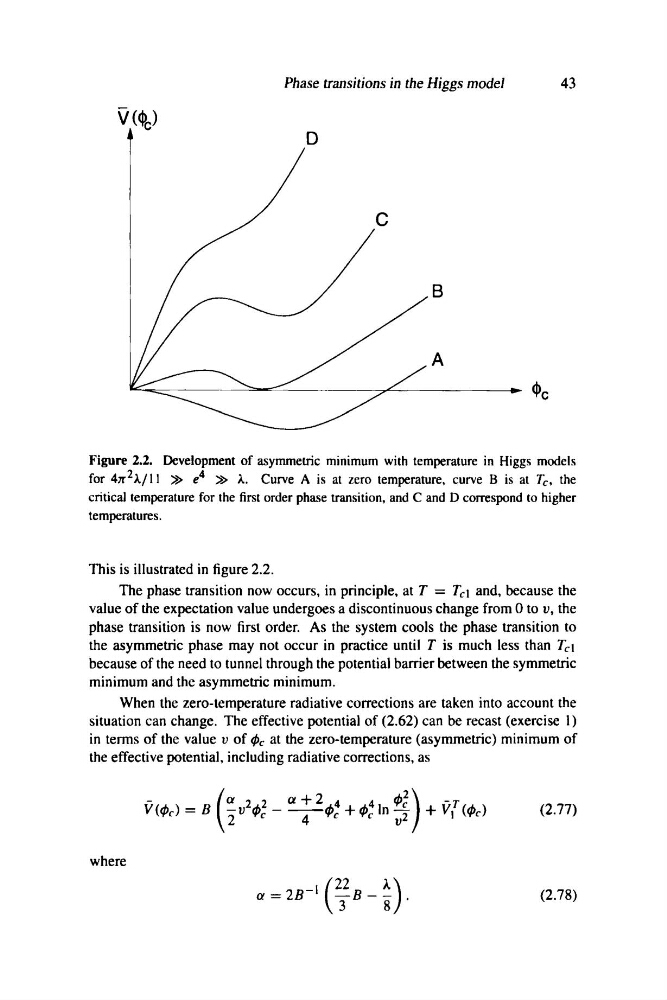
for 411'2 AlII » e 4 » A. Curve A is at zero temperature. curve B is at Tc. the
critical temperature for the first order phase transition, and C and D correspond to higher
temperatures.
This is illustrated in figure 2.2.
The phase transition now occurs. in principle. at T = Tcl and. because the
value of the expectation value undergoes a discontinuous change from 0 to v. the
phase transition is now first order. As the system cools the phase transition to
the asymmetric phase may not occur in practice until T is much less than Tcl
because of the need to tunnel through the potential barrier between the symmetric
minimum and the asymmetric minimum.
When the zero-temperature radiative corrections are taken into account the
situation can change. The effective potential of (2.62) can be recast (exercise 1)
in tenns of the value v of tPc at the zero-temperature (asymmetric) minimum of
the effective potential, including radiative corrections. as
V(tPc) -
(a 2 2 +
tP;) -
= B 2"v tPc - a -4-tPc
2 4
+ tPc
4
T
In v 2 + VI (tPc)
(2.17)
where
_\ (22
a = 2B
3 B - 8" A) .
(2.78)
43
V(~)
D
c
B
A
for 411'2 AlII » e 4 » A. Curve A is at zero temperature. curve B is at Tc. the
critical temperature for the first order phase transition, and C and D correspond to higher
temperatures.
This is illustrated in figure 2.2.
The phase transition now occurs. in principle. at T = Tcl and. because the
value of the expectation value undergoes a discontinuous change from 0 to v. the
phase transition is now first order. As the system cools the phase transition to
the asymmetric phase may not occur in practice until T is much less than Tcl
because of the need to tunnel through the potential barrier between the symmetric
minimum and the asymmetric minimum.
When the zero-temperature radiative corrections are taken into account the
situation can change. The effective potential of (2.62) can be recast (exercise 1)
in tenns of the value v of tPc at the zero-temperature (asymmetric) minimum of
the effective potential, including radiative corrections. as
V(tPc) -
(a 2 2 +
tP;) -
= B 2"v tPc - a -4-tPc
2 4
+ tPc
4
T
In v 2 + VI (tPc)
(2.17)
where
_\ (22
a = 2B
3 B - 8" A) .
(2.78)