

42
Phase transitions in the early universe
At the zero-temperature asymmetric minimum. still neglecting the radiative
corrections.
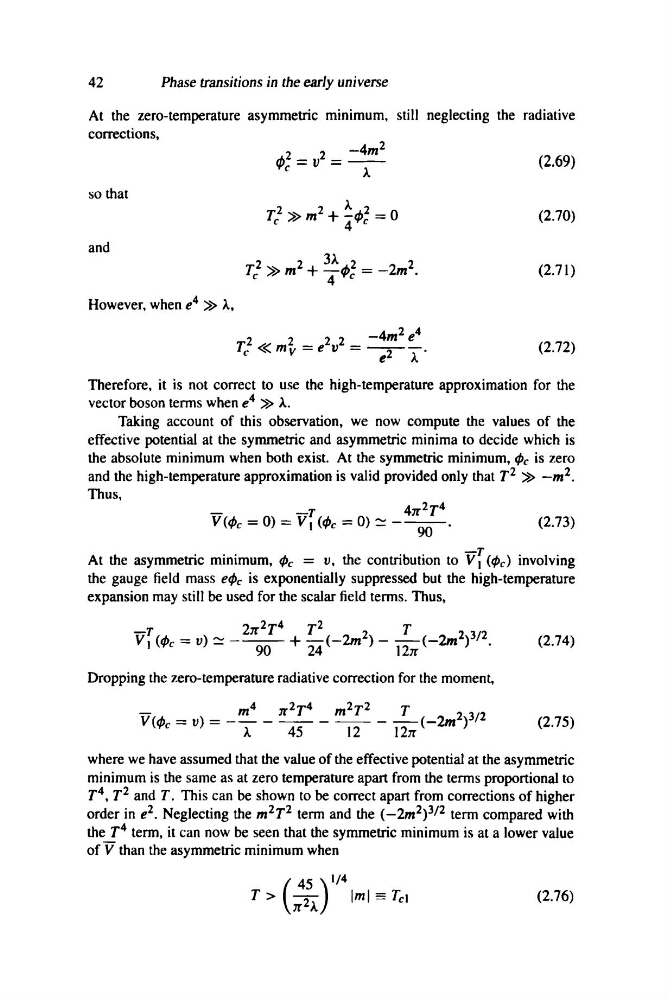
",2 _ 2
-4m 2
'l'c - V =-(2.69)
A
so that
A
(2.70)
Tc 2 » m 2 + -q,: = 0
4
and
3A
T;» m 2 + -q,: = _2m2.
(2.71)
4
However. when e 4 » A.
4m 2 4
2
2
22
-
e
Tc «mv =e v = ~T'
(2.72)
Therefore. it is not correct to use the high-temperature approximation for the
vector boson terms when e 4 » A.
Taking account of this observation. we now compute the values of the
effective potential at the symmetric and asymmetric minima to decide which is
the absolute minimum when both exist. At the symmetric minimum. q,c is zero
and the high-temperature approximation is valid provided only that T2 » -m 2 •
Thus.
v (q,c = 0) = vi (q,c = 0) ::: _ 411'2T4
(2.73)
90'
At the asymmetric minimum. q,c = v. the contribution to vi (q,c) involving
the gauge field mass etPc is exponentially suppressed but the high-temperature
expansion may still be used for the scalar field terms. Thus.
-T
211'2T4
T2
2
T
2 3/2
VI (tPc = v)::: -"9() + 24 (-2m ) - 1211' (-2m) .
(2.74)
Dropping the zero-temperature radiative correction for the moment,
-
m 4
1I'2T4
m 2 T2
T
2 3 2
V(~ = v ) = - - - - - - - - - - ( - 2 m ) 1
(2.75)
c
A
45
12
1211'
where we have assumed that the value of the effective potential at the asymmetric
minimum is the same as at zero temperature apart from the terms proportional to
T4. T2 and T. This can be shown to be correct apart from corrections of higher
order in e 2 • Neglecting the m 2 T2 term and the (_2m 2 )3/ 2 term compared with
the T4 term. it can now be seen that the symmetric minimum is at a lower value
of V than the asymmetric minimum when
T (45 )1/4
(2.76)
> 1I'2A
Iml == TcI
Phase transitions in the early universe
At the zero-temperature asymmetric minimum. still neglecting the radiative
corrections.
",2 _ 2
-4m 2
'l'c - V =-(2.69)
A
so that
A
(2.70)
Tc 2 » m 2 + -q,: = 0
4
and
3A
T;» m 2 + -q,: = _2m2.
(2.71)
4
However. when e 4 » A.
4m 2 4
2
2
22
-
e
Tc «mv =e v = ~T'
(2.72)
Therefore. it is not correct to use the high-temperature approximation for the
vector boson terms when e 4 » A.
Taking account of this observation. we now compute the values of the
effective potential at the symmetric and asymmetric minima to decide which is
the absolute minimum when both exist. At the symmetric minimum. q,c is zero
and the high-temperature approximation is valid provided only that T2 » -m 2 •
Thus.
v (q,c = 0) = vi (q,c = 0) ::: _ 411'2T4
(2.73)
90'
At the asymmetric minimum. q,c = v. the contribution to vi (q,c) involving
the gauge field mass etPc is exponentially suppressed but the high-temperature
expansion may still be used for the scalar field terms. Thus.
-T
211'2T4
T2
2
T
2 3/2
VI (tPc = v)::: -"9() + 24 (-2m ) - 1211' (-2m) .
(2.74)
Dropping the zero-temperature radiative correction for the moment,
-
m 4
1I'2T4
m 2 T2
T
2 3 2
V(~ = v ) = - - - - - - - - - - ( - 2 m ) 1
(2.75)
c
A
45
12
1211'
where we have assumed that the value of the effective potential at the asymmetric
minimum is the same as at zero temperature apart from the terms proportional to
T4. T2 and T. This can be shown to be correct apart from corrections of higher
order in e 2 • Neglecting the m 2 T2 term and the (_2m 2 )3/ 2 term compared with
the T4 term. it can now be seen that the symmetric minimum is at a lower value
of V than the asymmetric minimum when
T (45 )1/4
(2.76)
> 1I'2A
Iml == TcI