

Phase transitions in the Higgs model
41
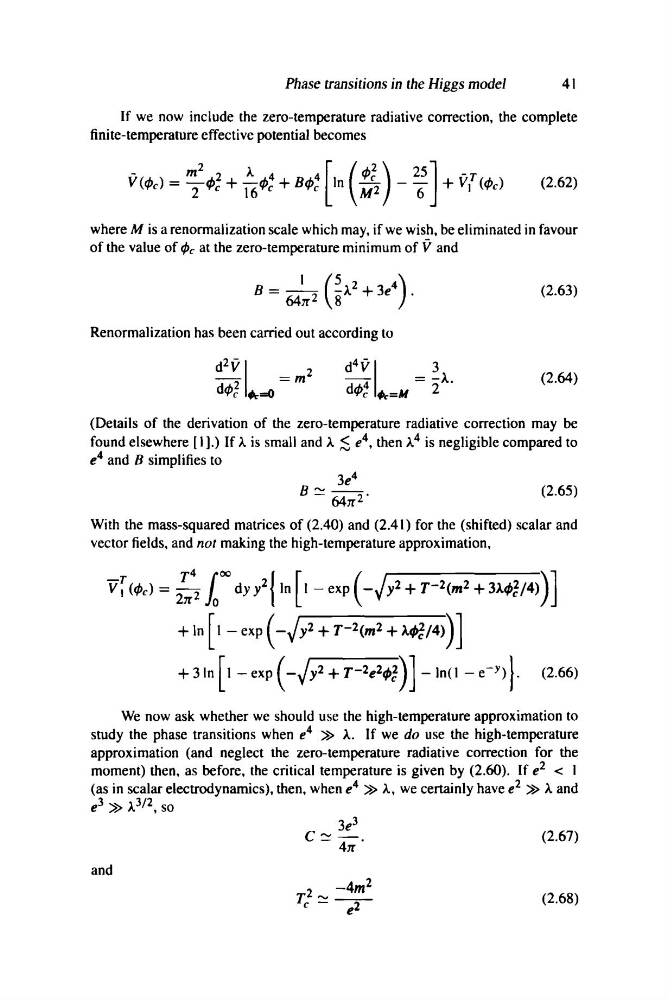
If we now include the zero-temperature radiative correction. the complete
finite-temperature effective potential becomes
2
-
m 2
A 4
4 [ ( tP~ ) 25] - T
(2.62)
V(tPc) = TtPc + 16tPc + BtPc In M2 -"6 + VI (tPc)
where M is a renormalization scale which may. if we wish. be eliminated in favour
of the value of tPc at the zero-temperature minimum of Y and
B=_I (5 2 )
(2.63)
64rr 2 SA + 3e 4 •
Renormalization has been carried out according to
d4YI
3
d
2
y I = m 2
(2.64)
dtP; .. =0
dtP: ,,=M = 2 A.
(Details of the derivation of the zero-temperature radiative correction may be
found elsewhere [1 ].) If A is small and A ~ e 4 • then A 4 is negligible compared to
e 4 and B simplifies to
3e 4
B ~ - 2 '
(2.65)
64rr
With the mass-squared matrices of (2.40) and (2.41) for the (shifted) scalar and
vector fields. and not making the high-temperature approximation.
V r (tPc) = ~421ooo dy i { In [1 - exp ( -J y2 + T-2(m 2 + 3AtPU4) ) ]
+ In [I -exp ( -J y2 + T-2(m 2 + AtPU4») ]
+ 31n [I -exp ( _Jy2 + T-2e2tP~)] -In(1 - e- Y )}. (2.66)
We now ask whether we should use the high-temperature approximation to
study the phase transitions when e 4 » A. If we do use the high-temperature
approximation (and neglect the zero-temperature radiative correction for the
moment) then. as before. the critical temperature is given by (2.60). If e 2 < I
(as in scalar electrodynamics). then, when e 4 » A, we certainly have e 2 » A and
e 3 » A 3 / 2 , so
c ~ 3e 3
(2.67)
4rr .
and
r2", -4m 2
c -
-
(2.68)
e 2
41
If we now include the zero-temperature radiative correction. the complete
finite-temperature effective potential becomes
2
-
m 2
A 4
4 [ ( tP~ ) 25] - T
(2.62)
V(tPc) = TtPc + 16tPc + BtPc In M2 -"6 + VI (tPc)
where M is a renormalization scale which may. if we wish. be eliminated in favour
of the value of tPc at the zero-temperature minimum of Y and
B=_I (5 2 )
(2.63)
64rr 2 SA + 3e 4 •
Renormalization has been carried out according to
d4YI
3
d
2
y I = m 2
(2.64)
dtP; .. =0
dtP: ,,=M = 2 A.
(Details of the derivation of the zero-temperature radiative correction may be
found elsewhere [1 ].) If A is small and A ~ e 4 • then A 4 is negligible compared to
e 4 and B simplifies to
3e 4
B ~ - 2 '
(2.65)
64rr
With the mass-squared matrices of (2.40) and (2.41) for the (shifted) scalar and
vector fields. and not making the high-temperature approximation.
V r (tPc) = ~421ooo dy i { In [1 - exp ( -J y2 + T-2(m 2 + 3AtPU4) ) ]
+ In [I -exp ( -J y2 + T-2(m 2 + AtPU4») ]
+ 31n [I -exp ( _Jy2 + T-2e2tP~)] -In(1 - e- Y )}. (2.66)
We now ask whether we should use the high-temperature approximation to
study the phase transitions when e 4 » A. If we do use the high-temperature
approximation (and neglect the zero-temperature radiative correction for the
moment) then. as before. the critical temperature is given by (2.60). If e 2 < I
(as in scalar electrodynamics). then, when e 4 » A, we certainly have e 2 » A and
e 3 » A 3 / 2 , so
c ~ 3e 3
(2.67)
4rr .
and
r2", -4m 2
c -
-
(2.68)
e 2