

40
Phase transitions in the early universe
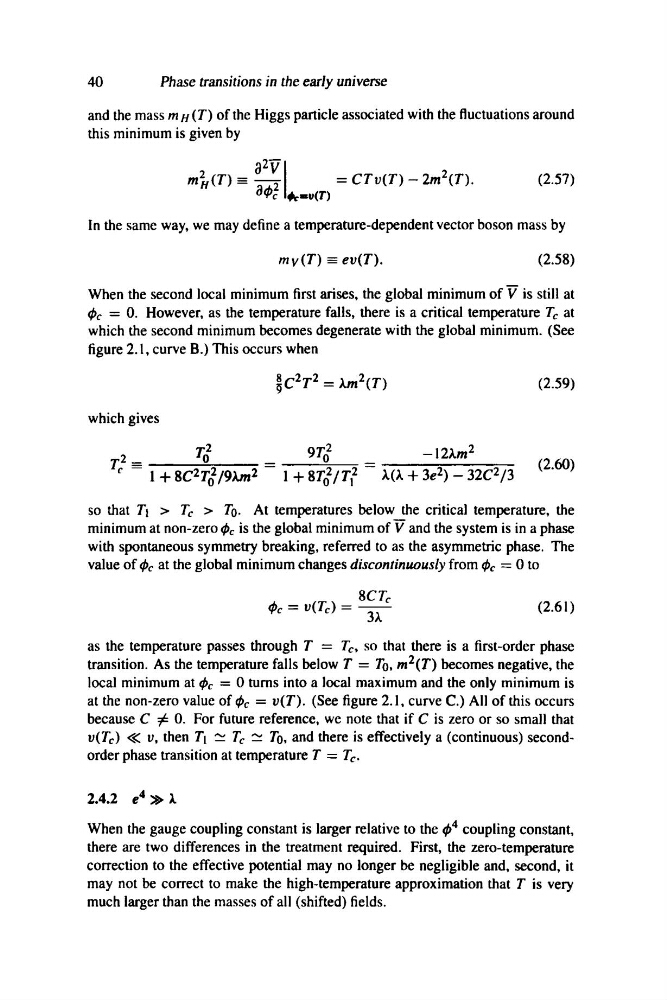
and the mass m H (T) of the Higgs particle associated with the fluctuations around
this minimum is given by
m~(T) ==
2
- 2
a2vI
= CTv(T) - 2m (T).
(2.57)
atPc ~-u(T)
In the same way. we may define a temperature-dependent vector boson mass by
mv(T) == ev(T).
(2.58)
When the second local minimum first arises. the global minimum of V is still at
tPc = O. However. as the temperature falls. there is a critical temperature Tc at
which the second minimum becomes degenerate with the global minimum. (See
figure 2.1. curve B.) This occurs when
&C 2 T2 = l.m2(T)
(2.59)
which gives
T2 =
TJ
_
9TJ
_
-12Am2
c - 1 + 8C2TJ/9l.m2 - 1+ 8TJ/Tl - A(A + 3e2) _ 32C2/3
(2.60)
so that TI > Tc > To. At temperatures below the critical temperature. the
minimum at non-zero tPc is the global minimum of V and the system is in a phase
with spontaneous symmetry breaking. referred to as the asymmetric phase. The
value of tPc at the global minimum changes discontinuously from tPc = 0 to
tPc = v(TC> = 8CT c
(2.61)
3A
as the temperature passes through T = Tc. so that there is a first-order phase
transition. As the temperature falls below T = To. m 2 (T) becomes negative. the
local minimum at tPc = 0 turns into a local maximum and the only minimum is
at the non-zero value of tPc = veT). (See figure 2.1. curve C.) All of this occurs
because C #: O. For future reference. we note that if C is zero or so small that
v(Tc) « v. then TI ~ Tc ~ To. and there is effectively a (continuous) secondorder phase transition at temperature T = Tc.
2.4.2 e 4 » l.
When the gauge coupling constant is larger relative to the tP4 coupling constant,
there are two differences in the treatment required. First, the zero-temperature
correction to the effective potential may no longer be negligible and, second, it
may not be correct to make the high-temperature approximation that T is very
much larger than the masses of all (shifted) fields.
Phase transitions in the early universe
and the mass m H (T) of the Higgs particle associated with the fluctuations around
this minimum is given by
m~(T) ==
2
- 2
a2vI
= CTv(T) - 2m (T).
(2.57)
atPc ~-u(T)
In the same way. we may define a temperature-dependent vector boson mass by
mv(T) == ev(T).
(2.58)
When the second local minimum first arises. the global minimum of V is still at
tPc = O. However. as the temperature falls. there is a critical temperature Tc at
which the second minimum becomes degenerate with the global minimum. (See
figure 2.1. curve B.) This occurs when
&C 2 T2 = l.m2(T)
(2.59)
which gives
T2 =
TJ
_
9TJ
_
-12Am2
c - 1 + 8C2TJ/9l.m2 - 1+ 8TJ/Tl - A(A + 3e2) _ 32C2/3
(2.60)
so that TI > Tc > To. At temperatures below the critical temperature. the
minimum at non-zero tPc is the global minimum of V and the system is in a phase
with spontaneous symmetry breaking. referred to as the asymmetric phase. The
value of tPc at the global minimum changes discontinuously from tPc = 0 to
tPc = v(TC> = 8CT c
(2.61)
3A
as the temperature passes through T = Tc. so that there is a first-order phase
transition. As the temperature falls below T = To. m 2 (T) becomes negative. the
local minimum at tPc = 0 turns into a local maximum and the only minimum is
at the non-zero value of tPc = veT). (See figure 2.1. curve C.) All of this occurs
because C #: O. For future reference. we note that if C is zero or so small that
v(Tc) « v. then TI ~ Tc ~ To. and there is effectively a (continuous) secondorder phase transition at temperature T = Tc.
2.4.2 e 4 » l.
When the gauge coupling constant is larger relative to the tP4 coupling constant,
there are two differences in the treatment required. First, the zero-temperature
correction to the effective potential may no longer be negligible and, second, it
may not be correct to make the high-temperature approximation that T is very
much larger than the masses of all (shifted) fields.