

Entropy of black holes
283
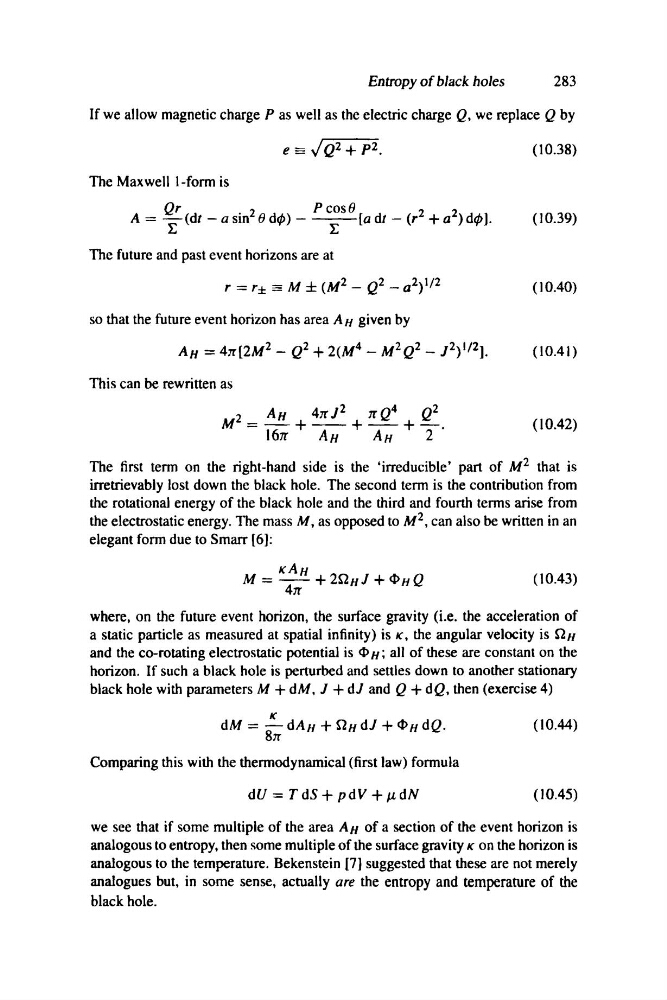
If we allow magnetic charge P as well as the electric charge Q, we replace Q by
e == JQ2+ p2.
(10.38)
The Maxwell I-fonn is
Qr
. 2
P cos(J
2
2
A = -(dt -aslO (Jdcp) - --[adt - (r +a )dcp].
(10.39)
1:
1:
The future and past event horizons are at
r = r± == M ± (M 2 _ Q2 _ a 2 )1/2
(10.40)
so that the future event horizon has area AH given by
AH = 41l'[2M 2 - Q2 + 2(M 4 _ M2Q2 _ J2)1/2].
(10.41 )
This can be rewritten as
2
AH
41l' J2
1l'Q4
Q2
M =-+--+-+-.
(10.42)
161l'
AH
AH
2
The first tenn on the right-hand side is the 'irreducible' part of M2 that is
irretrievably lost down the black hole. The second tenn is the contribution from
the rotational energy of the black hole and the third and fourth tenns arise from
the electrostatic energy. The mass M, as opposed to M2, can also be written in an
elegant fonn due to Smarr [6]:
M = -
KAH +20HJ +HQ
(10.43)
41l'
Where, on the future event horizon, the surface gravity (i.e. the acceleration of
a static particle as measured at spatial infinity) is K, the angular velocity is 0 H
and the co-rotating electrostatic potential is H; all of these are constant on the
horizon. If such a black hole is perturbed and settles down to another stationary
black hole with parameters M + dM, J + dJ and Q + dQ, then (exercise 4)
K
dM = 81l' dAH + OH dJ +H dQ.
(10.44)
Comparing this with the thermodynamical (first law) formula
dU = T dS + P d V + IL dN
(10.45)
we see that if some multiple of the area AH of a section of the event horizon is
analogous to entropy, then some multiple of the surface gravity K on the horizon is
analogous to the temperature. Bekenstein [7] suggested that these are not merely
analogues but, in some sense, actually are the entropy and temperature of the
black hole.
283
If we allow magnetic charge P as well as the electric charge Q, we replace Q by
e == JQ2+ p2.
(10.38)
The Maxwell I-fonn is
Qr
. 2
P cos(J
2
2
A = -(dt -aslO (Jdcp) - --[adt - (r +a )dcp].
(10.39)
1:
1:
The future and past event horizons are at
r = r± == M ± (M 2 _ Q2 _ a 2 )1/2
(10.40)
so that the future event horizon has area AH given by
AH = 41l'[2M 2 - Q2 + 2(M 4 _ M2Q2 _ J2)1/2].
(10.41 )
This can be rewritten as
2
AH
41l' J2
1l'Q4
Q2
M =-+--+-+-.
(10.42)
161l'
AH
AH
2
The first tenn on the right-hand side is the 'irreducible' part of M2 that is
irretrievably lost down the black hole. The second tenn is the contribution from
the rotational energy of the black hole and the third and fourth tenns arise from
the electrostatic energy. The mass M, as opposed to M2, can also be written in an
elegant fonn due to Smarr [6]:
M = -
KAH +20HJ +
(10.43)
41l'
Where, on the future event horizon, the surface gravity (i.e. the acceleration of
a static particle as measured at spatial infinity) is K, the angular velocity is 0 H
and the co-rotating electrostatic potential is H; all of these are constant on the
horizon. If such a black hole is perturbed and settles down to another stationary
black hole with parameters M + dM, J + dJ and Q + dQ, then (exercise 4)
K
dM = 81l' dAH + OH dJ +
(10.44)
Comparing this with the thermodynamical (first law) formula
dU = T dS + P d V + IL dN
(10.45)
we see that if some multiple of the area AH of a section of the event horizon is
analogous to entropy, then some multiple of the surface gravity K on the horizon is
analogous to the temperature. Bekenstein [7] suggested that these are not merely
analogues but, in some sense, actually are the entropy and temperature of the
black hole.