

282
Black holes in string theory
With modest assumptions about causality, it can be shown that the only static
(single) black-hole solution of the Einstein field equations is the (spberically
symmetric) Schwarzchild solution given in (10.2).
This result can be generalized to black holes with electric charge Q by
solving the Einstein-Maxwell equations. They are derived from the action
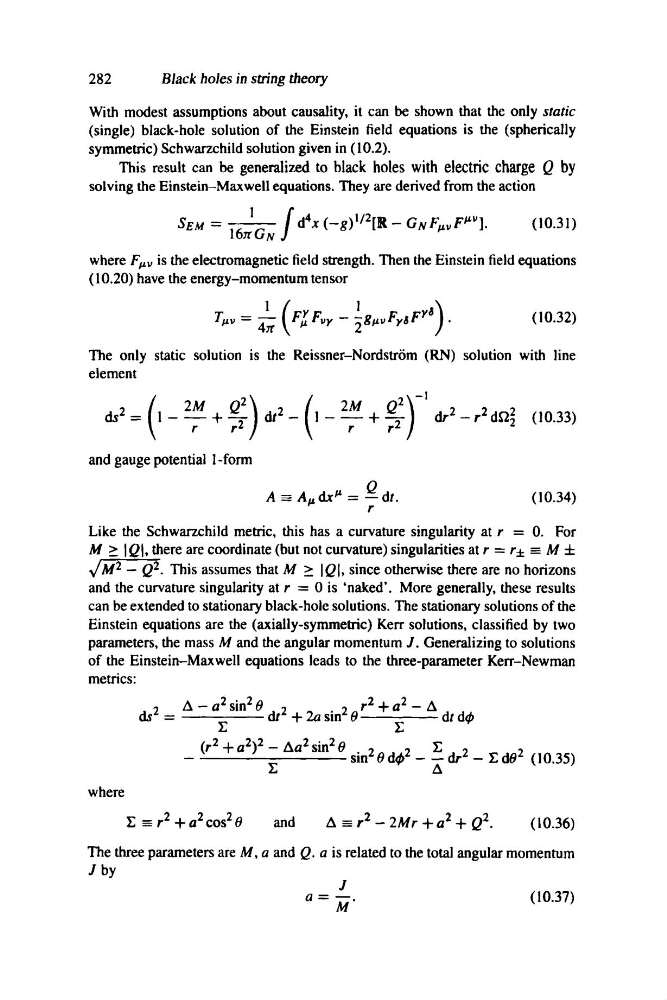
SEM = ., I ~ f d 4 x (_g)1/2[R - GNFJ",FJLI'). (10.31)
where F /LV is the electromagnetic field strength. Then the Einstein field equations
(10.20) have the energy-momentum tensor
1 ( y
I
y&)
T/Lv = 4", Fp. Flly - "2 g p.vFy &F •
(10.32)
The only static solution is the Reissner-Nordstrom (RN) solution with line
element
2
2M
Q
2
2M
Q
2
2
2
ds = ( I - - + - 2) dt - ( I - - + - 2)-1 dr - , d0 2 (10.33)
, , 2
, , 2
and gauge potential I-form
A == Ap.dxP. = Q , dt.
(10.34)
Like the Schwarzchild metric, this has a curvature singularity at, = O. For
M > I QI, there are coordinate (but not curvature) singularities at , = , ± == M ±
,1M2 - Q2. This assumes that M ~ IQI, since otherwise there are no horizons
and the curvature singularity at , = 0 is 'naked'. More generally, these results
can be extended to stationary black-hole solutions. The stationary solutions of the
Einstein equations are the (axially-symmetric) Kerr solutions, classified by two
parameters, the mass M and the angular momentum J. Generalizing to solutions
of the Einstein-Maxwell equations leads to the three-parameter Kerr-Newman
metrics:
2 . 2 (J
,2 + a2 - !J,.
2 _ !J,. - a san dt2 + 2a sin2 (J
dt dq,
ds1:
1:
(,2 + a 2 )2 - !J,.a 2 sin 2 (J sin2 (J dq,2 _ 1: dr2 _ 1: de2 (10.35)
-
!J,.
where
1: == ,2 + a 2 cos 2 (J and !J,. ==,2 _ 2M, +a 2 + Q2. (10.36)
The three parameters are M, a and Q. a is related to the total angular momentum
Jby
J
(10.37)
a= M'
Black holes in string theory
With modest assumptions about causality, it can be shown that the only static
(single) black-hole solution of the Einstein field equations is the (spberically
symmetric) Schwarzchild solution given in (10.2).
This result can be generalized to black holes with electric charge Q by
solving the Einstein-Maxwell equations. They are derived from the action
SEM = ., I ~ f d 4 x (_g)1/2[R - GNFJ",FJLI'). (10.31)
where F /LV is the electromagnetic field strength. Then the Einstein field equations
(10.20) have the energy-momentum tensor
1 ( y
I
y&)
T/Lv = 4", Fp. Flly - "2 g p.vFy &F •
(10.32)
The only static solution is the Reissner-Nordstrom (RN) solution with line
element
2
2M
Q
2
2M
Q
2
2
2
ds = ( I - - + - 2) dt - ( I - - + - 2)-1 dr - , d0 2 (10.33)
, , 2
, , 2
and gauge potential I-form
A == Ap.dxP. = Q , dt.
(10.34)
Like the Schwarzchild metric, this has a curvature singularity at, = O. For
M > I QI, there are coordinate (but not curvature) singularities at , = , ± == M ±
,1M2 - Q2. This assumes that M ~ IQI, since otherwise there are no horizons
and the curvature singularity at , = 0 is 'naked'. More generally, these results
can be extended to stationary black-hole solutions. The stationary solutions of the
Einstein equations are the (axially-symmetric) Kerr solutions, classified by two
parameters, the mass M and the angular momentum J. Generalizing to solutions
of the Einstein-Maxwell equations leads to the three-parameter Kerr-Newman
metrics:
2 . 2 (J
,2 + a2 - !J,.
2 _ !J,. - a san dt2 + 2a sin2 (J
dt dq,
ds1:
1:
(,2 + a 2 )2 - !J,.a 2 sin 2 (J sin2 (J dq,2 _ 1: dr2 _ 1: de2 (10.35)
-
!J,.
where
1: == ,2 + a 2 cos 2 (J and !J,. ==,2 _ 2M, +a 2 + Q2. (10.36)
The three parameters are M, a and Q. a is related to the total angular momentum
Jby
J
(10.37)
a= M'