

284
Black holes in string theory
However, if the black hole has a temperature, it should radiate a blackbody spectrum, thereby contradicting the defining property of a black hole that
it can absorb particles or radiation but not emit them. Hawking's resolution of
this paradox noted that this absorption-only property is a feature of the classical
theory of gravitation. He showed that quantum mechanical effects cause black
holes to create and emit particles as if they were hot bodies with a temperature
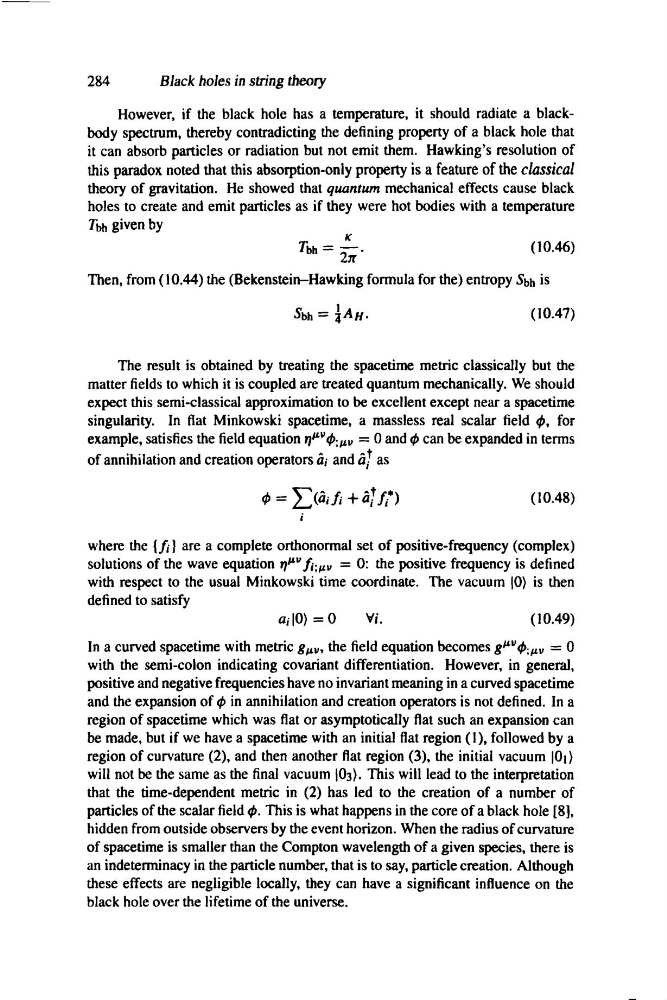
Tbh given by
K
(10.46)
Tbh = 2rr·
Then, from (10.44) the (Bekenstein-Hawking formula for the) entropy Sbh is
Sbh = lAH.
(10.47)
The result is obtained by treating the spacetime metric classically but the
matter fields to which it is coupled are treated quantum mechanically. We should
expect this semi-classical approximation to be excellent except near a spacetime
singularity. In flat Minkowski spacetime, a massless real scalar field tP, for
example, satisfies the field equation ,,110 11 tP:p.lI = ° and tP can be expanded in terms
of annihilation and creation operators a; and a; as
tP = L(a;/; + a; It)
(10.48)
where the {f;} are a complete orthonormal set of positive-frequency (complex)
solutions of the wave equation ,,110 11 /;:11011 = 0: the positive frequency is defined
with respect to the usual Minkowski time coordinate. The vacuum 10) is then
defined to satisfy
Vi.
(10.49)
a;IO) = °
In a curved spacetime with metric gp.II, the field equation becomes gp.II tP:p.II = °
with the semi-colon indicating covariant differentiation. However, in general,
positive and negative frequencies have no invariant meaning in a curved spacetime
and the expansion of tP in annihilation and creation operators is not defined. In a
region of spacetime which was flat or asymptotically flat such an expansion can
be made, but if we have a spacetime with an initial flat region (I), followed by a
region of curvature (2), and then another flat region (3), the initial vacuum 101)
will not be the same as the final vacuum 103). This will lead to the interpretation
that the time-dependent metric in (2) has led to the creation of a number of
particles of the scalar field tP. This is what happens in the core of a black hole [8],
hidden from outside observers by the event horizon. When the radius of curvature
of spacetime is smaller than the Compton wavelength of a given species, there is
an indeterminacy in the particle number, that is to say, particle creation. Although
these effects are negligible locally, they can have a significant influence on the
black hole over the lifetime of the universe.
Black holes in string theory
However, if the black hole has a temperature, it should radiate a blackbody spectrum, thereby contradicting the defining property of a black hole that
it can absorb particles or radiation but not emit them. Hawking's resolution of
this paradox noted that this absorption-only property is a feature of the classical
theory of gravitation. He showed that quantum mechanical effects cause black
holes to create and emit particles as if they were hot bodies with a temperature
Tbh given by
K
(10.46)
Tbh = 2rr·
Then, from (10.44) the (Bekenstein-Hawking formula for the) entropy Sbh is
Sbh = lAH.
(10.47)
The result is obtained by treating the spacetime metric classically but the
matter fields to which it is coupled are treated quantum mechanically. We should
expect this semi-classical approximation to be excellent except near a spacetime
singularity. In flat Minkowski spacetime, a massless real scalar field tP, for
example, satisfies the field equation ,,110 11 tP:p.lI = ° and tP can be expanded in terms
of annihilation and creation operators a; and a; as
tP = L(a;/; + a; It)
(10.48)
where the {f;} are a complete orthonormal set of positive-frequency (complex)
solutions of the wave equation ,,110 11 /;:11011 = 0: the positive frequency is defined
with respect to the usual Minkowski time coordinate. The vacuum 10) is then
defined to satisfy
Vi.
(10.49)
a;IO) = °
In a curved spacetime with metric gp.II, the field equation becomes gp.II tP:p.II = °
with the semi-colon indicating covariant differentiation. However, in general,
positive and negative frequencies have no invariant meaning in a curved spacetime
and the expansion of tP in annihilation and creation operators is not defined. In a
region of spacetime which was flat or asymptotically flat such an expansion can
be made, but if we have a spacetime with an initial flat region (I), followed by a
region of curvature (2), and then another flat region (3), the initial vacuum 101)
will not be the same as the final vacuum 103). This will lead to the interpretation
that the time-dependent metric in (2) has led to the creation of a number of
particles of the scalar field tP. This is what happens in the core of a black hole [8],
hidden from outside observers by the event horizon. When the radius of curvature
of spacetime is smaller than the Compton wavelength of a given species, there is
an indeterminacy in the particle number, that is to say, particle creation. Although
these effects are negligible locally, they can have a significant influence on the
black hole over the lifetime of the universe.