

254
Superstring cosmology
already started to oscillate. If the dilaton field were not to decay then, following
the discussion leading to (8.141), to avoid PS dominating the energy density of
the universe and producing an excessive expansion rate, we need S ;S I O-s. This
is not consistent with our expectation that S will not be very much less than unity
in reduced Planck-scale units. Thus, Ps will dominate the energy density of the
universe. This suggests that there might be a problem with entropy generation in
the realistic case where S decays before T = 2.7 K is reached. Then, following
the logic leading to (8.154), the increase in the entropy of the universe in the
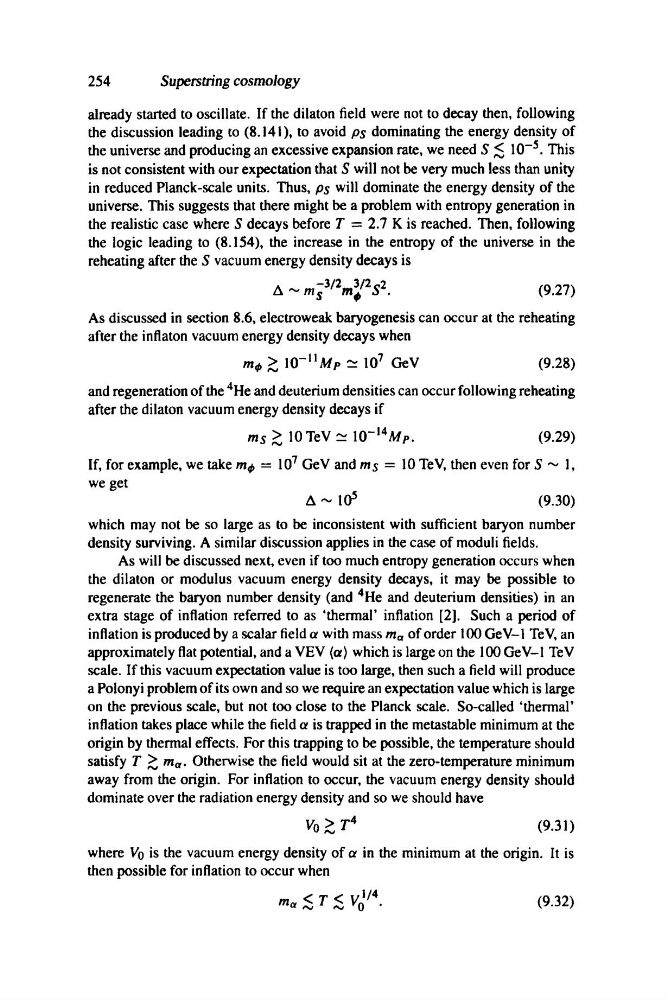
reheating after the S vacuum energy density decays is
..
-3/2 3/2S2
u -m s
(9.27)
m. .
As discussed in section 8.6, electroweak baryogenesis can occur at the reheating
after the inflaton vacuum energy density decays when
m. ~ IO-II Mp ~ 10 7 GeV
(9.28)
and regeneration of the 4He and deuterium densities can occur following reheating
after the dilaton vacuum energy density decays if
ms ~ 10 TeV ~ 10- 14 Mp.
(9.29)
If, for example, we take m. = 10 7 GeV and ms = 10 TeV, then even for S - I,
we get
11 ..... Io!!
(9.30)
which may not be so large as to be inconsistent with sufficient baryon number
density surviving. A similar discussion applies in the case of moduli fields.
As will be discussed next, even if too much entropy generation occurs when
the dilaton or modulus vacuum energy density decays, it may be possible to
regenerate the baryon number density (and 4He and deuterium densities) in an
extra stage of inflation referred to as 'thermal' inflation [2J. Such a period of
inflation is produced by a scalar field a with mass ma of order 100 GeV-I Te V, an
approximately flat potential, and a VEV (a) which is large on the 100 Ge V-I Te V
scale. If this vacuum expectation value is too large, then such a field will produce
a Polonyi problem of its own and so we require an expectation value which is large
on the previous scale, but not too close to the Planck scale. So-called 'thermal'
inflation takes place while the field a is trapped in the metastable minimum at the
origin by thermal effects. For this trapping to be possible, the temperature should
satisfy T ~ ma. Otherwise the field would sit at the zero-temperature minimum
away from the origin. For inflation to occur, the vacuum energy density should
dominate over the radiation energy density and so we should have
Vo ~ T4
(9.31)
where Vo is the vacuum energy density of a in the minimum at the origin. It is
then possible for inflation to occur when
1/4
ma ;S T ;S Vo .
(9.32)
Superstring cosmology
already started to oscillate. If the dilaton field were not to decay then, following
the discussion leading to (8.141), to avoid PS dominating the energy density of
the universe and producing an excessive expansion rate, we need S ;S I O-s. This
is not consistent with our expectation that S will not be very much less than unity
in reduced Planck-scale units. Thus, Ps will dominate the energy density of the
universe. This suggests that there might be a problem with entropy generation in
the realistic case where S decays before T = 2.7 K is reached. Then, following
the logic leading to (8.154), the increase in the entropy of the universe in the
reheating after the S vacuum energy density decays is
..
-3/2 3/2S2
u -m s
(9.27)
m. .
As discussed in section 8.6, electroweak baryogenesis can occur at the reheating
after the inflaton vacuum energy density decays when
m. ~ IO-II Mp ~ 10 7 GeV
(9.28)
and regeneration of the 4He and deuterium densities can occur following reheating
after the dilaton vacuum energy density decays if
ms ~ 10 TeV ~ 10- 14 Mp.
(9.29)
If, for example, we take m. = 10 7 GeV and ms = 10 TeV, then even for S - I,
we get
11 ..... Io!!
(9.30)
which may not be so large as to be inconsistent with sufficient baryon number
density surviving. A similar discussion applies in the case of moduli fields.
As will be discussed next, even if too much entropy generation occurs when
the dilaton or modulus vacuum energy density decays, it may be possible to
regenerate the baryon number density (and 4He and deuterium densities) in an
extra stage of inflation referred to as 'thermal' inflation [2J. Such a period of
inflation is produced by a scalar field a with mass ma of order 100 GeV-I Te V, an
approximately flat potential, and a VEV (a) which is large on the 100 Ge V-I Te V
scale. If this vacuum expectation value is too large, then such a field will produce
a Polonyi problem of its own and so we require an expectation value which is large
on the previous scale, but not too close to the Planck scale. So-called 'thermal'
inflation takes place while the field a is trapped in the metastable minimum at the
origin by thermal effects. For this trapping to be possible, the temperature should
satisfy T ~ ma. Otherwise the field would sit at the zero-temperature minimum
away from the origin. For inflation to occur, the vacuum energy density should
dominate over the radiation energy density and so we should have
Vo ~ T4
(9.31)
where Vo is the vacuum energy density of a in the minimum at the origin. It is
then possible for inflation to occur when
1/4
ma ;S T ;S Vo .
(9.32)