

Dilaton and moduli cosmology
253
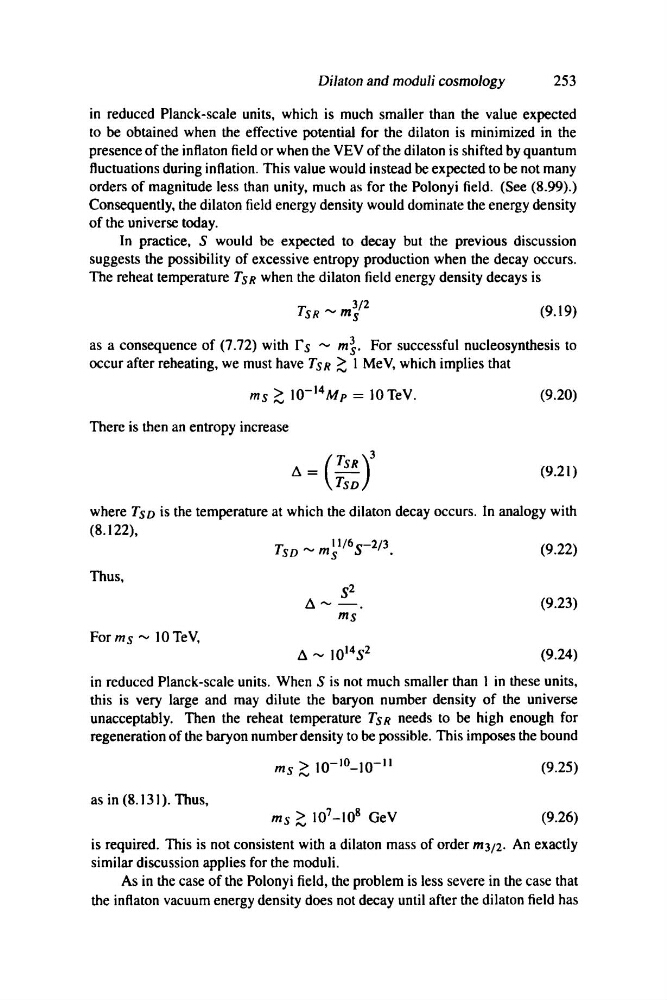
in reduced Planck-scale units, which is much smaller than the value expected
to be obtained when the effective potential for the dilaton is minimized in the
presence of the inflaton field or when the VEV of the dilaton is shifted by quantum
fluctuations during inflation. This value would instead be expected to be not many
orders of magnitude less than unity, much as for the Polonyi field. (See (8.99).)
Consequently, the dilaton field energy density would dominate the energy density
of the universe today.
In practice, S would be expected to decay but the previous discussion
suggests the possibility of excessive entropy production when the decay occurs.
The reheat temperature TSR when the dilaton field energy density decays is
TSR '" m 3
S / 2
(9.19)
as a consequence of (7.72) with rs '" m~. For successful nucleosynthesis to
occur after reheating, we must have TSR ~ 1 MeV, which implies that
ms ~ 1O- 14 Mp = 10 TeV.
(9.20)
There is then an entropy increase
/);. = (TSR)3
(9.21)
TSD
where TSD is the temperature at which the dilaton decay occurs. In analogy with
(8.122),
TSD '" m ll / 6 S- 2 / 3
S
•
(9.22)
Thus,
/);. '" S2
(9.23)
ms
For ms '" 10 TeV,
/);. '" 1014S2
(9.24)
in reduced Planck-scale units. When S is not much smaller than I in these units,
this is very large and may dilute the baryon number density of the universe
unacceptably. Then the reheat temperature TSR needs to be high enough for
regeneration of the baryon number density to be possible. This imposes the bound
mS ~ 10- 1 °_10- 11
(9.25)
as in (8.131). Thus,
ms ~ 10 7 _10 8 GeV
(9.26)
is required. This is not consistent with a dilaton mass of order m3/2. An exactly
similar discussion applies for the moduli.
As in the case of the Polonyi field, the problem is less severe in the case that
the inflaton vacuum energy density does not decay until after the dilaton field has
253
in reduced Planck-scale units, which is much smaller than the value expected
to be obtained when the effective potential for the dilaton is minimized in the
presence of the inflaton field or when the VEV of the dilaton is shifted by quantum
fluctuations during inflation. This value would instead be expected to be not many
orders of magnitude less than unity, much as for the Polonyi field. (See (8.99).)
Consequently, the dilaton field energy density would dominate the energy density
of the universe today.
In practice, S would be expected to decay but the previous discussion
suggests the possibility of excessive entropy production when the decay occurs.
The reheat temperature TSR when the dilaton field energy density decays is
TSR '" m 3
S / 2
(9.19)
as a consequence of (7.72) with rs '" m~. For successful nucleosynthesis to
occur after reheating, we must have TSR ~ 1 MeV, which implies that
ms ~ 1O- 14 Mp = 10 TeV.
(9.20)
There is then an entropy increase
/);. = (TSR)3
(9.21)
TSD
where TSD is the temperature at which the dilaton decay occurs. In analogy with
(8.122),
TSD '" m ll / 6 S- 2 / 3
S
•
(9.22)
Thus,
/);. '" S2
(9.23)
ms
For ms '" 10 TeV,
/);. '" 1014S2
(9.24)
in reduced Planck-scale units. When S is not much smaller than I in these units,
this is very large and may dilute the baryon number density of the universe
unacceptably. Then the reheat temperature TSR needs to be high enough for
regeneration of the baryon number density to be possible. This imposes the bound
mS ~ 10- 1 °_10- 11
(9.25)
as in (8.131). Thus,
ms ~ 10 7 _10 8 GeV
(9.26)
is required. This is not consistent with a dilaton mass of order m3/2. An exactly
similar discussion applies for the moduli.
As in the case of the Polonyi field, the problem is less severe in the case that
the inflaton vacuum energy density does not decay until after the dilaton field has