

Stabilization of the dilaton
255
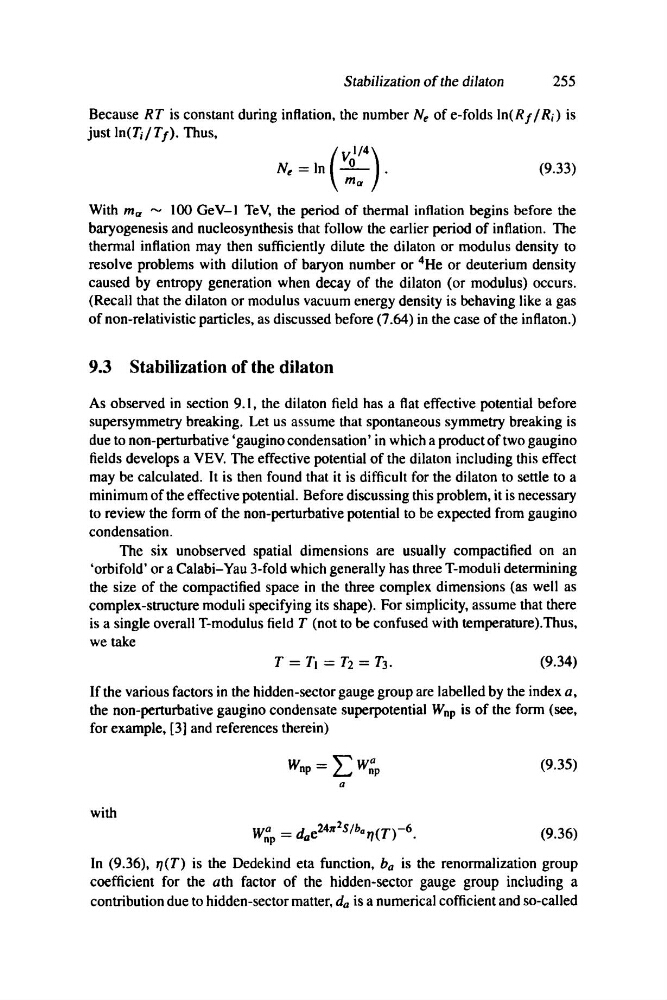
Because RT is constant during inflation, the number Ne of e-folds In(R j / Ri) is
just In(T;/Tj). Thus.
(9.33)
N.=ln(~)
With ma "" 100 GeV-1 TeV, the period of thermal inflation begins before the
baryogenesis and nucleosynthesis that follow the earlier period of inflation. The
thermal inflation may then sufficiently dilute the dilaton or modulus density to
resolve problems with dilution of baryon number or 4He or deuterium density
caused by entropy generation when decay of the dilaton (or modulus) occurs.
(Recall that the dilaton or modulus vacuum energy density is behaving like a gas
of non-relativistic particles, as discussed before (7.64) in the case of the inflaton.)
9.3 Stabilization of the dilaton
As observed in section 9.1, the dilaton field has a flat effective potential before
supersymmetry breaking. Let us assume that spontaneous symmetry breaking is
due to non-perturbative 'gauginocondensation' in which a product of two gaugino
fields develops a VEV. The effective potential of the dilaton including this effect
may be calculated. It is then found that it is difficult for the dilaton to settle to a
minimum of the effective potential. Before discussing this problem, it is necessary
to review the form of the non-perturbative potential to be expected from gaugino
condensation.
The six unobserved spatial dimensions are usually compactified on an
'orbifold' or a Calabi- Yau 3-fold which generally has three T-moduli determining
the size of the compactified space in the three complex dimensions (as well as
complex-structure moduli specifying its shape). For simplicity. assume that there
is a single overall T-modulus field T (not to be confused with temperature).Thus,
we take
T = Tl = T2 = T3.
(9.34)
If the various factors in the hidden-sector gauge group are labelled by the index a,
the non-perturbative gaugino condensate superpotential Wnp is of the form (see,
for example, [3] and references therein)
Wnp = EW:p
(9.35)
a
with
W: p = dae247r2Slbal1(T)-6.
(9.36)
In (9.36), l1(T) is the Dedekind eta function, ha is the renormalization group
coefficient for the ath factor of the hidden-sector gauge group including a
contribution due to hidden-sector matter, d a is a numerical cofficient and so-called
255
Because RT is constant during inflation, the number Ne of e-folds In(R j / Ri) is
just In(T;/Tj). Thus.
(9.33)
N.=ln(~)
With ma "" 100 GeV-1 TeV, the period of thermal inflation begins before the
baryogenesis and nucleosynthesis that follow the earlier period of inflation. The
thermal inflation may then sufficiently dilute the dilaton or modulus density to
resolve problems with dilution of baryon number or 4He or deuterium density
caused by entropy generation when decay of the dilaton (or modulus) occurs.
(Recall that the dilaton or modulus vacuum energy density is behaving like a gas
of non-relativistic particles, as discussed before (7.64) in the case of the inflaton.)
9.3 Stabilization of the dilaton
As observed in section 9.1, the dilaton field has a flat effective potential before
supersymmetry breaking. Let us assume that spontaneous symmetry breaking is
due to non-perturbative 'gauginocondensation' in which a product of two gaugino
fields develops a VEV. The effective potential of the dilaton including this effect
may be calculated. It is then found that it is difficult for the dilaton to settle to a
minimum of the effective potential. Before discussing this problem, it is necessary
to review the form of the non-perturbative potential to be expected from gaugino
condensation.
The six unobserved spatial dimensions are usually compactified on an
'orbifold' or a Calabi- Yau 3-fold which generally has three T-moduli determining
the size of the compactified space in the three complex dimensions (as well as
complex-structure moduli specifying its shape). For simplicity. assume that there
is a single overall T-modulus field T (not to be confused with temperature).Thus,
we take
T = Tl = T2 = T3.
(9.34)
If the various factors in the hidden-sector gauge group are labelled by the index a,
the non-perturbative gaugino condensate superpotential Wnp is of the form (see,
for example, [3] and references therein)
Wnp = EW:p
(9.35)
a
with
W: p = dae247r2Slbal1(T)-6.
(9.36)
In (9.36), l1(T) is the Dedekind eta function, ha is the renormalization group
coefficient for the ath factor of the hidden-sector gauge group including a
contribution due to hidden-sector matter, d a is a numerical cofficient and so-called