

246
Inflation in supergravity
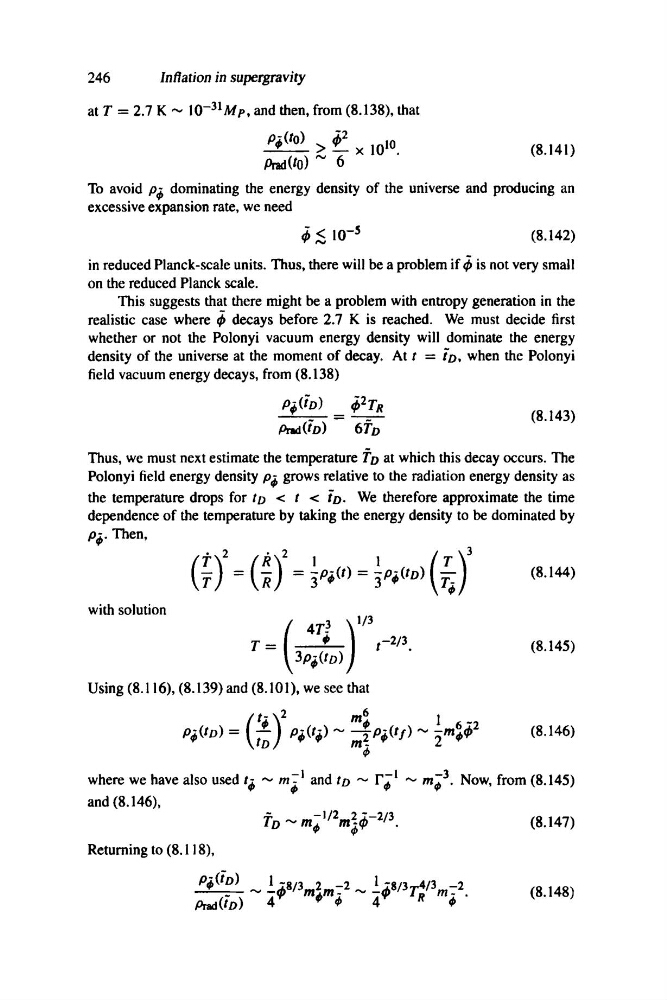
at T = 2.7 K '" 10- 31 Mp, and then, from (8.13S), that
p~(lo) > (';2
10
- -
-xlO.
(8.141)
Prad(tO)"" 6
To avoid p~ dominating the energy density of the universe and producing an
excessive expansion rate, we need
('; ~ 10- 5
(8.142)
in reduced Planck-scale units. Thus, there will be a problem if ('; is not very small
on the reduced Planck scale.
This suggests that there might be a problem with entropy generation in the
realistic case where ('; decays before 2.7 K is reached. We must decide first
whether or not the Polonyi vacuum energy density will dominate the energy
density of the universe at the moment of decay. At I = iD, when the Polonyi
field vacuum energy decays, from (8.13S)
P~(iD)
(';2TR
(S.143)
Pnd(iD ) = 6i D
Thus, we must next estimate the temperature iD at which this decay occurs. The
Polonyi field energy density p~ grows relative to the radiation energy density as
the temperature drops for ID < t < iD. We therefore approximate the time
dependence of the temperature by taking the energy density to be dominated by
p~. Then,
( t)2 (R)2
T )3
I
1
(
(8.144)
T = R = 3P~(t) = 3P~(ID) Tj,
with solution
4T3 )1 / 3
T = (
~
1- 2 / 3 •
(8.145)
3p~(tD)
Using (8.116), (8.139) and (8.101), we see that
( t_)2
1
m6
p~(ID) = .1.. p~(I~) '" -4P~(tf) '" 2'm:(';2
(8.146)
ID
m~
where we have also used t . ' " m~l and ID '" r;l '" m;3. Now, from (8.145)
and (8.146),
iD'" m -1/2m~;;-2/3
(8.147)
~
~."
.
Returning to (8.1 IS),
p.(i D ) '" ~ -S/3 2 -2 '" ~ -S/3T~J3 -2
(S.148)
Pnd(i D ) 44' m;m~
44' R m~ .
Inflation in supergravity
at T = 2.7 K '" 10- 31 Mp, and then, from (8.13S), that
p~(lo) > (';2
10
- -
-xlO.
(8.141)
Prad(tO)"" 6
To avoid p~ dominating the energy density of the universe and producing an
excessive expansion rate, we need
('; ~ 10- 5
(8.142)
in reduced Planck-scale units. Thus, there will be a problem if ('; is not very small
on the reduced Planck scale.
This suggests that there might be a problem with entropy generation in the
realistic case where ('; decays before 2.7 K is reached. We must decide first
whether or not the Polonyi vacuum energy density will dominate the energy
density of the universe at the moment of decay. At I = iD, when the Polonyi
field vacuum energy decays, from (8.13S)
P~(iD)
(';2TR
(S.143)
Pnd(iD ) = 6i D
Thus, we must next estimate the temperature iD at which this decay occurs. The
Polonyi field energy density p~ grows relative to the radiation energy density as
the temperature drops for ID < t < iD. We therefore approximate the time
dependence of the temperature by taking the energy density to be dominated by
p~. Then,
( t)2 (R)2
T )3
I
1
(
(8.144)
T = R = 3P~(t) = 3P~(ID) Tj,
with solution
4T3 )1 / 3
T = (
~
1- 2 / 3 •
(8.145)
3p~(tD)
Using (8.116), (8.139) and (8.101), we see that
( t_)2
1
m6
p~(ID) = .1.. p~(I~) '" -4P~(tf) '" 2'm:(';2
(8.146)
ID
m~
where we have also used t . ' " m~l and ID '" r;l '" m;3. Now, from (8.145)
and (8.146),
iD'" m -1/2m~;;-2/3
(8.147)
~
~."
.
Returning to (8.1 IS),
p.(i D ) '" ~ -S/3 2 -2 '" ~ -S/3T~J3 -2
(S.148)
Pnd(i D ) 44' m;m~
44' R m~ .