

The Polonyj problem
245
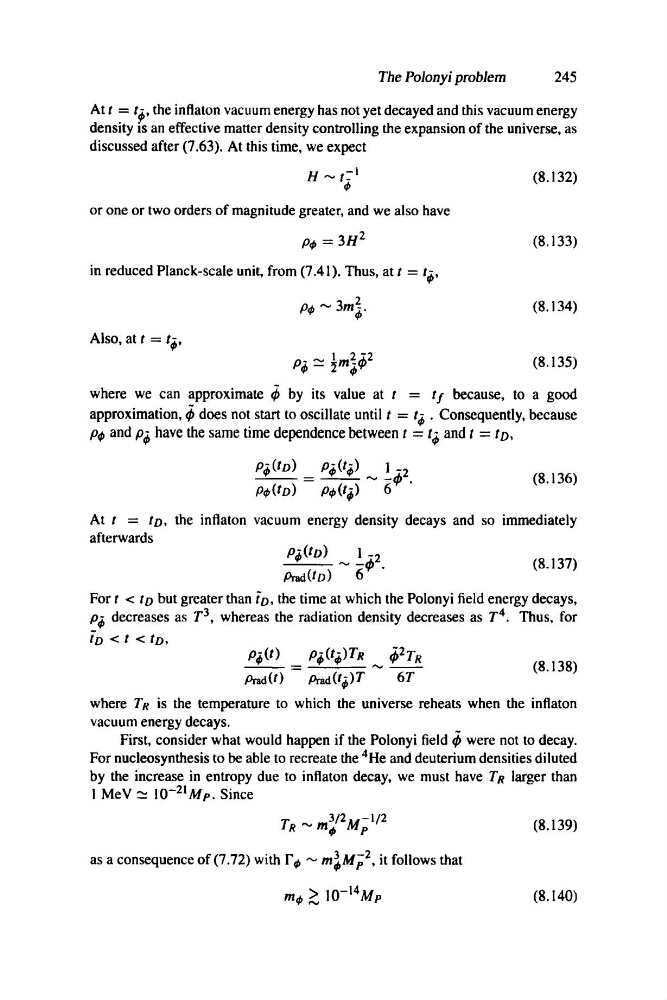
At t = t~, the inflaton vacuum energy has not yet decayed and this vacuum energy
density IS an effective matter density controlling the expansion of the universe, as
discussed after (7.63). At this time, we expect
H '" t:- I
(8.132)
~
or one or two orders of magnitude greater, and we also have
PIP = 3H 2
(8.133)
in reduced Planck-scale unit, from (7.41). Thus, at t = t~,
PIP '" 3m~.
(8.134)
Also, at t = t.,
P _ '" Im2 .J;2
(8.135)
IP-l.'"
where we can approximate ij) by its value at t = t f because, to a good
approximation, ij) does not start to oscillate until t = t~ . Consequently, because
PI/J and P~ have the same time dependence between I = I~ and I = ID,
p~(to)
p~(t~)
I -2
--=-"'-" .
(8.136)
PIP (to)
PI/J(t.)
6
At t = to. the inftaton vacuum energy density decays and so immediately
afterwards
p.(to)
I -2
(8.137)
Prad(tD) '" "6" .
For t < tD but greater than iD. the time at which the Polonyi field energy decays,
P~ decreases as T3. whereas the radiation density decreases as T4. Thus, for
iD < t < to,
p~(t)
p~(t~)TR
ij)2TR
(8.138)
Prad(t) = Prad(t~)T '" ~
where TR is the temperature to which the universe reheats when the inftaton
vacuum energy decays.
First, consider what would happen if the Polonyi field ij) were not to decay.
For nucleosynthesis to be able to recreate the 4He and deuterium densities diluted
by the increase in entropy due to inftaton decay, we must have TR larger than
I MeV:::: IO- 21 Mp. Since
TR .... m 3 / 2 M- 1 / 2
(8.139)
~
p
as a consequence of (7.72) with r ~ '" m~Mp2, it follows that
m~ ~ IO- 14 Mp
(8.140)
245
At t = t~, the inflaton vacuum energy has not yet decayed and this vacuum energy
density IS an effective matter density controlling the expansion of the universe, as
discussed after (7.63). At this time, we expect
H '" t:- I
(8.132)
~
or one or two orders of magnitude greater, and we also have
PIP = 3H 2
(8.133)
in reduced Planck-scale unit, from (7.41). Thus, at t = t~,
PIP '" 3m~.
(8.134)
Also, at t = t.,
P _ '" Im2 .J;2
(8.135)
IP-l.'"
where we can approximate ij) by its value at t = t f because, to a good
approximation, ij) does not start to oscillate until t = t~ . Consequently, because
PI/J and P~ have the same time dependence between I = I~ and I = ID,
p~(to)
p~(t~)
I -2
--=-"'-" .
(8.136)
PIP (to)
PI/J(t.)
6
At t = to. the inftaton vacuum energy density decays and so immediately
afterwards
p.(to)
I -2
(8.137)
Prad(tD) '" "6" .
For t < tD but greater than iD. the time at which the Polonyi field energy decays,
P~ decreases as T3. whereas the radiation density decreases as T4. Thus, for
iD < t < to,
p~(t)
p~(t~)TR
ij)2TR
(8.138)
Prad(t) = Prad(t~)T '" ~
where TR is the temperature to which the universe reheats when the inftaton
vacuum energy decays.
First, consider what would happen if the Polonyi field ij) were not to decay.
For nucleosynthesis to be able to recreate the 4He and deuterium densities diluted
by the increase in entropy due to inftaton decay, we must have TR larger than
I MeV:::: IO- 21 Mp. Since
TR .... m 3 / 2 M- 1 / 2
(8.139)
~
p
as a consequence of (7.72) with r ~ '" m~Mp2, it follows that
m~ ~ IO- 14 Mp
(8.140)