

244
Inflation in supergravity
Table 8.2. Event sequence when oscillations of the Polonyi field begin before the inflaton
vacuum energy density has decayed.
Time (t)
p.(t) p~(t)
Prad(t)
t/
_,-2
_,-2
::::::p.
0
0
r- I
t =to '" •
.... Prad(to)
tD < t < to - rit 0
_13
1
3/2 M -I/2
R-m.
p
_r4
t =io - r:-I
P~(iD) .... radiation
~
TR - m~2M;1/2
Whenever ;p is not very much greater than I in reduced Planck-scale units, this
is large and may dilute the baryon number density of the universe unacceptably.
In that case, a reheat temperature T R large enough to recreate the required baryon
number density is needed. For low-temperature baryogenesis,
TR ~ lOO GeV ~ 1O- 16 Mp
(8.130)
is required and, using (8.126), this imposes the bound
m - > 10- 1 °_10- 11
(8.131)
.' " .
In the model being studied here, m~ '" 10- 8 using (8.103), (8.104) and (8.89) and
so it should be possible to regenerate the baryon number by a low-temperature
mechanism. However, for other types of light fields with only gravitational
strength interactions, their masses may be too small for the entropy generation
problem to be solved in this way (and the entropy generation may also be larger).
8.6.2 Inflaton decays after Polonyi field oscillation
We consider next the alternative possibility [13, 14J that the inflaton vacuum
density does not decay until after the Polonyi field has already started to oscillate.
This might result in too low a reheating temperature to regenerate the baryon
number of the universe except with a low-temperature baryogenesis mechanism.
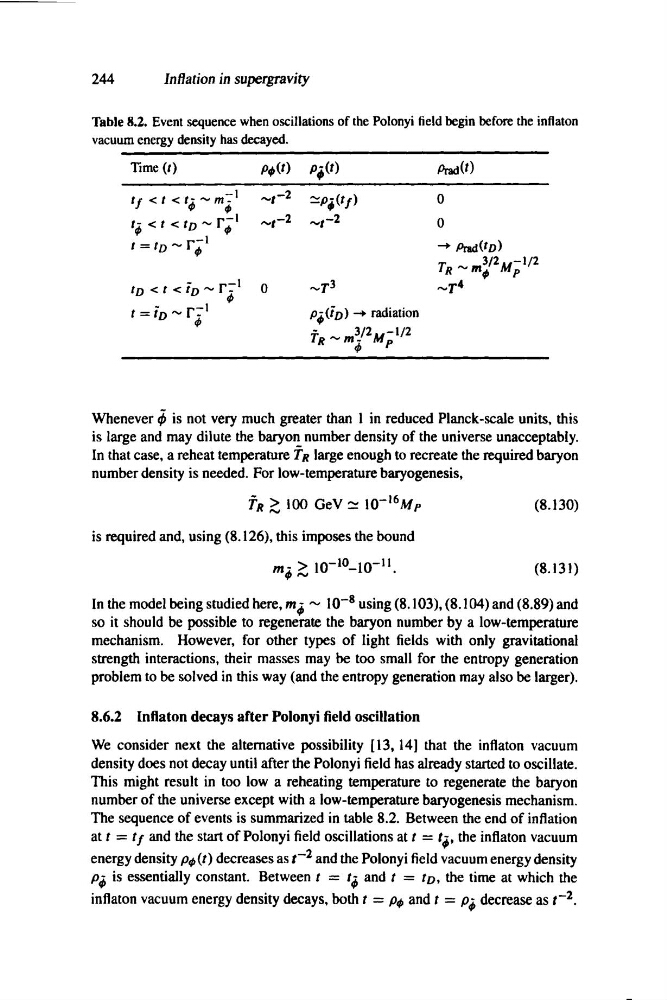
The sequence of events is summarized in table 8.2. Between the end of inflation
at t = t / and the start of Polonyi field oscillations at t = '.' the inflaton vacuum
energy density p~(t) decreases as ,-2 and the Polonyi field vacuum energy density
p~ is essentially constant. Between t = t~ and t = to, the time at which the
inflaton vacuum energy density decays, both t = p. and t = p~ decrease as ,-2.
Inflation in supergravity
Table 8.2. Event sequence when oscillations of the Polonyi field begin before the inflaton
vacuum energy density has decayed.
Time (t)
p.(t) p~(t)
Prad(t)
t/
_,-2
_,-2
::::::p.
0
0
r- I
t =to '" •
.... Prad(to)
tD < t < to - rit 0
_13
1
3/2 M -I/2
R-m.
p
_r4
t =io - r:-I
P~(iD) .... radiation
~
TR - m~2M;1/2
Whenever ;p is not very much greater than I in reduced Planck-scale units, this
is large and may dilute the baryon number density of the universe unacceptably.
In that case, a reheat temperature T R large enough to recreate the required baryon
number density is needed. For low-temperature baryogenesis,
TR ~ lOO GeV ~ 1O- 16 Mp
(8.130)
is required and, using (8.126), this imposes the bound
m - > 10- 1 °_10- 11
(8.131)
.' " .
In the model being studied here, m~ '" 10- 8 using (8.103), (8.104) and (8.89) and
so it should be possible to regenerate the baryon number by a low-temperature
mechanism. However, for other types of light fields with only gravitational
strength interactions, their masses may be too small for the entropy generation
problem to be solved in this way (and the entropy generation may also be larger).
8.6.2 Inflaton decays after Polonyi field oscillation
We consider next the alternative possibility [13, 14J that the inflaton vacuum
density does not decay until after the Polonyi field has already started to oscillate.
This might result in too low a reheating temperature to regenerate the baryon
number of the universe except with a low-temperature baryogenesis mechanism.
The sequence of events is summarized in table 8.2. Between the end of inflation
at t = t / and the start of Polonyi field oscillations at t = '.' the inflaton vacuum
energy density p~(t) decreases as ,-2 and the Polonyi field vacuum energy density
p~ is essentially constant. Between t = t~ and t = to, the time at which the
inflaton vacuum energy density decays, both t = p. and t = p~ decrease as ,-2.