

The Polonyj problem
247
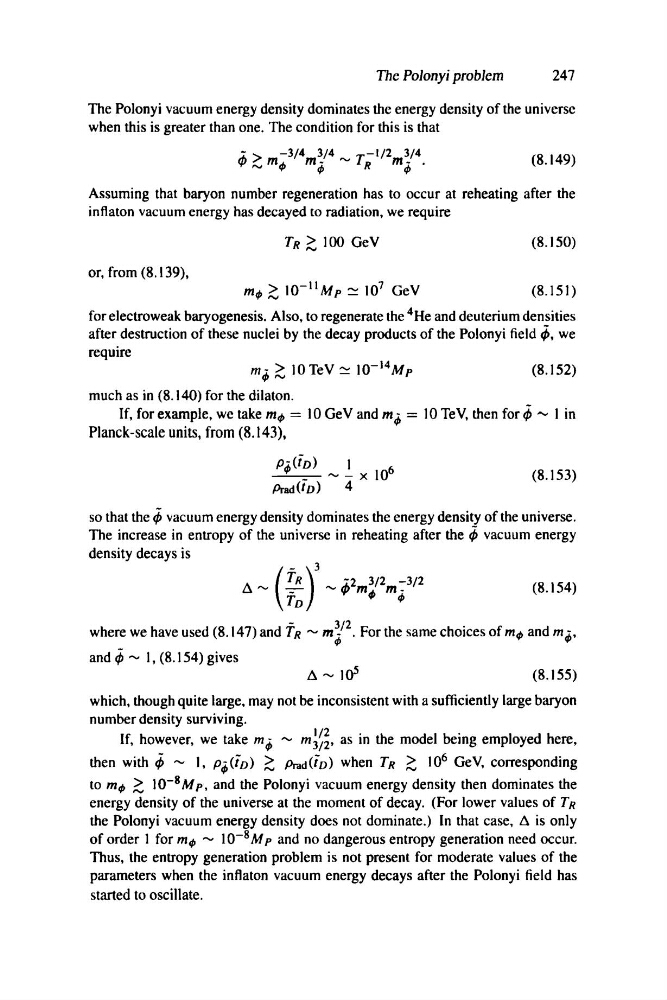
The Polonyi vacuum energy density dominates the energy density of the universe
when this is greater than one. The condition for this is that
~ > m- 3/ 4m3/ 4 _ T-1/2 3/4
(8.149)
"" ~
~
R
m~.
Assuming that baryon number regeneration has to occur at reheating after the
inflaton vacuum energy has decayed to radiation. we require
TR ~ lOO GeV
(8.150)
or. from (8.139).
m >IO- II M -10 7 GeV
(8.151)
I/J ""
Pfor electroweak baryogenesis. Also. to regenerate the 4He and deuterium densities
after destruction of these nuclei by the decay products of the Polonyi field ~. we
require
m~ ~ IOTeV ~ 1O- 14 Mp
(8.152)
much as in (8.140) for the dilaton.
If. for example. we take ml/J = 10 GeV and m~ = 10 TeV. then for ~ '" I in
Planek-scale units. from (8.143).
P~(tD)
1
6
----!...-_=__ -
-
x 10
(8.153)
Prad(tD)
4
so that the ~ vacuum energy density dominates the energy density of the universe.
The increase in entropy of the universe in reheating after the ~ vacuum energy
density decays is
A
(TR)3 ;'2 3/2 -3/2
u '"
-::'" ." m. m(8.154)
TD
I/J
-
3/2
where we have used (8.147) and TR '" m ~ . For the same choices of ml/J and m~.
and ~ '" I. (8.154) gives
l1 '" 105
(8.155)
which. though quite large. may not be inconsistent with a sufficiently large baryon
number density surviving.
If. however. we take m~ '" m~~~. as in the model being employed here.
then with ~ '" I. P~(iD) ~ Prad(tD) when TR ~ 106 GeV. corresponding
to m~ ~ 10- 8 Mp. and the Polonyi vacuum energy density then dominates the
energy density of the universe at the moment of decay. (For lower values of TR
the Polonyi vacuum energy density does not dominate.) In that case. l1 is only
of order I for m I/J '" 10- 8 M p and no dangerous entropy generation need occur.
Thus. the entropy generation problem is not present for moderate values of the
parameters when the inflaton vacuum energy decays after the Polonyi field has
started to oscillate.
247
The Polonyi vacuum energy density dominates the energy density of the universe
when this is greater than one. The condition for this is that
~ > m- 3/ 4m3/ 4 _ T-1/2 3/4
(8.149)
"" ~
~
R
m~.
Assuming that baryon number regeneration has to occur at reheating after the
inflaton vacuum energy has decayed to radiation. we require
TR ~ lOO GeV
(8.150)
or. from (8.139).
m >IO- II M -10 7 GeV
(8.151)
I/J ""
Pfor electroweak baryogenesis. Also. to regenerate the 4He and deuterium densities
after destruction of these nuclei by the decay products of the Polonyi field ~. we
require
m~ ~ IOTeV ~ 1O- 14 Mp
(8.152)
much as in (8.140) for the dilaton.
If. for example. we take ml/J = 10 GeV and m~ = 10 TeV. then for ~ '" I in
Planek-scale units. from (8.143).
P~(tD)
1
6
----!...-_=__ -
-
x 10
(8.153)
Prad(tD)
4
so that the ~ vacuum energy density dominates the energy density of the universe.
The increase in entropy of the universe in reheating after the ~ vacuum energy
density decays is
A
(TR)3 ;'2 3/2 -3/2
u '"
-::'" ." m. m(8.154)
TD
I/J
-
3/2
where we have used (8.147) and TR '" m ~ . For the same choices of ml/J and m~.
and ~ '" I. (8.154) gives
l1 '" 105
(8.155)
which. though quite large. may not be inconsistent with a sufficiently large baryon
number density surviving.
If. however. we take m~ '" m~~~. as in the model being employed here.
then with ~ '" I. P~(iD) ~ Prad(tD) when TR ~ 106 GeV. corresponding
to m~ ~ 10- 8 Mp. and the Polonyi vacuum energy density then dominates the
energy density of the universe at the moment of decay. (For lower values of TR
the Polonyi vacuum energy density does not dominate.) In that case. l1 is only
of order I for m I/J '" 10- 8 M p and no dangerous entropy generation need occur.
Thus. the entropy generation problem is not present for moderate values of the
parameters when the inflaton vacuum energy decays after the Polonyi field has
started to oscillate.