

236
Inflation in supergravity
so, for t/J f « t/Ji, we have
1 -2
N~ ~ l,t/Jf •
(8.73)
Thus, what sets the limit on the number of e-folds of inflation is how small tP f
can get. There is no limit set by slow roll because we have slow roll whenever
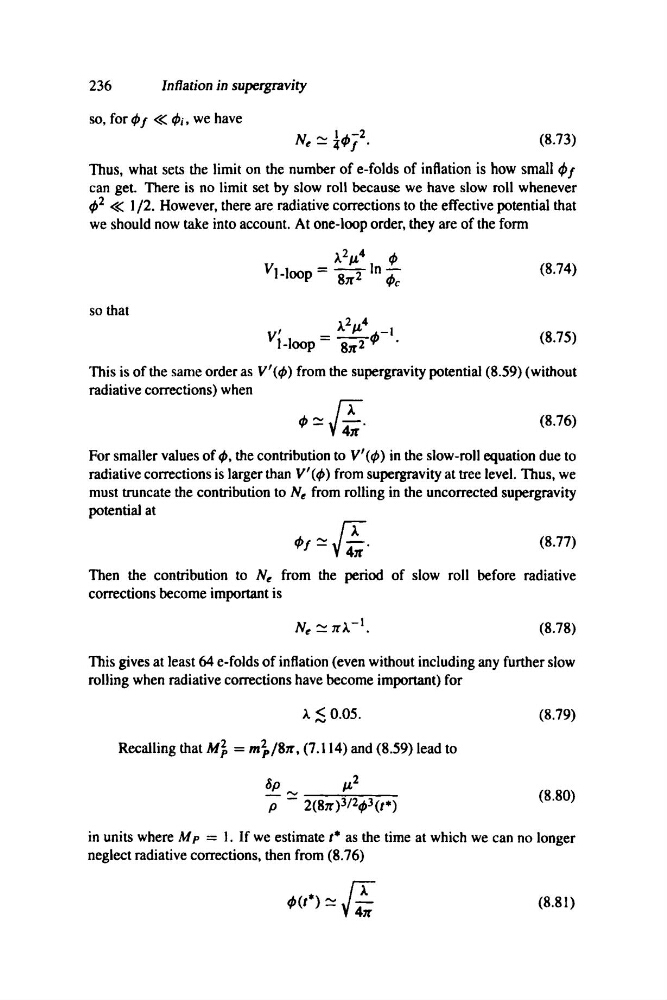
t/J2 « I /2. However, there are radiative corrections to the effective potential that
we should now take into account. At one-loop order, they are of the form
").2p,4
t/J
- --In:;;(8.74)
VI-loop - 811'2
'PC
so that
l. 2p,4
v,
-
-I
--t/J
(8.75)
I-loop - 811'2
This is of the same order as V' (t/J) from the supergravity potential (8.59) (without
radiative corrections) when
"'-'14;
A. ..... rr-.
(8.76)
For smaller values of t/J, the contribution to V' (t/J) in the slow-roll equation due to
radiative corrections is larger than V' (t/J) from supergravity at tree level. Thus, we
must truncate the contribution to N~ from rolling in the uncorrected supergravity
potential at
~
(8.77)
t/Jf ff·
Then the contribution to N~ from the period of slow roll before radiative
corrections become important is
N. ~ '" _ rrA \-1 .
(8.78)
This gives at least 64 e-folds of inflation (even without including any further slow
rolling when radiative corrections have become important) for
l. S 0.05.
(8.79)
Recalling that M~ = m~/81f, (7.114) and (8.59) lead to
8p
p,2
P ~
(8.80)
2(8rr)3/2t/J3(t·)
in units where Mp = I. If we estimate t· as the time at which we can no longer
neglect radiative corrections, then from (8.76)
t/J(t·) ~ J 4~
(8.81)
Inflation in supergravity
so, for t/J f « t/Ji, we have
1 -2
N~ ~ l,t/Jf •
(8.73)
Thus, what sets the limit on the number of e-folds of inflation is how small tP f
can get. There is no limit set by slow roll because we have slow roll whenever
t/J2 « I /2. However, there are radiative corrections to the effective potential that
we should now take into account. At one-loop order, they are of the form
").2p,4
t/J
- --In:;;(8.74)
VI-loop - 811'2
'PC
so that
l. 2p,4
v,
-
-I
--t/J
(8.75)
I-loop - 811'2
This is of the same order as V' (t/J) from the supergravity potential (8.59) (without
radiative corrections) when
"'-'14;
A. ..... rr-.
(8.76)
For smaller values of t/J, the contribution to V' (t/J) in the slow-roll equation due to
radiative corrections is larger than V' (t/J) from supergravity at tree level. Thus, we
must truncate the contribution to N~ from rolling in the uncorrected supergravity
potential at
~
(8.77)
t/Jf ff·
Then the contribution to N~ from the period of slow roll before radiative
corrections become important is
N. ~ '" _ rrA \-1 .
(8.78)
This gives at least 64 e-folds of inflation (even without including any further slow
rolling when radiative corrections have become important) for
l. S 0.05.
(8.79)
Recalling that M~ = m~/81f, (7.114) and (8.59) lead to
8p
p,2
P ~
(8.80)
2(8rr)3/2t/J3(t·)
in units where Mp = I. If we estimate t· as the time at which we can no longer
neglect radiative corrections, then from (8.76)
t/J(t·) ~ J 4~
(8.81)