

Hybrid inflation in super gravity
235
However, if
IJ.
4>
(8.63)
> ../l. == 4>c
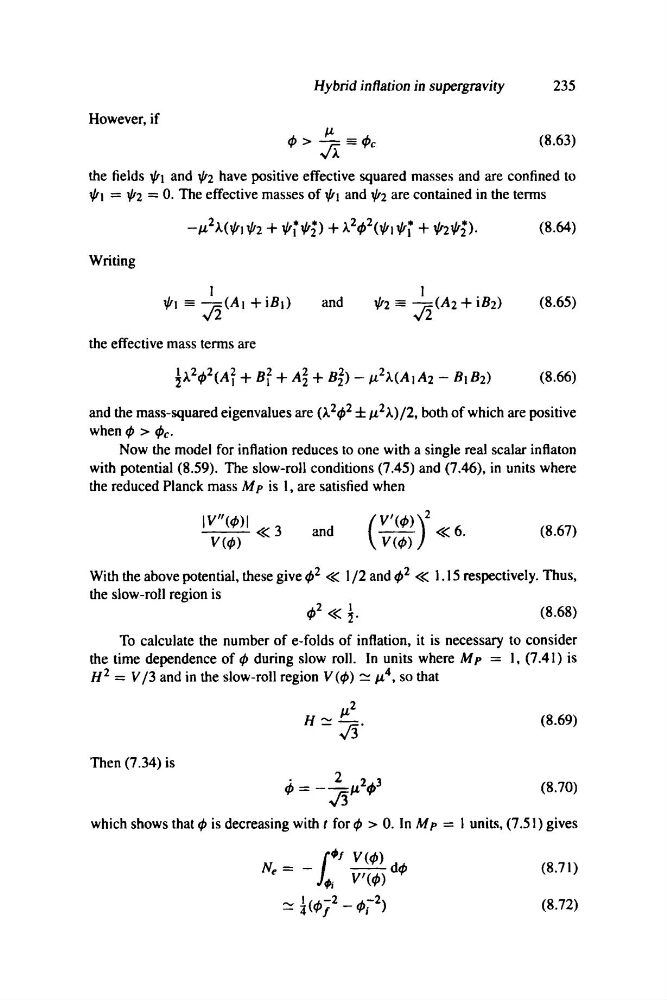
the fields 1/11 and 1/Iz have positive effective squared masses and are confined to
1/11 = 1/Iz = O. The effective masses of 1/11 and 1/Iz are contained in the terms
-IJ. Z )..(1/Il1/12 + 1/Ii1/l2> + )..24>2(1/Il1/1i + 1/121/12>.
(8.64)
Writing
I
I
1/11 == J2(AI + iBI) and 1/Iz == ,J2(A2 + iB2)
(8.65)
the effective mass terms are
!)..24>2(A~ + Bf + A~ + Bi) -1J.2)"(AIA2 - BIB2)
(8.66)
and the mass-squared eigenvalues are ().. 24>2 ± 1J.2 ),,)/2, both of which are positive
when 4> > 4>c.
Now the model for inflation reduces to one with a single real scalar inflaton
with potential (8.59). The slow-roll conditions (7.45) and (7.46), in units where
the reduced Planck mass Mp is I, are satisfied when
IV"
-
(4)) I
«
3
V'(4»)2
and
(
(8.67)
V (4))
« 6.
With the above potential, these give 4>2 « 1 /2 and 4>2 « 1.15 respectively. Thus,
the slow-roll region is
4>2 « i.
(8.68)
To calculate the number of e-folds of inflation, it is necessary to consider
the time dependence of 4> during slow roll. In units where Mp = I, (7.41) is
H2 = V /3 and in the slow-roll region V(4)) :::: 1J.4, so that
IJ.Z
H:::: .,fj.
(8.69)
Then (7.34) is
.
2 2 3
4> = --IJ. 4J
(8.70)
.,fj
which shows that 4> is decreasing with I for 4> > O. In Mp = I units, (7.51) gives
Ne = -1. 1 V(4)) d4>
(8.71)
"
V'(4))
'" 1 (.1.-2 .1.-2)
(8.72)
- 4 '1'/ - '1';
235
However, if
IJ.
4>
(8.63)
> ../l. == 4>c
the fields 1/11 and 1/Iz have positive effective squared masses and are confined to
1/11 = 1/Iz = O. The effective masses of 1/11 and 1/Iz are contained in the terms
-IJ. Z )..(1/Il1/12 + 1/Ii1/l2> + )..24>2(1/Il1/1i + 1/121/12>.
(8.64)
Writing
I
I
1/11 == J2(AI + iBI) and 1/Iz == ,J2(A2 + iB2)
(8.65)
the effective mass terms are
!)..24>2(A~ + Bf + A~ + Bi) -1J.2)"(AIA2 - BIB2)
(8.66)
and the mass-squared eigenvalues are ().. 24>2 ± 1J.2 ),,)/2, both of which are positive
when 4> > 4>c.
Now the model for inflation reduces to one with a single real scalar inflaton
with potential (8.59). The slow-roll conditions (7.45) and (7.46), in units where
the reduced Planck mass Mp is I, are satisfied when
IV"
-
(4)) I
«
3
V'(4»)2
and
(
(8.67)
V (4))
« 6.
With the above potential, these give 4>2 « 1 /2 and 4>2 « 1.15 respectively. Thus,
the slow-roll region is
4>2 « i.
(8.68)
To calculate the number of e-folds of inflation, it is necessary to consider
the time dependence of 4> during slow roll. In units where Mp = I, (7.41) is
H2 = V /3 and in the slow-roll region V(4)) :::: 1J.4, so that
IJ.Z
H:::: .,fj.
(8.69)
Then (7.34) is
.
2 2 3
4> = --IJ. 4J
(8.70)
.,fj
which shows that 4> is decreasing with I for 4> > O. In Mp = I units, (7.51) gives
Ne = -1. 1 V(4)) d4>
(8.71)
"
V'(4))
'" 1 (.1.-2 .1.-2)
(8.72)
- 4 '1'/ - '1';