

234
Inflation in supergravity
8.4 Hybrid inflation in supergravity
The hybrid inflation idea discussed in section 7.11 may be extended to the context
of supergravity. A simple superpotential which allows hybrid inflation to be
implemented [7] is
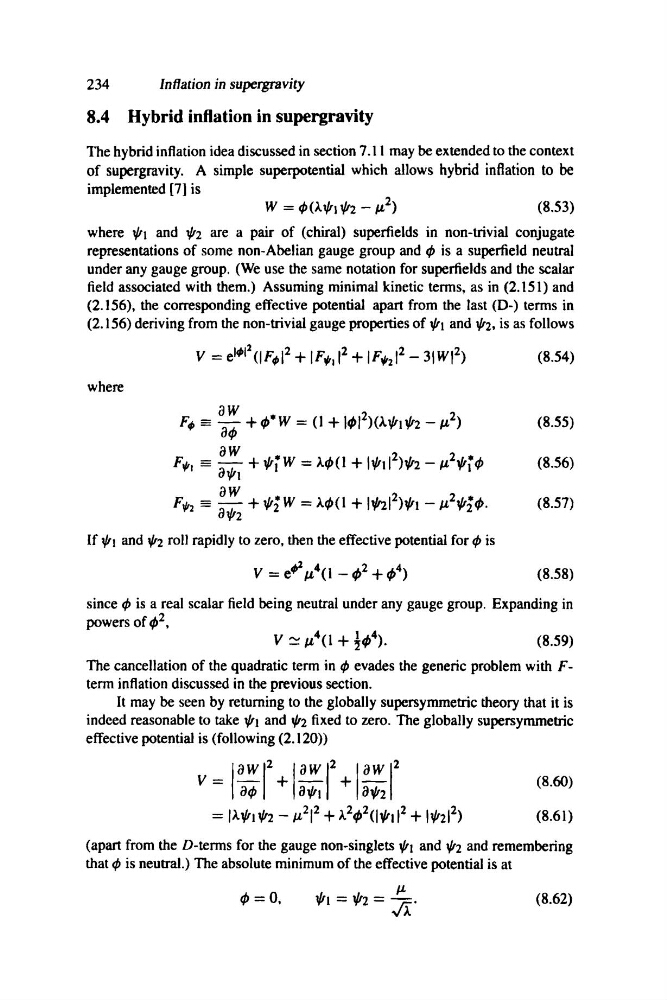
w = q, 0.. "'11/12 - ph
(8.53)
where "' I and "' 2 are a pair of (chiral) superfields in non-trivial conjugate
representations of some non-Abelian gauge group and q, is a superfield neutral
under any gauge group. (We use the same notation for superfields and the scalar
field associated with them.) Assuming minimal kinetic terms, as in (2.151) and
(2.156), the corresponding effective potential apart from the last (0-) terms in
(2.156) deriving from the non-trivial gauge properties of "' I and 1/12, is as follows
V = elfflI2(IFt/l12 + IFt.l 2 + IFt z l 2 - 31W12)
(8.54)
where
aw
FffI == aq, + q,*w = (l + 1q,1 2 )(>''''11/I2 -ph
(8.55)
aw
Ft, == a"'l + "'i W = >'q,(l + 1"'11 2 )1/12 -,.,,2"'iq,
(8.56)
aw
Ftz == a"'2 + "'2 W = ).q,( I + 11/121 2 )"'1 - ,.,,2"'2 q,.
(8.57)
If "' I and "' 2 roll rapidly to zero, then the effective potential for q, is
V = e",z ,.,,4(l - q,2 + q,4)
(8.58)
since q, is a real scalar field being neutral under any gauge group. Expanding in
powers of q,2,
V ~ ,.,,4(l + 1.4).
(8.59)
The cancellation of the quadratic term in q, evades the generic problem with Fterm inflation discussed in the previous section.
It may be seen by returning to the globally supersymmetric theory that it is
indeed reasonable to take "' 1 and "' 2 fixed to zero. The globally supersymmetric
effective potential is (following (2.120»
V = I a W 12 1 a W 12 1 a W 12
(8.60)
aq, + a"'l + a"'2
= 1)."'11/12 - ,.,,21 2 +). 2q,2(1"'112 + 11/1212)
(8.61)
(apart from the D-terms for the gauge non-singlets "' 1 and "' 2 and remembering
that q, is neutral.) The absolute minimum of the effective potential is at
q, = 0,
,."
(8.62)
"' I = 1/12 = .fi. .
Inflation in supergravity
8.4 Hybrid inflation in supergravity
The hybrid inflation idea discussed in section 7.11 may be extended to the context
of supergravity. A simple superpotential which allows hybrid inflation to be
implemented [7] is
w = q, 0.. "'11/12 - ph
(8.53)
where "' I and "' 2 are a pair of (chiral) superfields in non-trivial conjugate
representations of some non-Abelian gauge group and q, is a superfield neutral
under any gauge group. (We use the same notation for superfields and the scalar
field associated with them.) Assuming minimal kinetic terms, as in (2.151) and
(2.156), the corresponding effective potential apart from the last (0-) terms in
(2.156) deriving from the non-trivial gauge properties of "' I and 1/12, is as follows
V = elfflI2(IFt/l12 + IFt.l 2 + IFt z l 2 - 31W12)
(8.54)
where
aw
FffI == aq, + q,*w = (l + 1q,1 2 )(>''''11/I2 -ph
(8.55)
aw
Ft, == a"'l + "'i W = >'q,(l + 1"'11 2 )1/12 -,.,,2"'iq,
(8.56)
aw
Ftz == a"'2 + "'2 W = ).q,( I + 11/121 2 )"'1 - ,.,,2"'2 q,.
(8.57)
If "' I and "' 2 roll rapidly to zero, then the effective potential for q, is
V = e",z ,.,,4(l - q,2 + q,4)
(8.58)
since q, is a real scalar field being neutral under any gauge group. Expanding in
powers of q,2,
V ~ ,.,,4(l + 1.4).
(8.59)
The cancellation of the quadratic term in q, evades the generic problem with Fterm inflation discussed in the previous section.
It may be seen by returning to the globally supersymmetric theory that it is
indeed reasonable to take "' 1 and "' 2 fixed to zero. The globally supersymmetric
effective potential is (following (2.120»
V = I a W 12 1 a W 12 1 a W 12
(8.60)
aq, + a"'l + a"'2
= 1)."'11/12 - ,.,,21 2 +). 2q,2(1"'112 + 11/1212)
(8.61)
(apart from the D-terms for the gauge non-singlets "' 1 and "' 2 and remembering
that q, is neutral.) The absolute minimum of the effective potential is at
q, = 0,
,."
(8.62)
"' I = 1/12 = .fi. .