

D-tenn supergravity inflation
233
To obtain sufficient e-folds of inflation generally requires some fine-tuning of the
parameters of the superpotential, so that other quadratic terms can cancel the one
displayed. In the model just discussed in section 8.2, the choice of superpotential
is such that a quadratic term in V(4)) does not occur. Nevertheless, there is a
similar problem because sufficient inflation required the parameter #L 2 1l.21 in the
superpotential to be :5 10- 3 .
This generic difficulty for F -term inflation can be avoided if the positive
value of V required for inflation originates from the second term of (2.156)
(referred to as the D-term because it generalizes the contribution of the auxiliary
field denoted by D in the context of global supersymmetry). Because there is no
factor of e.*' in the D-term, the previous argument does not apply and D-tenn
inflation [6] does not suffer from the generic problem discussed above.
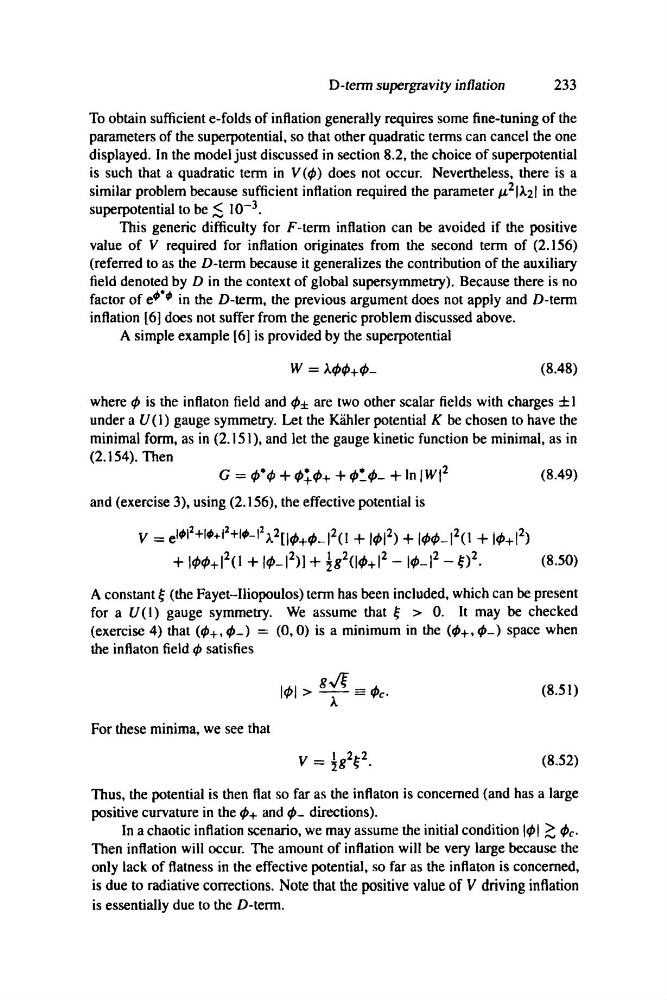
A simple example [6] is provided by the superpotential
W = l.tP4>+4>(8.48)
where 4> is the inflaton field and 4>± are two other scalar fields with charges ± I
under a U (I) gauge symmetry. Let the Kabler potential K be chosen to have the
minimal form, as in (2.151), and let the gauge kinetic function be minimal, as in
(2.154). Then
G = 4>.4> + 4>~4>+ + 4>~tP- + In IWI 2
(8.49)
and (exercise 3). using (2.156), the effective potential is
V = el.,2+1.+12+1.-12l.2[14>+4>_12(l + ItP12) + 14>4>_12(1 + 14>+12)
+ 14>4>+12(1 + 14>_12)] + !g204>+12 -14>_12 - ~)2.
(8.50)
A constant ~ (the Fayet-IIiopoulos) term has been included, which can be present
for a U(I) gauge symmetry. We assume that ~ > O. It may be checked
(exercise 4) that (4)+. tP-) = (0,0) is a minimum in the (4)+, tP-) space when
the inflaton field 4> satisfies
14>1 > g,Jf -
(8.5 t)
l. = 4>c.
For these minima, we see that
V = !g2~2.
(8.52)
Thus, the potential is then flat so far as the inflaton is concerned (and has a large
positive curvature in the 4>+ and tP- directions).
In a chaotic inflation scenario. we may assume the initial condition 14>1 z: 4>c.
Then inflation will occur. The amount of inflation will be very large because the
only lack of flatness in the effective potential, so far as the inflaton is concerned,
is due to radiative corrections. Note that the positive value of V driving inflation
is essentially due to the D-term.
233
To obtain sufficient e-folds of inflation generally requires some fine-tuning of the
parameters of the superpotential, so that other quadratic terms can cancel the one
displayed. In the model just discussed in section 8.2, the choice of superpotential
is such that a quadratic term in V(4)) does not occur. Nevertheless, there is a
similar problem because sufficient inflation required the parameter #L 2 1l.21 in the
superpotential to be :5 10- 3 .
This generic difficulty for F -term inflation can be avoided if the positive
value of V required for inflation originates from the second term of (2.156)
(referred to as the D-term because it generalizes the contribution of the auxiliary
field denoted by D in the context of global supersymmetry). Because there is no
factor of e.*' in the D-term, the previous argument does not apply and D-tenn
inflation [6] does not suffer from the generic problem discussed above.
A simple example [6] is provided by the superpotential
W = l.tP4>+4>(8.48)
where 4> is the inflaton field and 4>± are two other scalar fields with charges ± I
under a U (I) gauge symmetry. Let the Kabler potential K be chosen to have the
minimal form, as in (2.151), and let the gauge kinetic function be minimal, as in
(2.154). Then
G = 4>.4> + 4>~4>+ + 4>~tP- + In IWI 2
(8.49)
and (exercise 3). using (2.156), the effective potential is
V = el.,2+1.+12+1.-12l.2[14>+4>_12(l + ItP12) + 14>4>_12(1 + 14>+12)
+ 14>4>+12(1 + 14>_12)] + !g204>+12 -14>_12 - ~)2.
(8.50)
A constant ~ (the Fayet-IIiopoulos) term has been included, which can be present
for a U(I) gauge symmetry. We assume that ~ > O. It may be checked
(exercise 4) that (4)+. tP-) = (0,0) is a minimum in the (4)+, tP-) space when
the inflaton field 4> satisfies
14>1 > g,Jf -
(8.5 t)
l. = 4>c.
For these minima, we see that
V = !g2~2.
(8.52)
Thus, the potential is then flat so far as the inflaton is concerned (and has a large
positive curvature in the 4>+ and tP- directions).
In a chaotic inflation scenario. we may assume the initial condition 14>1 z: 4>c.
Then inflation will occur. The amount of inflation will be very large because the
only lack of flatness in the effective potential, so far as the inflaton is concerned,
is due to radiative corrections. Note that the positive value of V driving inflation
is essentially due to the D-term.