

Thermal production of gravitinos by reheating
237
and
8p
1L2
P
(8.82)
~ 25/2(411')3)..3/2'
The requirement that 8p / p ~ 2 x 10- 5 fixes IL in units of Mp once).. has been
chosen. For).. chosen as in (8.79), we have
IL $ O.05Mp.
(8.83)
8.S Thermal production of gravitinos by reheating
The thermal production of gravitinos in the early universe can cause problems, as
discussed in section 6.3. At first sight, a possible solution to these problems is for
the gravitino density to be diluted by inflation. However, a gravitino density can
be produced by reheating after inflation and it is necessary for this density to be
low enough that the problem is not recreated.
Gravitinos produced by reheating after inflation can have a serious effect on
the abundances of deuterium (D) and 3He relative to the 4He abundance. The
problem is that D and 3He can be produced by photofission from 4He by radiation
from gravitino decay. These relative abundances are known to be very small and
so we must avoid gravitino densities sufficiently large to violate these bounds.
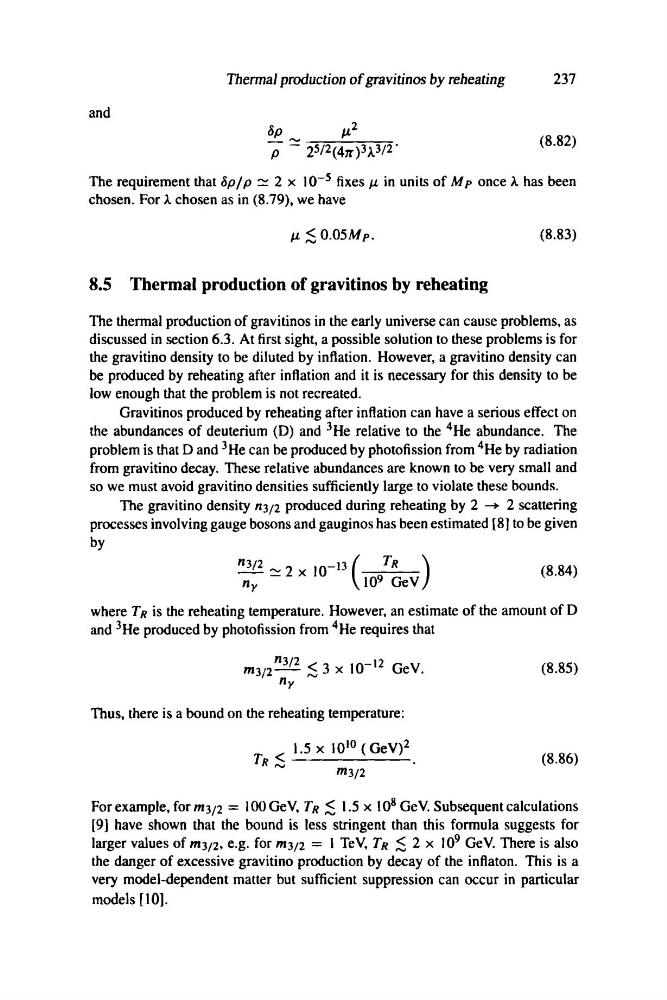
The gravitino density "3/2 produced during reheating by 2 -+ 2 scattering
processes involving gauge bosons and gauginos has been estimated [8J to be given
by
"3/2 ~ 2 x 10-13 ( TR )
(8.84)
"y
10 9 GeV
where T R is the reheating temperature. However, an estimate of the amount of D
and 3He produced by photofission from 4He requires that
m3/2 "3/2 < 3 x 10- 12 GeV.
(8.85)
" y '"
Thus, there is a bound on the reheating temperature:
T < 1.5 x 10¹⁰ (GeV)2
R '" --~~::::..:!(8.86)
m3/2
For example, for m3/2 = 100 Ge V, T R $ 1.5 x 10 8 Ge V. Subsequent calculations
[9J have shown that the bound is less stringent than this formula suggests for
larger values of m3/2, e.g. for m3/2 = I TeV, TR $ 2 x 10 9 GeV. There is also
the danger of excessive gravitino production by decay of the inflaton. This is a
very model-dependent matter but sufficient suppression can occur in particular
models [10].
237
and
8p
1L2
P
(8.82)
~ 25/2(411')3)..3/2'
The requirement that 8p / p ~ 2 x 10- 5 fixes IL in units of Mp once).. has been
chosen. For).. chosen as in (8.79), we have
IL $ O.05Mp.
(8.83)
8.S Thermal production of gravitinos by reheating
The thermal production of gravitinos in the early universe can cause problems, as
discussed in section 6.3. At first sight, a possible solution to these problems is for
the gravitino density to be diluted by inflation. However, a gravitino density can
be produced by reheating after inflation and it is necessary for this density to be
low enough that the problem is not recreated.
Gravitinos produced by reheating after inflation can have a serious effect on
the abundances of deuterium (D) and 3He relative to the 4He abundance. The
problem is that D and 3He can be produced by photofission from 4He by radiation
from gravitino decay. These relative abundances are known to be very small and
so we must avoid gravitino densities sufficiently large to violate these bounds.
The gravitino density "3/2 produced during reheating by 2 -+ 2 scattering
processes involving gauge bosons and gauginos has been estimated [8J to be given
by
"3/2 ~ 2 x 10-13 ( TR )
(8.84)
"y
10 9 GeV
where T R is the reheating temperature. However, an estimate of the amount of D
and 3He produced by photofission from 4He requires that
m3/2 "3/2 < 3 x 10- 12 GeV.
(8.85)
" y '"
Thus, there is a bound on the reheating temperature:
T < 1.5 x 10¹⁰ (GeV)2
R '" --~~::::..:!(8.86)
m3/2
For example, for m3/2 = 100 Ge V, T R $ 1.5 x 10 8 Ge V. Subsequent calculations
[9J have shown that the bound is less stringent than this formula suggests for
larger values of m3/2, e.g. for m3/2 = I TeV, TR $ 2 x 10 9 GeV. There is also
the danger of excessive gravitino production by decay of the inflaton. This is a
very model-dependent matter but sufficient suppression can occur in particular
models [10].