

212
Inflationary cosmology
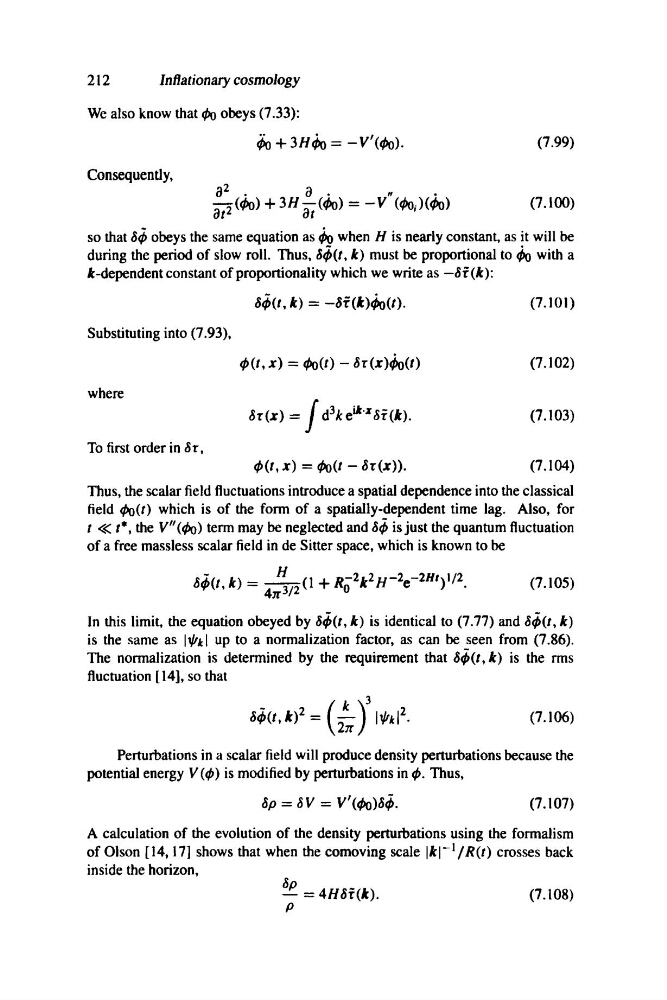
We also know that t/Io obeys (7.33):
(fio + 3H~ = -V'(t/Io).
(7.99)
Consequently,
a 2 •
a .
"
.
at 2 (t/Io) + 3H a/flo) = - V (t/Io; )(t/Io)
(7.100)
so that 8~ obeys the same equation as ~ when H is nearly constant, as it will be
during the period of slow roll. Thus, 8~(t, k) must be proportional to ~ with a
k-dependent constant of proportionality which we write as -8i(k):
8~(t, k) = -8i(k)~(t).
(7.101)
Substituting into (7.93),
t/J(t, x) = t/Io(t) - ch(x)~(t)
(7.102)
where
8T(X) = J d 3 ke ik . z 8i(k).
(7.103)
To first order in 8T,
t/J(t, x) = t/Io(t - 8T(X».
(7.104)
Thus, the scalar field fluctuations introduce a spatial dependence into the classical
field t/Io(t) which is of the form of a spatially-dependent time lag. Also, for
t « t*, the V" (t/Io) term may be neglected and 8~ is just the quantum fluctuation
of a free massless scalar field in de Sitter space, which is known to be
-
H
8t/J(t, k) = - - ( 1 + R- 2 k 2 H-2e-2H1) 1/2
(7.105)
411"3/2
0
.
In this limit, the equation obeyed by 8~(t, k) is identical to (7.77) and 8~(t, k)
is the same as 11/Ikl up to a normalization factor, as can be seen from (7.86).
The normalization is determined by the requirement that 8~(t, k) is the rms
fluctuation [14], so that
8~(t, k)2 = (2: Y 11/Id.
(7.106)
Perturbations in a scalar field will produce density perturbations because the
potential energy V(t/J) is modified by perturbations in t/J' Thus,
8p = 8V = V'(t/Io)8~.
(7.107)
A calculation of the evolution of the density perturbations using the formalism
of Olson [14,17] shows that when the comoving scale Ikl- I / R(I) crosses back
inside the horizon,
8p = 4H8i(k).
(7.108)
p
Inflationary cosmology
We also know that t/Io obeys (7.33):
(fio + 3H~ = -V'(t/Io).
(7.99)
Consequently,
a 2 •
a .
"
.
at 2 (t/Io) + 3H a/flo) = - V (t/Io; )(t/Io)
(7.100)
so that 8~ obeys the same equation as ~ when H is nearly constant, as it will be
during the period of slow roll. Thus, 8~(t, k) must be proportional to ~ with a
k-dependent constant of proportionality which we write as -8i(k):
8~(t, k) = -8i(k)~(t).
(7.101)
Substituting into (7.93),
t/J(t, x) = t/Io(t) - ch(x)~(t)
(7.102)
where
8T(X) = J d 3 ke ik . z 8i(k).
(7.103)
To first order in 8T,
t/J(t, x) = t/Io(t - 8T(X».
(7.104)
Thus, the scalar field fluctuations introduce a spatial dependence into the classical
field t/Io(t) which is of the form of a spatially-dependent time lag. Also, for
t « t*, the V" (t/Io) term may be neglected and 8~ is just the quantum fluctuation
of a free massless scalar field in de Sitter space, which is known to be
-
H
8t/J(t, k) = - - ( 1 + R- 2 k 2 H-2e-2H1) 1/2
(7.105)
411"3/2
0
.
In this limit, the equation obeyed by 8~(t, k) is identical to (7.77) and 8~(t, k)
is the same as 11/Ikl up to a normalization factor, as can be seen from (7.86).
The normalization is determined by the requirement that 8~(t, k) is the rms
fluctuation [14], so that
8~(t, k)2 = (2: Y 11/Id.
(7.106)
Perturbations in a scalar field will produce density perturbations because the
potential energy V(t/J) is modified by perturbations in t/J' Thus,
8p = 8V = V'(t/Io)8~.
(7.107)
A calculation of the evolution of the density perturbations using the formalism
of Olson [14,17] shows that when the comoving scale Ikl- I / R(I) crosses back
inside the horizon,
8p = 4H8i(k).
(7.108)
p