

Density perturbations
213
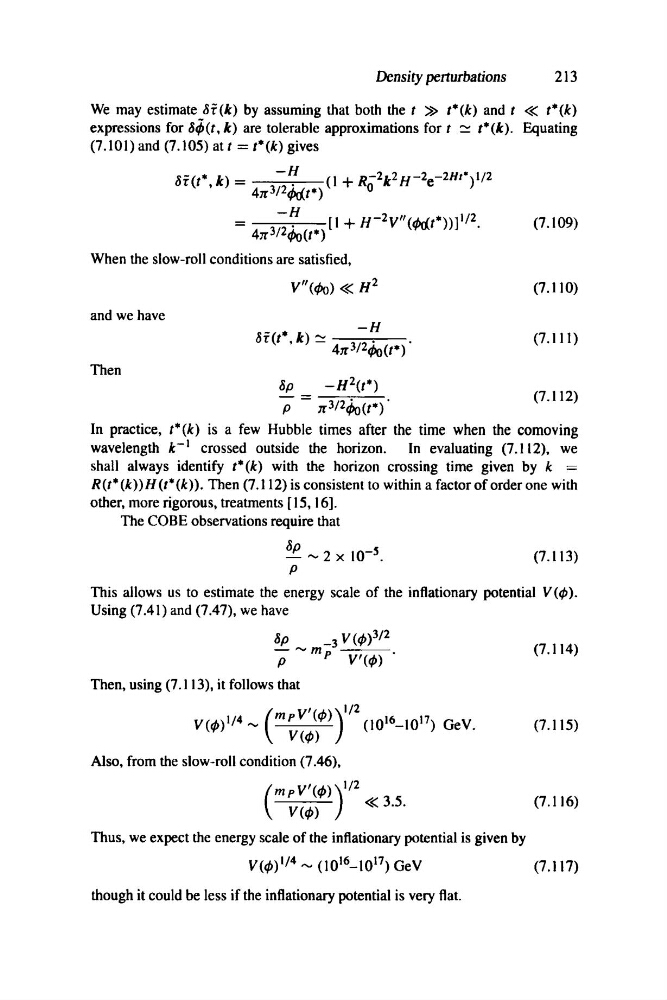
We may estimate 8i(k) by assuming that both the t » t*(k) and t « t*(k)
expressions for 8~(t, k) are tolerable approximations for t ~ t*(k). Equating
(7.101) and (7.105) att = t* (k) gives
8i(t* k) = -f! (1 + R-2k2H-2e-2Ht*)1/2
,
4rr 3/2t/Jd..t*)
0
=
-'! [I + H- 2 VI/(t/Jd..t*»]1/2.
(7.109)
4rr3/2cf>o(t*)
When the slow-roll conditions are satisfied,
VI/(cf>o) « H2
(7.110)
and we have
-H
(7.111)
8i(t*,k) ~ 4rr 3/2
8p
_H2(t*)
(7.112)
P - rr 3/2
wavelength k- I crossed outside the horizon.
In evaluating (7.112), we
shall always identify t*(k) with the horizon crossing time given by k =
R(t*(k»H (t*(k». Then (7.112) is consistent to within a factor of order one with
other, more rigorous, treatments [15, 16].
The COBE observations require that
8p '" 2 x IO- s .
(7.113)
p
This allows us to estimate the energy scale of the inflationary potential V(cp).
Using (7.41) and (7.47), we have
8p "'mp3~~~?~:2
(7.114)
p
Then, using (7.113), it follows that
m VI(A,»)1/2
V(cp)I/4", ( P 'I'
(10 16 _10 17 ) GeV.
(7.115)
V(cp)
Also, from the slow-roll condition (7.46),
mpVI(cp»)1/2
(
(7.116)
V(cp)
«3.5.
Thus, we expect the energy scale of the inflationary potential is given by
V(cp) 1/4 '" (10 16 _10 17 ) GeV
(7.117)
though it could be less if the inflationary potential is very flat.
213
We may estimate 8i(k) by assuming that both the t » t*(k) and t « t*(k)
expressions for 8~(t, k) are tolerable approximations for t ~ t*(k). Equating
(7.101) and (7.105) att = t* (k) gives
8i(t* k) = -f! (1 + R-2k2H-2e-2Ht*)1/2
,
4rr 3/2t/Jd..t*)
0
=
-'! [I + H- 2 VI/(t/Jd..t*»]1/2.
(7.109)
4rr3/2cf>o(t*)
When the slow-roll conditions are satisfied,
VI/(cf>o) « H2
(7.110)
and we have
-H
(7.111)
8i(t*,k) ~ 4rr 3/2
8p
_H2(t*)
(7.112)
P - rr 3/2
wavelength k- I crossed outside the horizon.
In evaluating (7.112), we
shall always identify t*(k) with the horizon crossing time given by k =
R(t*(k»H (t*(k». Then (7.112) is consistent to within a factor of order one with
other, more rigorous, treatments [15, 16].
The COBE observations require that
8p '" 2 x IO- s .
(7.113)
p
This allows us to estimate the energy scale of the inflationary potential V(cp).
Using (7.41) and (7.47), we have
8p "'mp3~~~?~:2
(7.114)
p
Then, using (7.113), it follows that
m VI(A,»)1/2
V(cp)I/4", ( P 'I'
(10 16 _10 17 ) GeV.
(7.115)
V(cp)
Also, from the slow-roll condition (7.46),
mpVI(cp»)1/2
(
(7.116)
V(cp)
«3.5.
Thus, we expect the energy scale of the inflationary potential is given by
V(cp) 1/4 '" (10 16 _10 17 ) GeV
(7.117)
though it could be less if the inflationary potential is very flat.