

Weakly interacting massive particles or WIMPs
175
we discuss the bounds that can be put on the neutralino mass using cosmological
data and also the constraints on the parameters of the MSSM that arise from other
data whose theoretical prediction depends upon these parameters. We discuss the
prospects for the experimental detection of (neutralino) dark matter in section 6.6.
6.2 Weakly interacting massive particles or WIMPs
To have survived until the present epoch, any (non-baryonic) dark matter particles
must either be stable or have a lifetime comparable with the present age of the
universe. Further, if the dark matter particles have electromagnetic or strong
interactions, they would bind to nucleons and form anomalous heavy isotopes.
Such isotopes have been sought but not found [10]. Thus, the dark matter
particles can, at best, participate in weak (and gravitational) interactions or, at
worst, only in gravitational interactions. One obvious possibility satisfying the
foregoing constraints is that the dark matter consists of neutrinos. However,
we have already noted that the present data on neutrino masses (from tritium
decay, atmospheric and solar neutrino experiments) show that although neutrinos
might barely account for the inferred mass density (5.22) or (6.14), simulations
of galaxy formation and cluster formation require cold dark matter. That is, the
dark matter is made of weakly interacting massive particles (WIMPs). No such
particles exist in the standard model but they do in its enlargement to the minimal
supersymmetric standard model (MSSM).
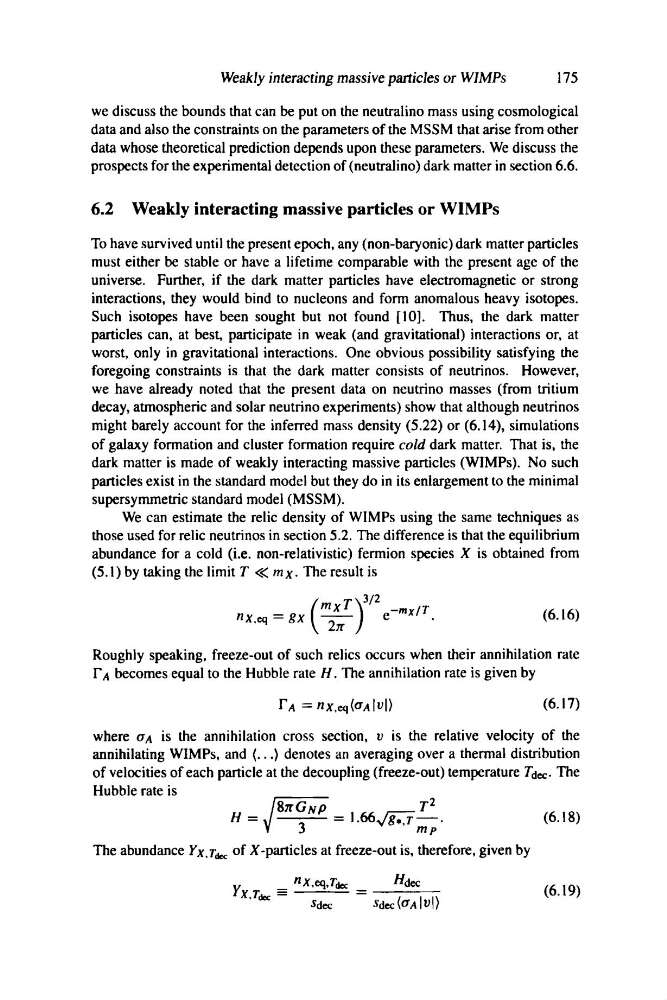
We can estimate the relic density of WIMPs using the same techniques as
those used for relic neutrinos in section 5.2. The difference is that the equilibrium
abundance for a cold (i.e. non-relativistic) fermion species X is obtained from
(5.1) by taking the limit T « m x. The result is
mXT)3/2
nx.cq = gx ( - -
e- mx / T
(6.16)
21f
•
Roughly speaking, freeze-out of such relics occurs when their annihilation rate
r A becomes equal to the Hubble rate H. The annihilation rate is given by
r A = nX.eq(UA Ivl)
(6.17)
where U A is the annihilation cross section, v is the relative velocity of the
annihilating WIMPs, and ( ... ) denotes an averaging over a thermal distribution
of velocities of each particle at the decoupling (freeze-out) temperature Tdcc. The
Hubble rate is
/81fGNP
T2
(6.18)
H =
3
= 1.66.Jg •. T mp'
The abundance YX.Tdoc of X-particles at freeze-out is, therefore, given by
_ nX.cq.Tdec
Hdec
Y X.Tdcc =
= - - -
(6.19)
Sdec
sdcc(uAlvl)
175
we discuss the bounds that can be put on the neutralino mass using cosmological
data and also the constraints on the parameters of the MSSM that arise from other
data whose theoretical prediction depends upon these parameters. We discuss the
prospects for the experimental detection of (neutralino) dark matter in section 6.6.
6.2 Weakly interacting massive particles or WIMPs
To have survived until the present epoch, any (non-baryonic) dark matter particles
must either be stable or have a lifetime comparable with the present age of the
universe. Further, if the dark matter particles have electromagnetic or strong
interactions, they would bind to nucleons and form anomalous heavy isotopes.
Such isotopes have been sought but not found [10]. Thus, the dark matter
particles can, at best, participate in weak (and gravitational) interactions or, at
worst, only in gravitational interactions. One obvious possibility satisfying the
foregoing constraints is that the dark matter consists of neutrinos. However,
we have already noted that the present data on neutrino masses (from tritium
decay, atmospheric and solar neutrino experiments) show that although neutrinos
might barely account for the inferred mass density (5.22) or (6.14), simulations
of galaxy formation and cluster formation require cold dark matter. That is, the
dark matter is made of weakly interacting massive particles (WIMPs). No such
particles exist in the standard model but they do in its enlargement to the minimal
supersymmetric standard model (MSSM).
We can estimate the relic density of WIMPs using the same techniques as
those used for relic neutrinos in section 5.2. The difference is that the equilibrium
abundance for a cold (i.e. non-relativistic) fermion species X is obtained from
(5.1) by taking the limit T « m x. The result is
mXT)3/2
nx.cq = gx ( - -
e- mx / T
(6.16)
21f
•
Roughly speaking, freeze-out of such relics occurs when their annihilation rate
r A becomes equal to the Hubble rate H. The annihilation rate is given by
r A = nX.eq(UA Ivl)
(6.17)
where U A is the annihilation cross section, v is the relative velocity of the
annihilating WIMPs, and ( ... ) denotes an averaging over a thermal distribution
of velocities of each particle at the decoupling (freeze-out) temperature Tdcc. The
Hubble rate is
/81fGNP
T2
(6.18)
H =
3
= 1.66.Jg •. T mp'
The abundance YX.Tdoc of X-particles at freeze-out is, therefore, given by
_ nX.cq.Tdec
Hdec
Y X.Tdcc =
= - - -
(6.19)
Sdec
sdcc(uAlvl)