

174
Supersymmetric dark matter
In other words, luminous matter accounts for less than I % of the mass of the
universe. When these techniques are applied to the rare stars and neutral hydrogen
(HI) clouds beyond the radius where light from the galaxy is emitted. it is
found that M(r) continues to increase. reaching a maximum in the range 1503oo km 8- 1 within a few kpc, and then remaining constant out to the largest radii
at which HI clouds can be found. If there were no matter outside of the luminous
region, then from (6.10) v(r) should fall off as ,-1/2. Thus, the measurement of
roughly constant values of v(r) in over lOoo galaxies indicates that the galaxies
have huge 'halos' of dark matter, with mass 3-10 times that of the luminous
component. The rotation curve for our own Milky Way galaxy is difficult to
measure. because the observer is inside the galaxy but there is little doubt that our
galaxy too is immersed in a dark matter halo. Further, by studying the motion of
galactic clusters a universal mass density corresponding to [7]
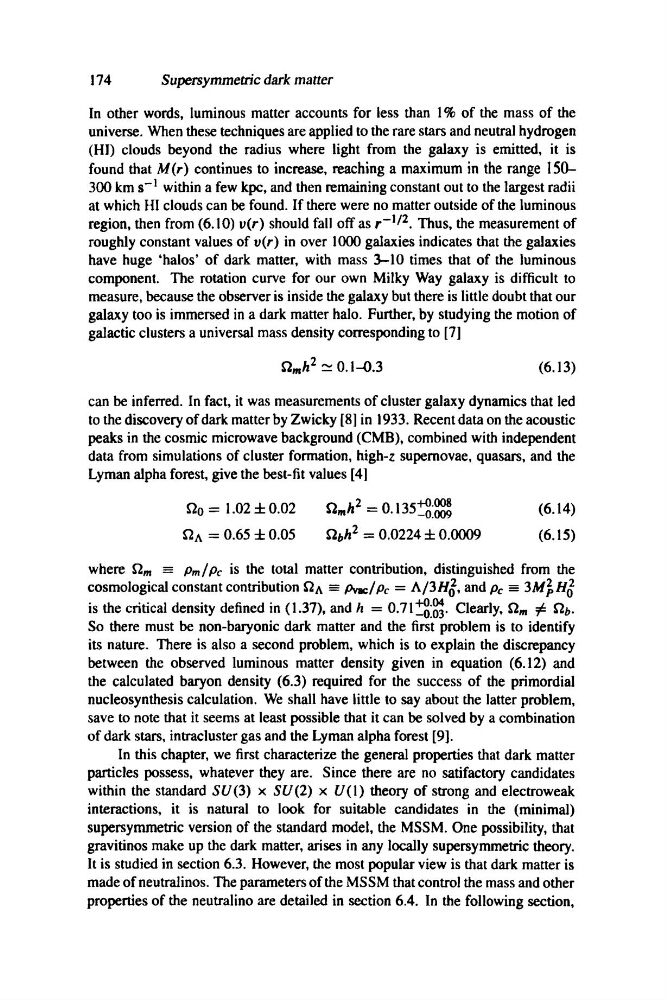
0",h 2 ~ 0.1-0.3
(6.13)
can be inferred. In fact, it was measurements of cluster galaxy dynamics that led
to the discovery of dark matter by Zwicky [8] in 1933. Recent data on the acoustic
peaks in the cosmic microwave background (CMB). combined with independent
data from simulations of cluster formation. high-z supernovae. quasars. and the
Lyman alpha forest, give the best-fit values [4]
00 = 1.02 ±0.02 Omh2 = 0.135~:=
(6.14)
OA = 0.65 ± 0.05 Obh2 = 0.0224 ± 0.0009
(6.15)
where Om == Pm / Pc is the total matter contribution, distinguished from the
cosmological constant contribution OA == p.,.;/ Pc = A/3HJ, and Pc == 3M~HJ
is the critical density defined in (1.37), and h = 0.71~:g;. Clearly. Om # Ob.
So there must be non-baryonic dark matter and the first problem is to identify
its nature. There is also a second problem. which is to explain the discrepancy
between the observed luminous matter density given in equation (6.12) and
the calculated baryon density (6.3) required for the success of the primordial
nucleosynthesis calculation. We shall have little to say about the latter problem.
save to note that it seems at least possible that it can be solved by a combination
of dark stars. intracluster gas and the Lyman alpha forest [9).
In this chapter. we first characterize the general properties that dark matter
particles possess, whatever they are. Since there are no satifactory candidates
within the standard SU(3) x SU(2) x U(l) theory of strong and electroweak
interactions, it is natural to look for suitable candidates in the (minimal)
supersymmetric version of the standard model, the MSSM. One possibility. that
gravitinos make up the dark matter, arises in any locally supersymmetric theory.
It is studied in section 6.3. However. the most popular view is that dark matter is
made of neutralinos. The parameters of the MSSM that control the mass and other
properties of the neutralino are detailed in section 6.4. In the following section,
Supersymmetric dark matter
In other words, luminous matter accounts for less than I % of the mass of the
universe. When these techniques are applied to the rare stars and neutral hydrogen
(HI) clouds beyond the radius where light from the galaxy is emitted. it is
found that M(r) continues to increase. reaching a maximum in the range 1503oo km 8- 1 within a few kpc, and then remaining constant out to the largest radii
at which HI clouds can be found. If there were no matter outside of the luminous
region, then from (6.10) v(r) should fall off as ,-1/2. Thus, the measurement of
roughly constant values of v(r) in over lOoo galaxies indicates that the galaxies
have huge 'halos' of dark matter, with mass 3-10 times that of the luminous
component. The rotation curve for our own Milky Way galaxy is difficult to
measure. because the observer is inside the galaxy but there is little doubt that our
galaxy too is immersed in a dark matter halo. Further, by studying the motion of
galactic clusters a universal mass density corresponding to [7]
0",h 2 ~ 0.1-0.3
(6.13)
can be inferred. In fact, it was measurements of cluster galaxy dynamics that led
to the discovery of dark matter by Zwicky [8] in 1933. Recent data on the acoustic
peaks in the cosmic microwave background (CMB). combined with independent
data from simulations of cluster formation. high-z supernovae. quasars. and the
Lyman alpha forest, give the best-fit values [4]
00 = 1.02 ±0.02 Omh2 = 0.135~:=
(6.14)
OA = 0.65 ± 0.05 Obh2 = 0.0224 ± 0.0009
(6.15)
where Om == Pm / Pc is the total matter contribution, distinguished from the
cosmological constant contribution OA == p.,.;/ Pc = A/3HJ, and Pc == 3M~HJ
is the critical density defined in (1.37), and h = 0.71~:g;. Clearly. Om # Ob.
So there must be non-baryonic dark matter and the first problem is to identify
its nature. There is also a second problem. which is to explain the discrepancy
between the observed luminous matter density given in equation (6.12) and
the calculated baryon density (6.3) required for the success of the primordial
nucleosynthesis calculation. We shall have little to say about the latter problem.
save to note that it seems at least possible that it can be solved by a combination
of dark stars. intracluster gas and the Lyman alpha forest [9).
In this chapter. we first characterize the general properties that dark matter
particles possess, whatever they are. Since there are no satifactory candidates
within the standard SU(3) x SU(2) x U(l) theory of strong and electroweak
interactions, it is natural to look for suitable candidates in the (minimal)
supersymmetric version of the standard model, the MSSM. One possibility. that
gravitinos make up the dark matter, arises in any locally supersymmetric theory.
It is studied in section 6.3. However. the most popular view is that dark matter is
made of neutralinos. The parameters of the MSSM that control the mass and other
properties of the neutralino are detailed in section 6.4. In the following section,