

176
Supersymmetric dark matter
where
_ 211'2
r. 3
Sdec -
45 g.,S,TdeI: dec
(6.20)
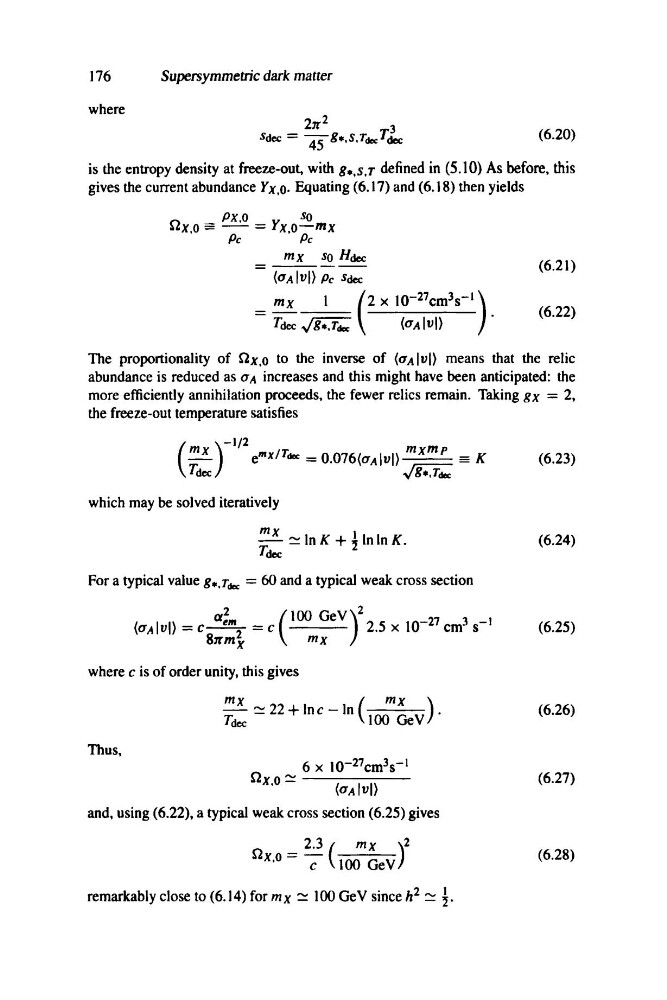
is the entropy density at freeze-out. with g.,S,T defined in (5.10) As before, this
gives the current abundance Y x ,0. Equating (6.17) and (6.18) then yields
Px,O
So
nxo == -
= Yxo-mx
,
Pc
' Pc
mx So Hdec
= - - - -
(6.21)
(0',4 Ivl) Pc Sdec
= mx
I
(2 x 1O- 27 cm 3 s- I ) •
(6.22)
Tdec Jg.,TdeI:
(O',4lvl)
The proportionality of nx,o to the inverse of (0',4 Ivl) means that the relic
abundance is reduced as 0',4 increases and this might have been anticipated: the
more efficiently annihilation proceeds, the fewer relics remain. Taking gx = 2,
the freeze-out temperature satisfies
mx)-1/2
T.
mxmp
( -
e mxl del: = 0.076(0',4lvl)
== K
(6.23)
~«
Jg.,~
which may be solved iteratively
mx ~lnK+!lnlnK.
(6.24)
Tdec
For a typical value g.,TdeI: = 60 and a typical weak cross section
a 2
(0',4 Ivl) = c~ = c (100 Gev)2 2.5 x 10- 27 cm 3 S-I
(6.25)
81fm x
mx
where c is of order unity, this gives
mx ~ 22 + In c - In
Tdec
(100 m~v ) .
(6.26)
Thus,
6 x 1O- 27 cm 3 s- 1
n x o " " - - - - - -
(6.27)
, -
(O',4lvl)
and, using (6.22), a typical weak cross section (6.25) gives
n _ 2.3 ( mx )2
(6.28)
x.o - c lOO GeV
remarkablycIoseto (6.14)formx ~ lOOGeVsinceh 2 ~!.
Supersymmetric dark matter
where
_ 211'2
r. 3
Sdec -
45 g.,S,TdeI: dec
(6.20)
is the entropy density at freeze-out. with g.,S,T defined in (5.10) As before, this
gives the current abundance Y x ,0. Equating (6.17) and (6.18) then yields
Px,O
So
nxo == -
= Yxo-mx
,
Pc
' Pc
mx So Hdec
= - - - -
(6.21)
(0',4 Ivl) Pc Sdec
= mx
I
(2 x 1O- 27 cm 3 s- I ) •
(6.22)
Tdec Jg.,TdeI:
(O',4lvl)
The proportionality of nx,o to the inverse of (0',4 Ivl) means that the relic
abundance is reduced as 0',4 increases and this might have been anticipated: the
more efficiently annihilation proceeds, the fewer relics remain. Taking gx = 2,
the freeze-out temperature satisfies
mx)-1/2
T.
mxmp
( -
e mxl del: = 0.076(0',4lvl)
== K
(6.23)
~«
Jg.,~
which may be solved iteratively
mx ~lnK+!lnlnK.
(6.24)
Tdec
For a typical value g.,TdeI: = 60 and a typical weak cross section
a 2
(0',4 Ivl) = c~ = c (100 Gev)2 2.5 x 10- 27 cm 3 S-I
(6.25)
81fm x
mx
where c is of order unity, this gives
mx ~ 22 + In c - In
Tdec
(100 m~v ) .
(6.26)
Thus,
6 x 1O- 27 cm 3 s- 1
n x o " " - - - - - -
(6.27)
, -
(O',4lvl)
and, using (6.22), a typical weak cross section (6.25) gives
n _ 2.3 ( mx )2
(6.28)
x.o - c lOO GeV
remarkablycIoseto (6.14)formx ~ lOOGeVsinceh 2 ~!.