

162
Relic neutrinos and axions
. . . . . . a
......
......
......
......
...... ' "
..
F
e---------~--------~--+-~~~--+------ ~e •
e
(Z,A)
(Z,A)
",a
,/
/
,/
,/
. ..
~.----------..--------e
e
• ~e
(Z,A)
(Z,A)
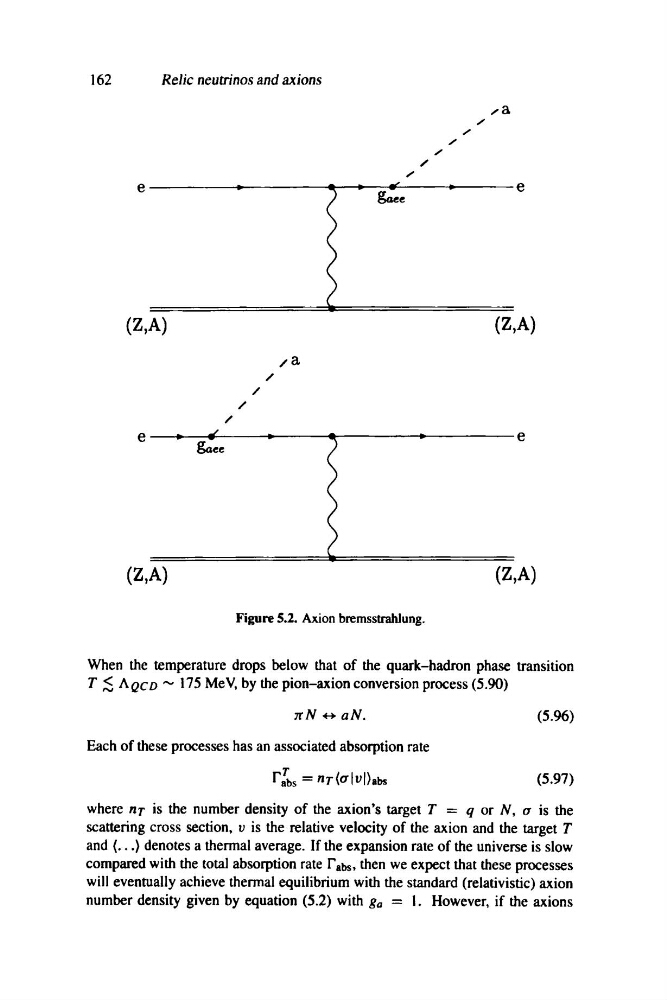
Figure S.2. Axion bremsstrahlung.
When the temperature drops below that of the quark-hadron phase transition
T ;S AQCD '" 175 MeV, by the pion-axion conversion process (5.90)
7rN ~ aN.
(5.96)
Each of these processes has an associated absorption rate
rIt,s = nr(ul vl)abs
(5.97)
where nr is the number density of the axion's target T = q or N, u is the
scattering cross section, v is the relative velocity of the axion and the target T
and ( ... ) denotes a thennal average. If the expansion rate of the universe is slow
compared with the total absorption rate r abs, then we expect that these processes
will eventually achieve thennal equilibrium with the standard (relativistic) axion
number density given by equation (5.2) with ga = I. However, if the axions
Relic neutrinos and axions
. . . . . . a
......
......
......
......
...... ' "
..
F
e---------~--------~--+-~~~--+------ ~e •
e
(Z,A)
(Z,A)
",a
,/
/
,/
,/
. ..
~.----------..--------e
e
• ~e
(Z,A)
(Z,A)
Figure S.2. Axion bremsstrahlung.
When the temperature drops below that of the quark-hadron phase transition
T ;S AQCD '" 175 MeV, by the pion-axion conversion process (5.90)
7rN ~ aN.
(5.96)
Each of these processes has an associated absorption rate
rIt,s = nr(ul vl)abs
(5.97)
where nr is the number density of the axion's target T = q or N, u is the
scattering cross section, v is the relative velocity of the axion and the target T
and ( ... ) denotes a thennal average. If the expansion rate of the universe is slow
compared with the total absorption rate r abs, then we expect that these processes
will eventually achieve thennal equilibrium with the standard (relativistic) axion
number density given by equation (5.2) with ga = I. However, if the axions