

Axions
161
'YI
"a
.... "
"
"
.... "
....
"
~
e
~
•
e
&!e
' Y
e
~
rf
•
~
e
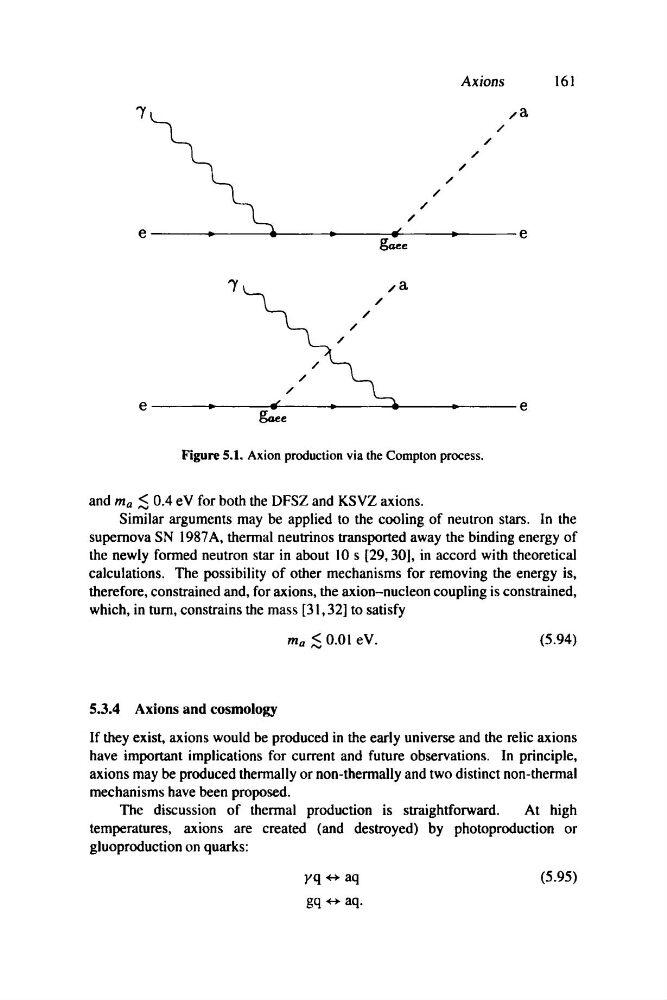
Figure 5.1. Axion production via the Compton process.
and ma $ 0.4 eV for both the DFSZ and KSVZ axions.
Similar arguments may be applied to the cooling of neutron stars. In the
supernova SN 1987 A. thermal neutrinos transported away the binding energy of
the newly formed neutron star in about 10 s [29.30). in accord with theoretical
calculations. The possibility of other mechanisms for removing the energy is.
therefore, constrained and, for axions, the axion-nuc1eon coupling is constrained,
which. in turn, constrains the mass [31,32] to satisfy
ma $ 0.01 eV.
(5.94)
5.3.4 Axions and cosmology
If they exist, axions would be produced in the early universe and the relic axions
have important implications for current and future observations. In principle,
axions may be produced thermally or non-thermally and two distinct non-thermal
mechanisms have been proposed.
The discussion of thermal production is straightforward.
At high
temperatures, axions are created (and destroyed) by photoproduction or
gluoproduction on quarks:
yq .. aq
(5.95)
gq .. aq.
161
'YI
"a
.... "
"
"
.... "
....
"
~
e
~
•
e
&!e
' Y
e
~
rf
•
~
e
Figure 5.1. Axion production via the Compton process.
and ma $ 0.4 eV for both the DFSZ and KSVZ axions.
Similar arguments may be applied to the cooling of neutron stars. In the
supernova SN 1987 A. thermal neutrinos transported away the binding energy of
the newly formed neutron star in about 10 s [29.30). in accord with theoretical
calculations. The possibility of other mechanisms for removing the energy is.
therefore, constrained and, for axions, the axion-nuc1eon coupling is constrained,
which. in turn, constrains the mass [31,32] to satisfy
ma $ 0.01 eV.
(5.94)
5.3.4 Axions and cosmology
If they exist, axions would be produced in the early universe and the relic axions
have important implications for current and future observations. In principle,
axions may be produced thermally or non-thermally and two distinct non-thermal
mechanisms have been proposed.
The discussion of thermal production is straightforward.
At high
temperatures, axions are created (and destroyed) by photoproduction or
gluoproduction on quarks:
yq .. aq
(5.95)
gq .. aq.